dsh-terraform
Run the following command in DeepSeek Harness:
dsh plugin install WODE25500/dsh-terraform
Paste the following prompt into your AI chat to install this plugin:
Run dsh plugin install WODE25500/dsh-terraform in DeepSeek Harness to install this plugin; source is available at https://github.com/WODE25500/dsh-terraform .
About this plugin
As AI agents increasingly step into DevOps pipelines, handing a large model a raw terraform apply is a recipe for uncontrolled changes. dsh-terraform was built for exactly this gap: it gives DeepSeek Harness agents a structured Terraform interface with 8 native tools (init, plan, apply, destroy, state, output, show, validate), each wrapped in auditable, gate-controlled calls so the agent can reason about infrastructure within a clearly defined read-only boundary before any mutation is approved.
The design prioritises safety and reproducibility. Plan output honours the -detailed-exitcode contract (exit 2 signals pending changes) and surfaces it explicitly. The plan-file workflow (terraform plan -out then apply against the .tfplan) lets every change be reviewed offline and replayed deterministically. Read-only operations (plan, state, output, show, validate) are the default surface; write operations (init, apply, destroy) require explicit gating. Schemastery configuration and a bundle-patch layer allow upstream harnesses to orchestrates plugin behaviour uniformly.
Targeted at DevOps teams and platform engineers wiring AI agents into their IaC pipelines: instead of hand-rolled shell scripts stitching together terraform subcommands, you declare intent in a dsh workflow and the plugin resolves semantics, executes, and returns structured results—while preserving human approval and rollback checkpoints at every write step.
Use Cases
- An agent reviews terraform plan diffs and flags changes before apply
- Terraform state and output queries are embedded in a dsh workflow for automated inspection
- Human-in-the-loop gating on apply and destroy to prevent accidental mutations
Best For
- DevOps teams integrating AI agents into IaC pipelines
- Platform engineers building agent-driven workflows
- Security teams requiring auditable and rollback-safe Terraform operations
Related Plugins
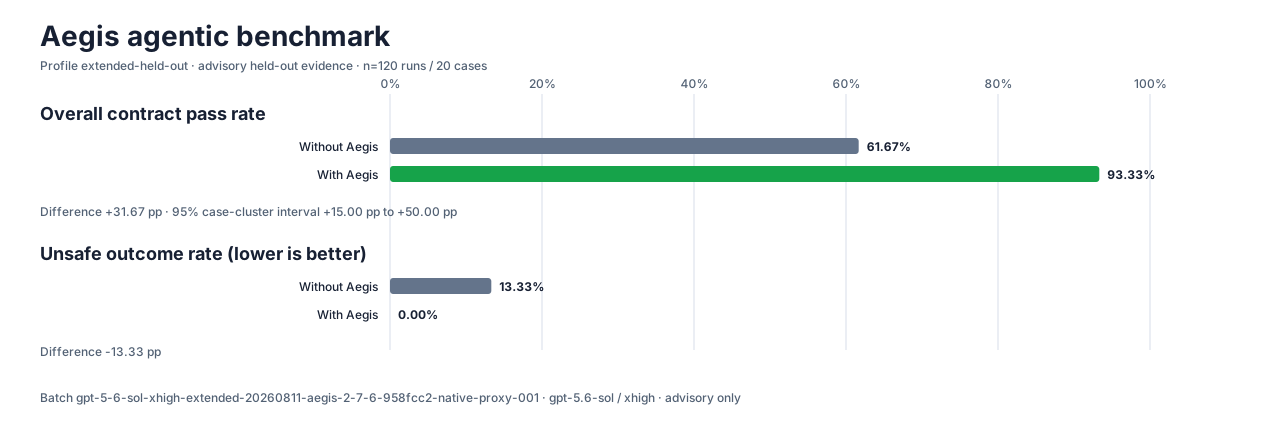
A method pack that makes AI coding agents plan against your real baseline, prove completion with fresh evidence, and reduce reworks and unsafe changes.
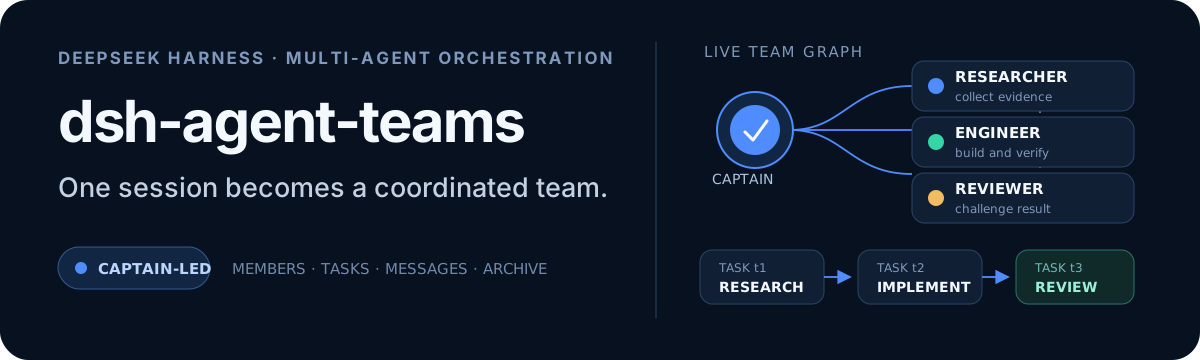
Turns the DeepSeek Harness session into a captain that builds a durable sub-agent team, splits goals into dependency-aware tasks, and coordinates work via direct messages and a live Web UI.
Gives coding agents design judgment, letting Claude Code, Cursor, and 70+ agents generate and iterate high-quality UI, presentations, and graphics right from the terminal.
Run the Pi ecosystem's plugins on DeepSeek Harness, unmodified, via a compatibility layer that implements Pi's public extension ABI on DSH's native services.