dsh-e2e-dev-sdd
Run the following command in DeepSeek Harness:
dsh plugin install Army1900/dsh-e2e-dev-sdd
Paste the following prompt into your AI chat to install this plugin:
Run dsh plugin install Army1900/dsh-e2e-dev-sdd to install this plugin in DeepSeek Harness; the source is available at https://github.com/Army1900/dsh-e2e-dev-sdd .
About this plugin
Between a one-line product request and shippable code lie four gates: prototyping, architecture design, spec definition, and test acceptance. In practice, most teams either lock these into a rigid pipeline or let the artifacts scatter across chat threads where they are hard to trace and reuse. dsh-e2e-dev-sdd treats the five stages as independent entry points, so a team picks only the upstream deliverables a given requirement actually needs instead of replaying the full chain every time. Teams without an enterprise adapter can hand-enter requirements and run the entire loop out of the box; teams with one unify business facts into a Source Envelope via Source Providers or Connector adapters, sharing a single schema across plugin-level and project-level with project config overriding the plugin layer on name collisions.
The plugin revolves around one .sdd/ project space. A project board aggregates requirement bundles, standalone defects, and five-stage status, complete with burndown charts, delivery coverage, and a filterable delivery matrix. Each deliverable is a multi-file package-body text, diagrams, prototype, and attachments-whose file manifest and SHA-256 hash are frozen at acceptance. Later revisions open dedicated change sessions while older versions stay read-only. Linked code repositories automatically feed the first four stages as read-only reference; in the dev-test stage the plugin creates an isolated Worktree or Clone for every confirmed target repo, branches a dedicated SDD feature branch from the chosen baseline, lets the AI execute tests, records real exit codes and code fingerprints, and blocks local commits when evidence is stale or failing. All outer SDD repository Git operations-Fetch, fast-forward sync, scoped commits, and explicit Push-require human confirmation; on divergence or text conflict the plugin halts and defers to the operator.
If you build with the DSH Agent on DeepSeek Harness and want the requirement-to-code trace to be explicit, auditable, and reusable, this workbench slots naturally into daily practice. A simple need can skip straight from source to dev-test, while a complex project stages acceptance and freezes deliverables incrementally-the flexibility level is yours to set.
Use Cases
- Progress a product requirement through discussion, prototype, and system design with per-stage acceptance and hash-freezing
- Track five-stage status, defect coverage, and the delivery matrix in real time across the team
- Branch an isolated SDD feature branch from a confirmed spec baseline, let AI run tests and record real exit codes
Best For
- Engineers and small teams using DeepSeek Harness for AI-assisted daily development
- Mid-size R&D teams that need an explicit audit trail and deliverable version control
- Platform engineering teams with enterprise adapters who want to fold business systems into the SDD workflow
Related Plugins
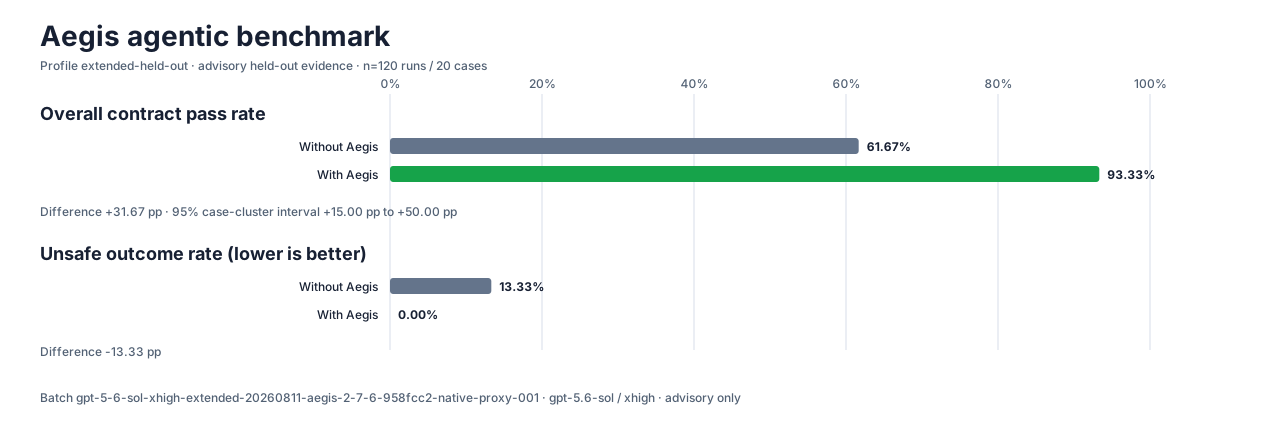
A method pack that makes AI coding agents plan against your real baseline, prove completion with fresh evidence, and reduce reworks and unsafe changes.
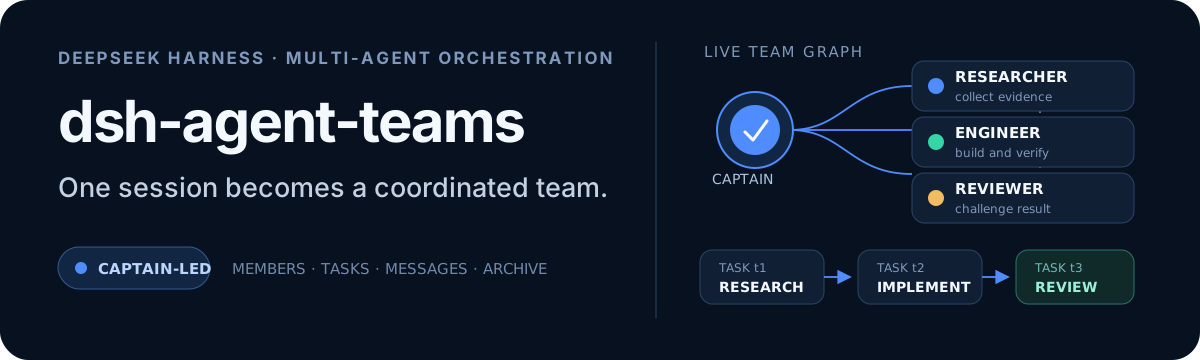
Turns the DeepSeek Harness session into a captain that builds a durable sub-agent team, splits goals into dependency-aware tasks, and coordinates work via direct messages and a live Web UI.
Gives coding agents design judgment, letting Claude Code, Cursor, and 70+ agents generate and iterate high-quality UI, presentations, and graphics right from the terminal.
Run the Pi ecosystem's plugins on DeepSeek Harness, unmodified, via a compatibility layer that implements Pi's public extension ABI on DSH's native services.