dsh-model-jury
Run the following command in DeepSeek Harness:
dsh plugin install gjjkbssg/dsh-model-jury
Paste the following prompt into your AI chat to install this plugin:
Run dsh plugin install gjjkbssg/dsh-model-jury in the DeepSeek Harness terminal to install; source code is at https://github.com/gjjkbssg/dsh-model-jury .
About this plugin
Most model-council setups share a blind spot: several models give independent answers, then another model is asked to judge them—so the final verdict still rests on a single LLM's subjective take. dsh-model-jury removes that bottleneck by making code the judge. Three seats answer blind, critique each other anonymously, revise, and a deterministic aggregator computes quorum, vote state, and keeps dissent and critical risks visible to the user at all times.
The protocol runs in three rounds. Round 1 dispatches the same question, instructions, and JSON schema to all seats concurrently; no seat sees another response. A random per-run mapping then assigns responses to P1, P2, P3 position labels. Round 2 redistributes the anonymized positions after scrubbing provider, model, and product identity terms, and asks each model to point out strongest points, weakest points, missing evidence, and actual disagreement—without rewarding consensus. Round 3 lets each surviving model revise, merge, stay undecided, or preserve dissent. The aggregator accepts only P1, P2, P3, hybrid, or undecided, computes vote state and quorum deterministically, and surfaces any critical-risk flag prominently. The plugin is strictly deliberation-only: it never edits files, installs dependencies, commits, deploys, or performs network mutations. GLM and DeepSeek seats receive no tools; the Codex seat runs with permissionMode: never.
The reference deployment seats GPT/Codex, GLM, and DeepSeek, but the protocol is provider-neutral—any compatible model can be routed through the same blind, anonymous, structured state machine via a CouncilSeat implementation. It suits developers and teams working in DeepSeek Harness who want structured multi-perspective evaluation for architecture reviews, strategy decisions, or complex technical questions without a single model acting as the final authority. Every run writes owner-only trace files containing structured responses, safe call metadata, prompts, aggregation data, and the final report—never environment snapshots, request headers, API keys, OAuth state, or hidden chain-of-thought.
Use Cases
- Architecture or design reviews where multiple models answer independently, critique anonymously, and code computes the final vote instead of a single judge model
- Strategy decisions and complex technical questions where dissent and critical-risk flags must stay visible rather than lost in consensus
- Cross-provider evaluation (GPT/Codex, GLM, DeepSeek) using a unified blind, anonymous, structured three-round protocol
Best For
- Developers already using DeepSeek Harness who want to add structured multi-model cross-validation
- Teams that need a transparent, reproducible multi-model review process without a single judge LLM
- Technical leads who value preserving dissent, degraded verdicts, and critical-risk flags for auditability
Related Plugins
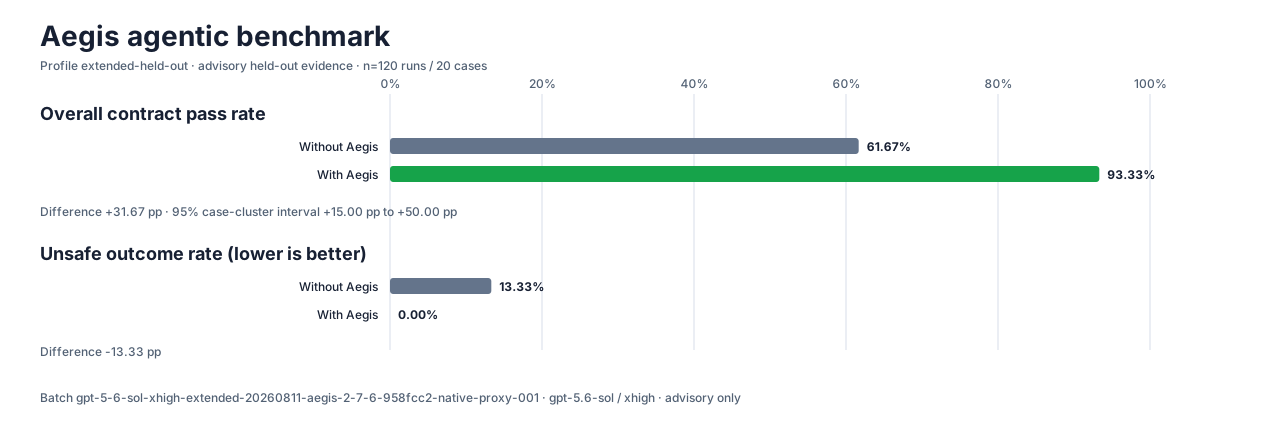
A method pack that makes AI coding agents plan against your real baseline, prove completion with fresh evidence, and reduce reworks and unsafe changes.
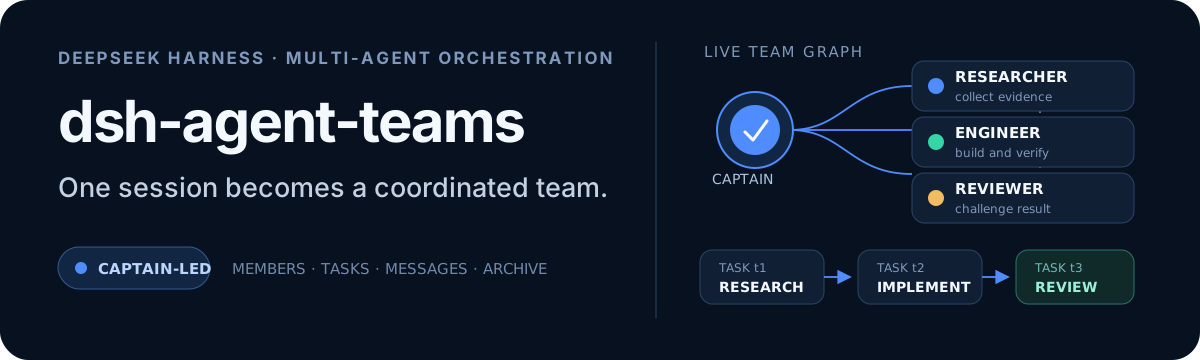
Turns the DeepSeek Harness session into a captain that builds a durable sub-agent team, splits goals into dependency-aware tasks, and coordinates work via direct messages and a live Web UI.
Gives coding agents design judgment, letting Claude Code, Cursor, and 70+ agents generate and iterate high-quality UI, presentations, and graphics right from the terminal.
Run the Pi ecosystem's plugins on DeepSeek Harness, unmodified, via a compatibility layer that implements Pi's public extension ABI on DSH's native services.