dsh-taskboard-flow
Run the following command in DeepSeek Harness:
dsh plugin install markelayan/dsh-taskboard-flow
Paste the following prompt into your AI chat to install this plugin:
Run dsh plugin install markelayan/dsh-taskboard-flow in DeepSeek Harness to install this plugin (source: https://github.com/markelayan/dsh-taskboard-flow); restart dsh web after installation to load the configuration.
About this plugin
dsh-taskboard gives you the kanban board, the cards, and a set of taskboard tools — but the cards do not move on their own. You push, they budge. Reviews need a human to notice. Multiple agents stay siloed. taskboard-flow is the missing flow layer: it watches the local ledger for card transitions and, the moment a card lands in a new column, fires the right action so the whole board runs without manual nudging.
Four capability pillars do the heavy lifting. First, an automated triage-and-execute pipeline: a backlog card spawns a triage session that decomposes it into model-pinned child tasks; a todo card executes through the real run API; an in_review card wakes the creator session live or resumes it after a restart. Second, cross-session communication: session_message delivers a message from any session to any other, adapting its strategy to the target state (idle vs mid-turn) so a human always sees it and the agent reads it at the next turn; the companion contacts tool turns raw session IDs into named aliases you can list, status-check, and message in one call. Third, decision and escalation routing: a comment prefixed with @orchestrator escalates to the project-bound orchestrator session, while [ASK] cards skip decomposition entirely and wake a designated answerer. Fourth, controllability: three-tier concurrency caps (global, per-project, per-column), three callback delivery modes (wake, notify, context), all configured in a local file-based patch — no database, no telemetry, no runtime dependencies.
It is built for individual developers and small teams already running multi-agent workflows on DeepSeek Harness. If you want to drop a work-order card into backlog and walk away, want several projects each with their own orchestrator yet sharing one messaging bus, or need an orchestrator to nudge a stuck executor with a single line — this is the piece that turns dsh-taskboard from a board you operate into a pipeline that operates itself.
Use Cases
- Turn backlog cards into decomposed, executed, and review-ready work automatically
- Coordinate multiple agent sessions through named contacts and cross-session messaging
- Escalate decisions with @orchestrator and [ASK] cards for human-in-the-loop routing
Best For
- Developers already orchestrating multiple agent sessions on DeepSeek Harness
- Small teams that want to cut manual kanban nudging and missed reviews
- Automation engineers building local multi-agent workflow pipelines
Related Plugins
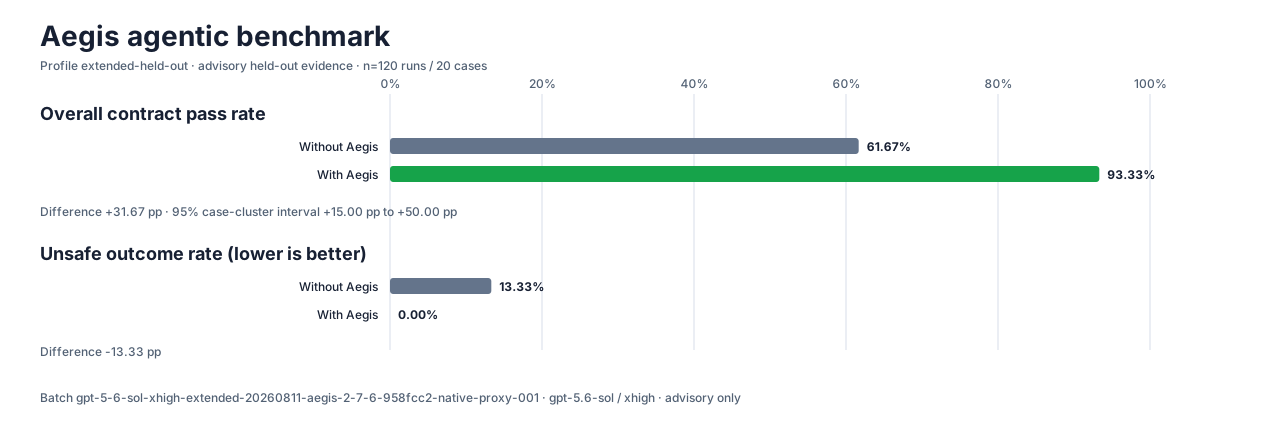
A method pack that makes AI coding agents plan against your real baseline, prove completion with fresh evidence, and reduce reworks and unsafe changes.
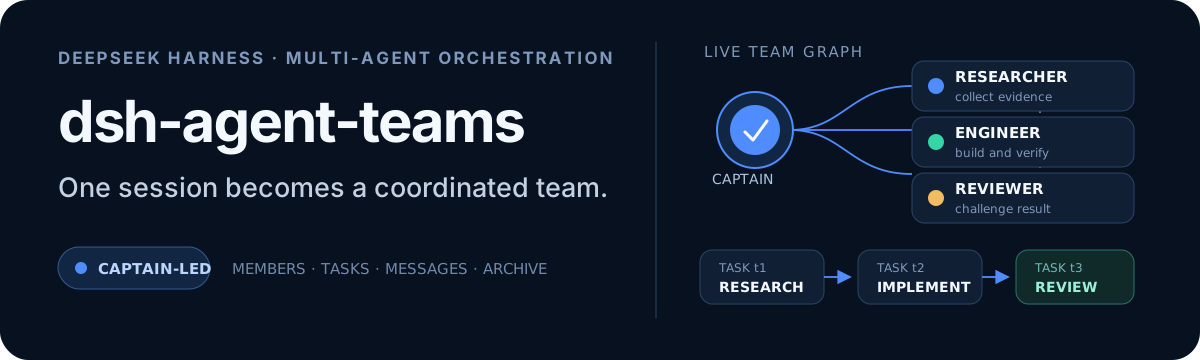
Turns the DeepSeek Harness session into a captain that builds a durable sub-agent team, splits goals into dependency-aware tasks, and coordinates work via direct messages and a live Web UI.
Gives coding agents design judgment, letting Claude Code, Cursor, and 70+ agents generate and iterate high-quality UI, presentations, and graphics right from the terminal.
Run the Pi ecosystem's plugins on DeepSeek Harness, unmodified, via a compatibility layer that implements Pi's public extension ABI on DSH's native services.