dsh-moa
Run the following command in DeepSeek Harness:
dsh plugin install GooDAnDReaDY/dsh-moa
Paste the following prompt into your AI chat to install this plugin:
Install it in DeepSeek Harness by running dsh plugin install GooDAnDReaDY/dsh-moa; full documentation and source code are available at https://github.com/GooDAnDReaDY/dsh-moa.
About this plugin
Single-model AI generation often falls short on ambiguous or complex engineering tasks: it makes premature assumptions, produces monolithic unvetted implementations, and suffers from single-perspective biases that a human reviewer only catches too late. dsh-moa brings the Mixture of Agents architecture natively to DeepSeek Harness, fanning a prompt out to multiple proposer models in parallel, then entrusting a frontier reasoning model to critically benchmark every candidate and promote the winning files straight into your project root.
The whole workflow is triggered with a single /moa command. When a prompt is underspecified, advisor models first compose a structured two-to-four-question clarification questionnaire so you can steer the architecture before any code is written. Once requirements are locked in, independent proposers generate files inside isolated .moa/candidate-N sandboxes on disk, eliminating cross-pollution. The judge selects the optimal implementation via a machine-readable marker, the winner is promoted to the workspace root, and temporary directories are pruned automatically. For web artifacts, dsh-moa plugs into Live Canvas to spawn a one-click browser preview. Incremental-edit mode detects an existing codebase and emits precise delta changes instead of destructive full-file rewrites, while a built-in cost tracker estimates token usage and run pricing without any external dependency.
It is built for engineers who regularly face open-ended coding briefs, perform multi-approach code reviews, or want a structured, repeatable workflow that surfaces several independent solutions and lets a reasoning model adjudicate quality before anything lands in the repository.
Use Cases
- Turn an ambiguous prompt into several competing implementations and keep the best one
- Run parallel code-review proposals and let a frontier judge adjudicate quality
- Generate UI components and preview them instantly in a live browser canvas
Best For
- Independent engineers who regularly tackle open-ended coding briefs
- Reviewers who want multiple approaches evaluated before committing
- Small teams that use reasoning models to gate AI-generated code quality
Related Plugins
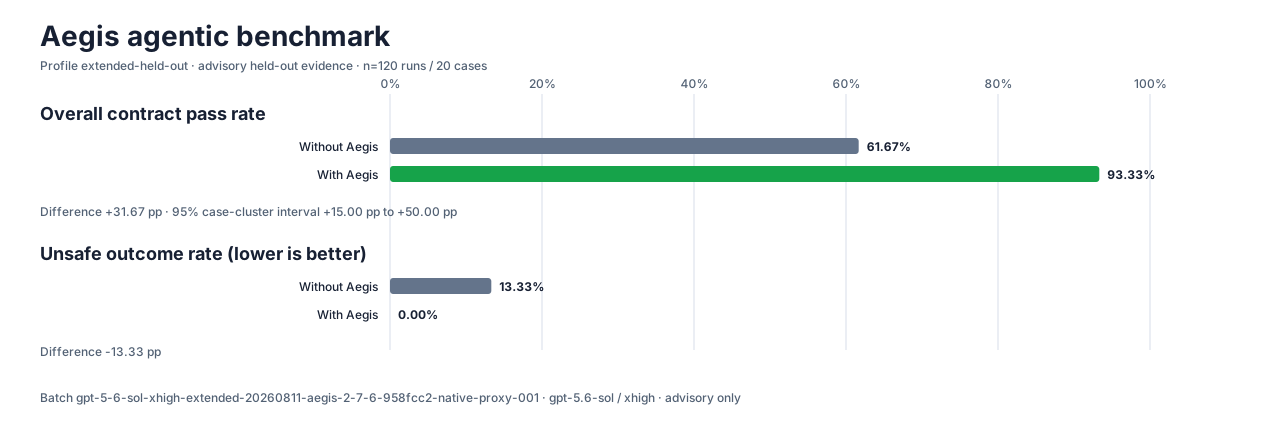
A method pack that makes AI coding agents plan against your real baseline, prove completion with fresh evidence, and reduce reworks and unsafe changes.
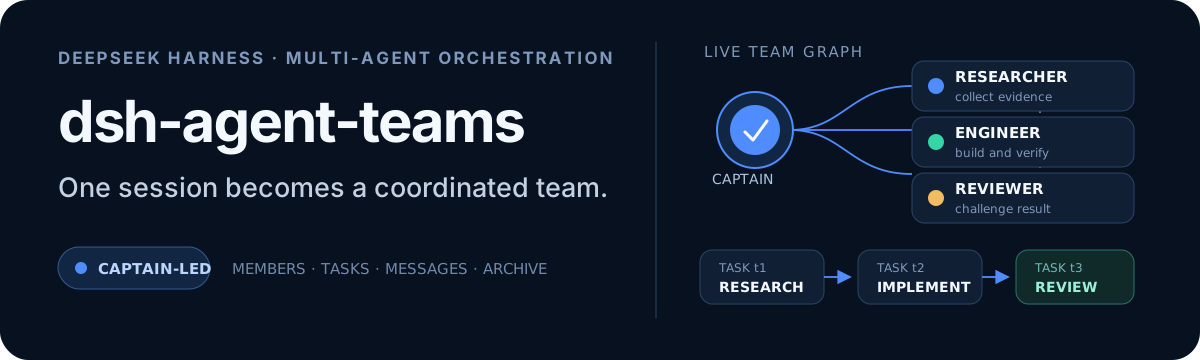
Turns the DeepSeek Harness session into a captain that builds a durable sub-agent team, splits goals into dependency-aware tasks, and coordinates work via direct messages and a live Web UI.
Gives coding agents design judgment, letting Claude Code, Cursor, and 70+ agents generate and iterate high-quality UI, presentations, and graphics right from the terminal.
Run the Pi ecosystem's plugins on DeepSeek Harness, unmodified, via a compatibility layer that implements Pi's public extension ABI on DSH's native services.