dsh-module-driven-develop
Run the following command in DeepSeek Harness:
dsh plugin install phantomSuying/dsh-module-driven-develop
Paste the following prompt into your AI chat to install this plugin:
Install this plugin in DeepSeek Harness by running dsh plugin install phantomSuying/dsh-module-driven-develop; the full source code is available at https://github.com/phantomSuying/dsh-module-driven-develop
About this plugin
Shipping a mid-size service is rarely a problem of writing one clever function; it is a problem of breaking requirements into pieces small enough for a single agent to own, and then making those pieces actually work together. dsh-module-driven-develop encodes exactly that discipline: it recursively decomposes any requirement into a module tree whose leaves are independent and small enough for one sub-agent to design and implement on its own, while a main agent handles orchestration, topological scheduling, integration, and debugging. You do not manually decide who writes what or in what order; the protocol handles all of it.
The design document is treated as the single source of truth, and the plugin enforces that rule strictly. When a module design is revised, the old code is not patched; it is archived, the module directory is wiped, and everything is regenerated from the new design. Requirement changes follow the same principle: a dedicated change-analyst sub-agent traces the dependency graph to locate every affected module, each module agent decides whether the change must propagate further down to its children, and the whole chain redesigns, regenerates, and re-integrates. This no-patch policy may feel heavy, but it eliminates the subtle drift that accumulates from incremental edits. In the bundled auth-service demo, the result is 169 passing tests and 15 clean HTTP smoke checks, with every design decision, delegation batch, and delivery report recorded under .mdd/.
This plugin fits well if you are doing real development in DeepSeek Harness and your requirements span multiple modules and agents. Rather than firing one large prompt and hoping for coherence, you get a structured workflow with design documents, topological build batches, integration logs, and a full audit trail. It is especially useful when requirements evolve over time, because the regeneration-first approach keeps the codebase aligned with the latest design instead of layering patches on top of patches.
Use Cases
- Recursively decompose large requirements into independent leaf modules and let parallel sub-agents design and generate each one
- Propagate a requirement or design change along the dependency graph, archive stale code, and regenerate every affected module from the updated design
- Run an auditable workflow with per-module design docs, topological batch delegation logs, and delivery reports under .mdd/
Best For
- Solo developers or small teams building real projects in DeepSeek Harness
- Project teams handling mid-to-large systems that need multi-agent coordination, modular decomposition, and change tracking
- Architects and tech leads who prioritize design traceability, code auditability, and delivery accountability
Related Plugins
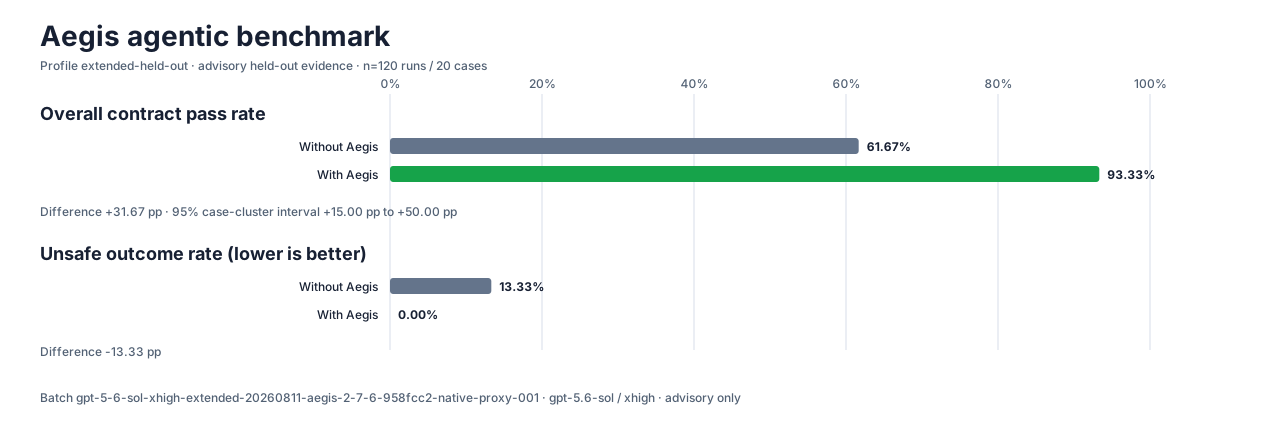
A method pack that makes AI coding agents plan against your real baseline, prove completion with fresh evidence, and reduce reworks and unsafe changes.
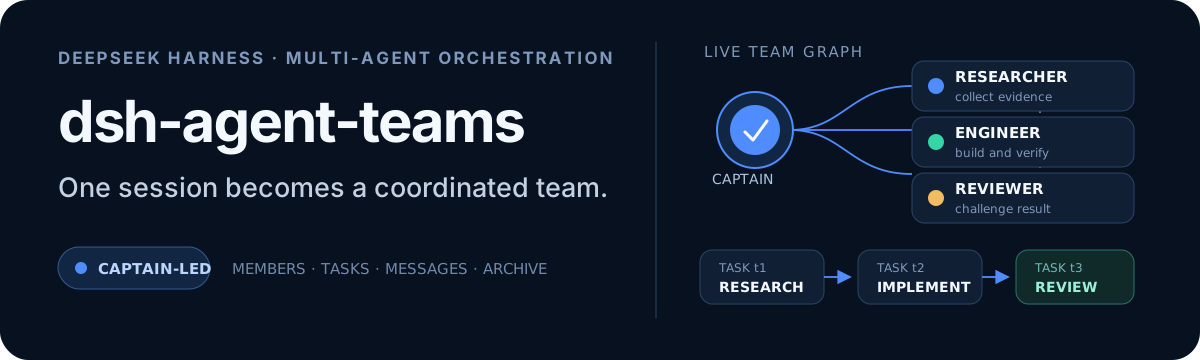
Turns the DeepSeek Harness session into a captain that builds a durable sub-agent team, splits goals into dependency-aware tasks, and coordinates work via direct messages and a live Web UI.
Gives coding agents design judgment, letting Claude Code, Cursor, and 70+ agents generate and iterate high-quality UI, presentations, and graphics right from the terminal.
Run the Pi ecosystem's plugins on DeepSeek Harness, unmodified, via a compatibility layer that implements Pi's public extension ABI on DSH's native services.