Polaris
Run the following command in DeepSeek Harness:
dsh plugin install existyay/Polaris
Paste the following prompt into your AI chat to install this plugin:
Install the plugin in DeepSeek Harness by running the install command; the source repository is https://github.com/existyay/Polaris .
About this plugin
Tooling fragmentation is a daily drag for developers: DSH plugins, third-party MCP/Skills, and emerging desktop utilities each speak their own dialect, forcing you to manually select, verify, and dispatch for every new intent. Polaris turns that chore into a single general-purpose aggregation and evolution layer. It continuously sniffs heterogeneous sources, normalizes them into a unified Polaris IR contract, benchmarks and validates them through a dual-track arena (hot-start smoke tests, cold-release contract checks, fuzzing, benchmarks, SBOM verification, and adversarial replay), seals provenance with Ed25519 signatures, and pins everything in an immutable content-addressed index. A deterministic semantic router then maps one developer intent to the currently best implementation, with the underlying dispatch fully transparent.
After installation and a profile restart, the seven atomic primitives register simultaneously as model tools. During dependency changes, authentication rewrites, bounded smoke execution, coverage-gated testing, symbol retrieval, and license compliance checks, your development agent invokes the appropriate capability automatically-hands-off, no manual commands required. Slash commands remain available for explicit human operations. Each primitive is independently toggleable, stateless, single-responsibility, composable, and verifiable; every pipeline stage declares file-count, size, timeout, and output ceilings, keeping costs naturally bounded.
Polaris is purpose-built for STEM domains (mathematics, physics, chemistry, engineering, numerical methods, simulation) and code-optimization workflows (performance, refactoring, static analysis, test quality, benchmarking, debugging). It is a strong fit for engineers and researchers who switch between research and high-performance coding and need an auditable, swappable toolchain that gets out of the way.
Use Cases
- Automatically dispatching the best numerical-simulation and benchmark tools in a research project
- Triggering dependency audits and coverage-gated tests after authentication or dependency changes
- Transparently routing a single developer intent to the optimal implementation across a multi-plugin ecosystem
Best For
- Engineers working in mathematics, physics, chemistry, engineering, and other STEM research domains
- Practitioners with high demands on performance, refactoring, static analysis, and test quality
- Teams managing multi-plugin ecosystems who need auditable, swappable toolchains
Related Plugins
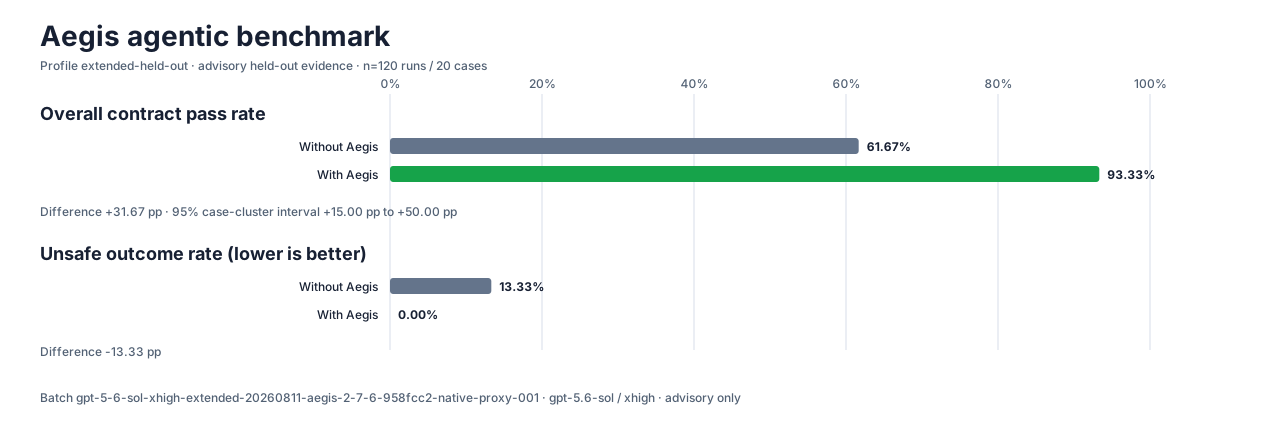
A method pack that makes AI coding agents plan against your real baseline, prove completion with fresh evidence, and reduce reworks and unsafe changes.
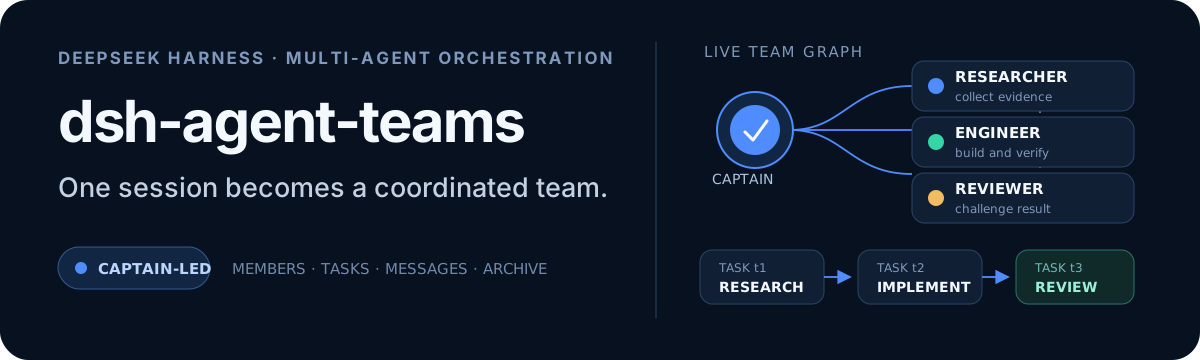
Turns the DeepSeek Harness session into a captain that builds a durable sub-agent team, splits goals into dependency-aware tasks, and coordinates work via direct messages and a live Web UI.
Gives coding agents design judgment, letting Claude Code, Cursor, and 70+ agents generate and iterate high-quality UI, presentations, and graphics right from the terminal.
Run the Pi ecosystem's plugins on DeepSeek Harness, unmodified, via a compatibility layer that implements Pi's public extension ABI on DSH's native services.