dsh-plugin-workflow-laoboshi
Run the following command in DeepSeek Harness:
dsh plugin install Modole/dsh-plugin-workflow-laoboshi
Paste the following prompt into your AI chat to install this plugin:
Run dsh plugin install Modole/dsh-plugin-workflow-laoboshi in your terminal; the source is available at https://github.com/Modole/dsh-plugin-workflow-laoboshi. After installation, restart dsh web to activate the workflow plugin in your Agent.
About this plugin
Building multi-step DAG workflows inside a DSH Agent setup often means stitching nodes together by hand, debugging in isolation, and manually promoting changes to production. Laoboshi DSH Plugin closes that gap by bringing a full create-test-publish-execute lifecycle directly into the DSH plugin ecosystem, so developers no longer have to juggle external orchestration tools alongside their Agent.
The plugin supports every stage of a DAG workflow: authoring new flow graphs, testing individual nodes and branch paths, publishing a validated version, and executing the released workflow in a live environment. After installation, restarting dsh web lets the system read the dsh.bundle manifest and inject the plugin into the active profile automatically, making the workflow features immediately available in the Agent interface.
Extracted from the built-in capabilities of Laoboshi Agent Studio, this plugin is well suited for developers and small teams already working on multi-agent pipelines in DSH who want to decompose complex tasks into visual DAGs and iterate on them efficiently. If your workflows involve conditional branches, parallel nodes, or sequential dependencies, this plugin can meaningfully reduce the overhead of building and maintaining them.
Use Cases
- Author multi-step flows with conditional branches and parallel nodes inside DSH Agent
- Publish a tested workflow version as a reusable production-ready process
- Visually compose, debug, and rapidly iterate on multi-agent collaboration tasks
Best For
- Developers already building multi-agent pipelines on the DSH platform
- Small teams that decompose complex tasks into visual DAGs and need efficient iteration
- Engineers handling sequential or parallel node dependencies within DSH Agent
Related Plugins
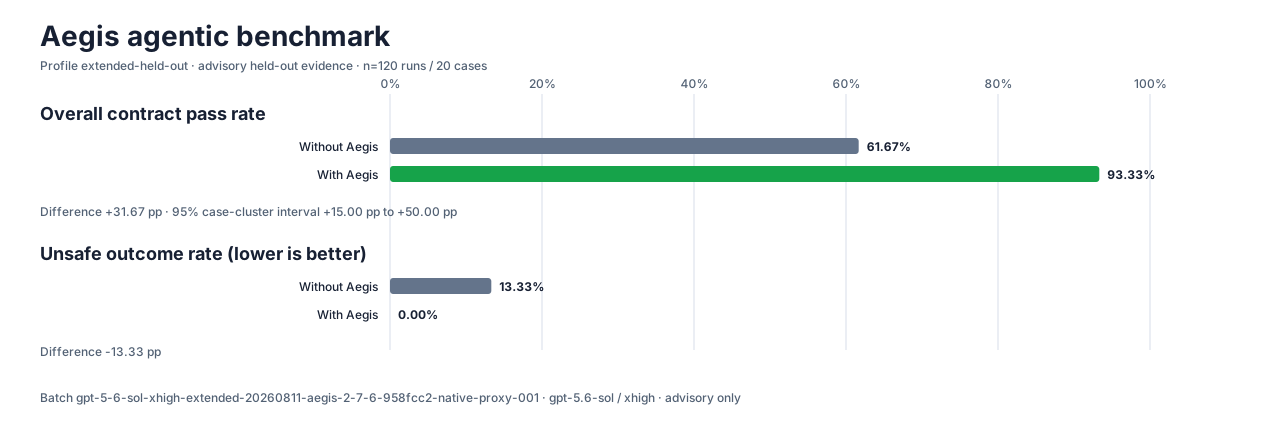
A method pack that makes AI coding agents plan against your real baseline, prove completion with fresh evidence, and reduce reworks and unsafe changes.
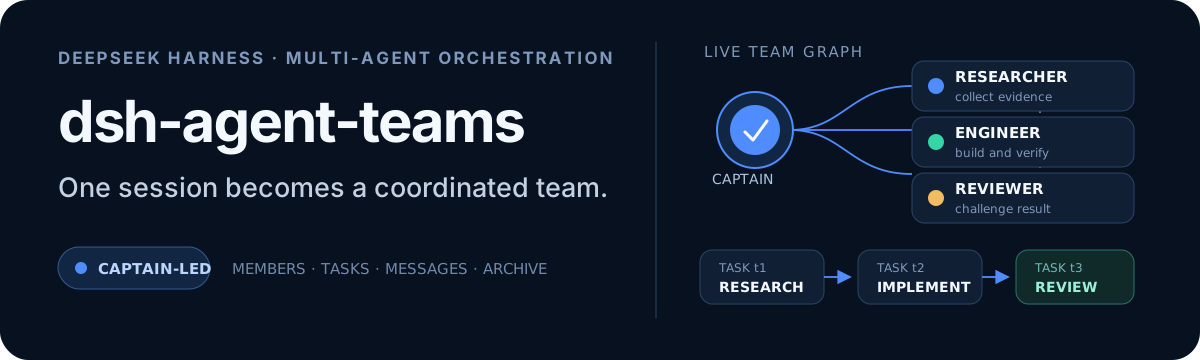
Turns the DeepSeek Harness session into a captain that builds a durable sub-agent team, splits goals into dependency-aware tasks, and coordinates work via direct messages and a live Web UI.
Gives coding agents design judgment, letting Claude Code, Cursor, and 70+ agents generate and iterate high-quality UI, presentations, and graphics right from the terminal.
Run the Pi ecosystem's plugins on DeepSeek Harness, unmodified, via a compatibility layer that implements Pi's public extension ABI on DSH's native services.