dsh-cross-session-agent
Run the following command in DeepSeek Harness:
dsh plugin install dd2673/dsh-cross-session-agent
Paste the following prompt into your AI chat to install this plugin:
Run dsh plugin install dd2673/dsh-cross-session-agent in your DeepSeek Harness terminal to install; source repository at https://github.com/dd2673/dsh-cross-session-agent .
About this plugin
When several Agents work in parallel on the same repository, conflicts tend to go unnoticed: two Agents edit the same file, the second one redoes an investigation the first already completed, and a task stalls because no explicit handoff was ever issued. dsh-cross-session-agent closes that coordination gap with a structured peer-to-peer message channel, turning isolated parallel work into cooperative, conflict-aware progress.
The plugin contributes four core tools: discovering communicable peers in the same workspace, sending an explicit coordination message to a chosen peer, querying the transport receipt of that message (accepted, pending, claimed, discarded), and reading a bounded, field-whitelisted context projection of an authorized peer. It deliberately does not expose full session transcripts, does not allow peer messages to trigger automatic command execution, and keeps every boundary under the caller's explicit control.
Best suited to developers who drive multiple concurrent Agents on a single repository, especially for refactoring, migration, or code-review workflows where negotiating file ownership and task handoffs across Agents is essential. It does not replace user approval, does not inherit permissions, and simply lowers coordination cost from file locking and manual monitoring to a single verifiable message round.
Use Cases
- Negotiating file ownership and task boundaries among concurrent Agents in one repo
- Sending explicit handoff messages and confirming transport receipts
- Avoiding duplicate investigation and mutual overwrites during refactoring or migration
Best For
- Developers driving multiple Agents on a single repository
- Workflow architects who need cross-Agent boundary negotiation
- Harness users who prioritize minimal permissions and interface security
Related Plugins
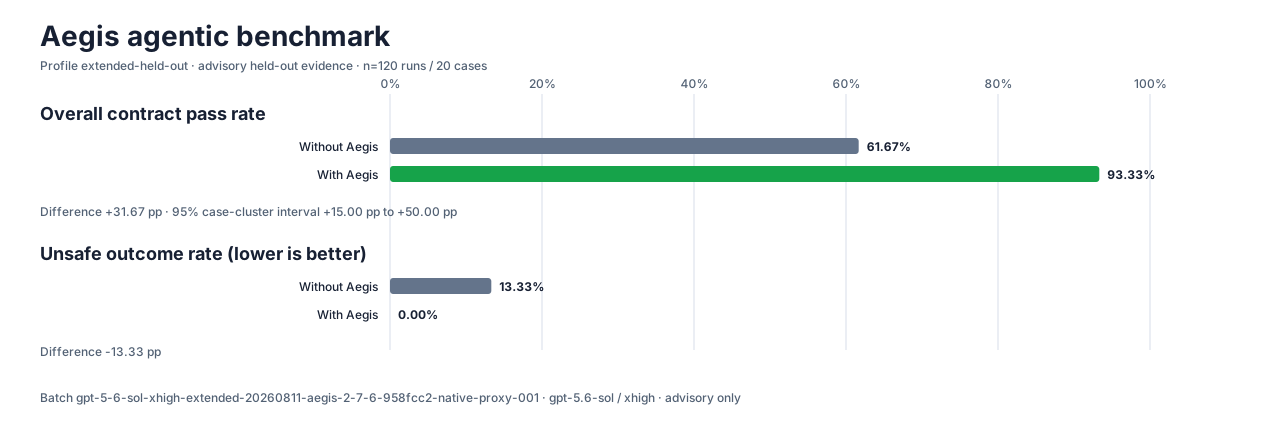
A method pack that makes AI coding agents plan against your real baseline, prove completion with fresh evidence, and reduce reworks and unsafe changes.
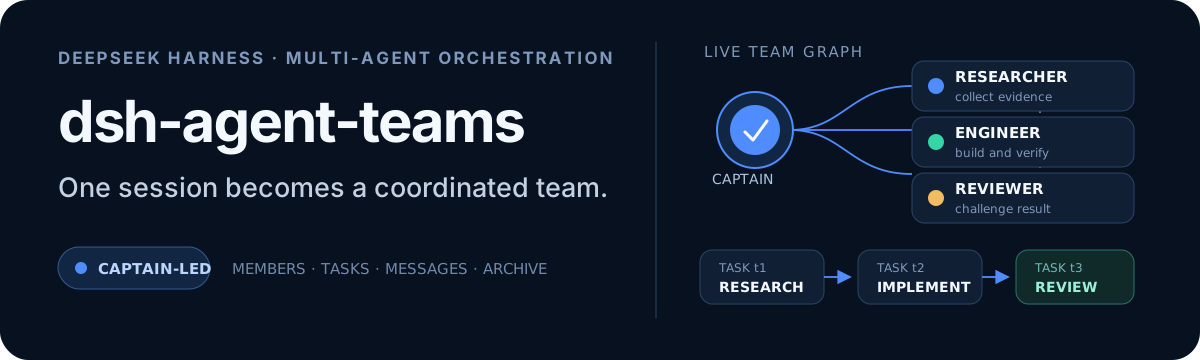
Turns the DeepSeek Harness session into a captain that builds a durable sub-agent team, splits goals into dependency-aware tasks, and coordinates work via direct messages and a live Web UI.
Gives coding agents design judgment, letting Claude Code, Cursor, and 70+ agents generate and iterate high-quality UI, presentations, and graphics right from the terminal.
Run the Pi ecosystem's plugins on DeepSeek Harness, unmodified, via a compatibility layer that implements Pi's public extension ABI on DSH's native services.