dsh-specify
Run the following command in DeepSeek Harness:
dsh plugin install 904915452/dsh-specify
Paste the following prompt into your AI chat to install this plugin:
Run dsh plugin install 904915452/dsh-specify in your DeepSeek Harness terminal to install this plugin, source code at https://github.com/904915452/dsh-specify ; restart the session after installation to use the /speckit-* commands.
About this plugin
In the DeepSeek Harness environment, spec-driven development often suffers from fragmentation: requirements, architecture plans, task breakdowns, implementation, and acceptance criteria live in separate conversations or tools with no single thread to follow, pause, or revisit. dsh-specify pulls the full Spec-Kit spec-driven pipeline into a suite of /speckit-* slash commands, letting you walk from project constitution all the way to working code within one session, with each step producing a concrete artifact file and a checkable consistency report.
The command set covers constitution (project principles), specify (WHAT/WHY requirements), clarify (ambiguity resolution), plan (technical design), tasks (decomposition), analyze (coverage audit), implement (task-driven coding), checklist (quality gate), and status (progress dashboard). Every command writes its output to a dedicated file that references the others, forming a traceable document chain. Branch handling is built into the flow: /speckit-specify decides automatically whether to create a feat/ branch, respects --no-branch or --branch for manual control, and /speckit-implement commits to the correct branch accordingly.
It is aimed at engineers who already practice spec-driven or similar methodologies and want to eliminate context-switching between browsers, terminals, and docs. If you prefer a single set of slash commands that string the entire delivery pipeline together inside your Harness session, this plugin is built for you or your team.
Use Cases
- Starting a new feature: define requirements with /speckit-specify, then walk through plan and task breakdown
- Onboarding to a legacy codebase: establish principles via /speckit-constitution and audit coverage with /speckit-analyze
- During implementation: code by task list with /speckit-implement, then enforce the quality gate via /speckit-checklist
- After pausing mid-flow: check progress, dependencies, and next steps with /speckit-status instead of digging through files
Best For
- Engineers practicing spec-driven development inside DeepSeek Harness
- Teams that want a single set of slash commands linking requirements through delivery
- Developers migrating from Claude Code sdd skill into the Harness ecosystem
Related Plugins
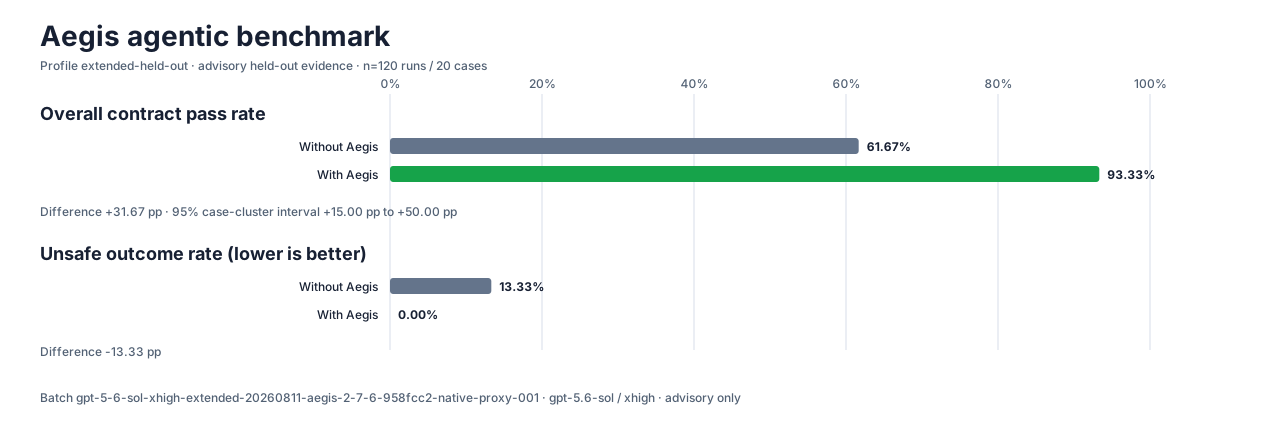
A method pack that makes AI coding agents plan against your real baseline, prove completion with fresh evidence, and reduce reworks and unsafe changes.
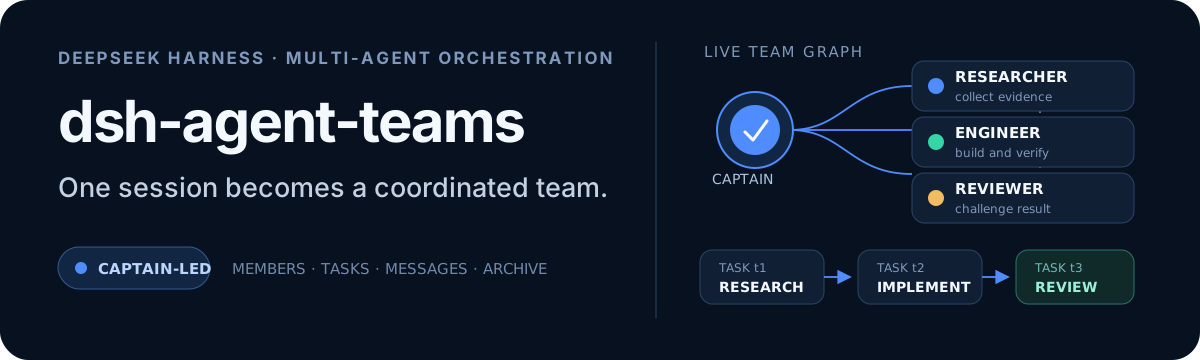
Turns the DeepSeek Harness session into a captain that builds a durable sub-agent team, splits goals into dependency-aware tasks, and coordinates work via direct messages and a live Web UI.
Gives coding agents design judgment, letting Claude Code, Cursor, and 70+ agents generate and iterate high-quality UI, presentations, and graphics right from the terminal.
Run the Pi ecosystem's plugins on DeepSeek Harness, unmodified, via a compatibility layer that implements Pi's public extension ABI on DSH's native services.