dsh-double
Run the following command in DeepSeek Harness:
dsh plugin install Junkrat9527/dsh-double
Paste the following prompt into your AI chat to install this plugin:
Run dsh plugin install Junkrat9527/dsh-double in the DeepSeek Harness terminal to install this plugin. Full source code is available at https://github.com/Junkrat9527/dsh-double .
About this plugin
An agent edits its own config, restarts, and immediately breaks. That is the moment every DeepSeek Harness user dreads. dsh-double closes the loop: a change set is applied to a standby copy first, statically pre-checked (config dump, YAML/JSON syntax, bundle resolvability, duplicate loader detection) and trial-booted. Only when both pass is the change promoted to the main instance, which must confirm healthy before the standby is stopped. If the main fails to boot, it auto-rolls back to the pre-evolution snapshot. You stop needing an outside agent to rescue the one that broke itself.
Beyond blue-green self-evolution, the plugin adds three-layer health probing (TCP, HTTP, process), an on-demand cold standby that wakes as a spare brain when mechanical recovery fails, and a fully isolated second dsh instance called the testbed running on port 3081. Each side gets its own LLM agent, and the two converse over the official session gateway. The testbed proves an evolution in its sandbox first; once validated, the twin agent blue-greens the delta back onto main. Every exchange lands in a shared, replayable JSONL transcript surfaced in the settings dashboard, so you can follow the full two-way conversation from a single page.
If you run long-lived agent workloads on dsh and want your agent to iterate on its own config or workflow without dropping context, dsh-double turns self-evolution from a risky stunt into a reliable daily routine. The zero-dependency CLI and out-of-process supervisor keep the life-support layer alive even when dsh itself cannot boot, giving you a safety net that no in-process plugin alone can provide.
It is built for power users who deploy dsh in production-like environments, run multi-agent pipelines, and need an auditable trail of every self-modification. Testbed-first workflow guidance, optional evolve approval, and transparent restart notices make the whole cycle visible and controllable from the dashboard.
Use Cases
- Agent self-modifies config and safely restarts with auto-rollback on failure
- Twin validates changes in an isolated sandbox then co-evolves the main instance
- Cold standby wakes as a spare brain to diagnose and repair a stuck main
Best For
- Power users running DeepSeek Harness in production-like environments
- Multi-agent pipeline operators who need an auditable trail of every change
- Developers who want autonomous workflow iteration without losing context
Related Plugins
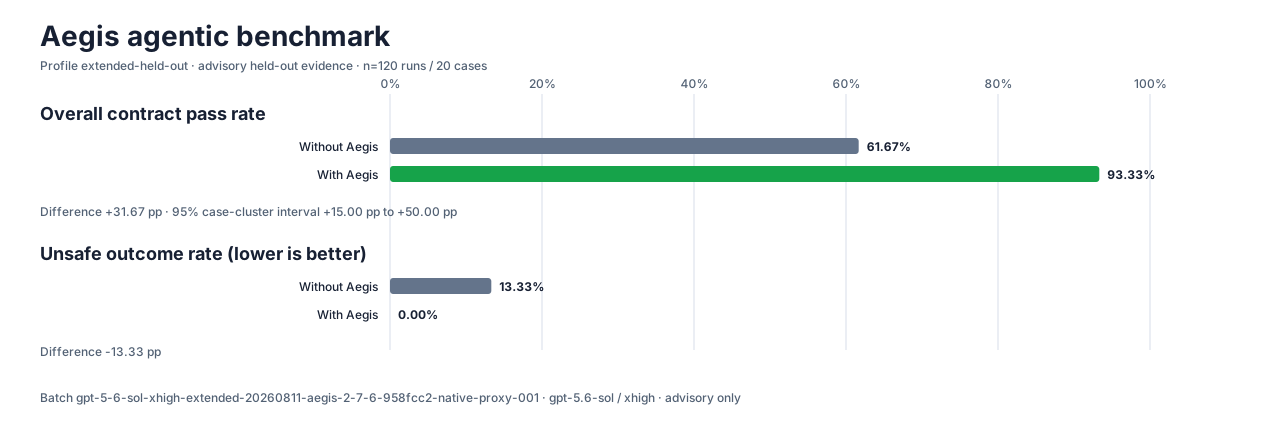
A method pack that makes AI coding agents plan against your real baseline, prove completion with fresh evidence, and reduce reworks and unsafe changes.
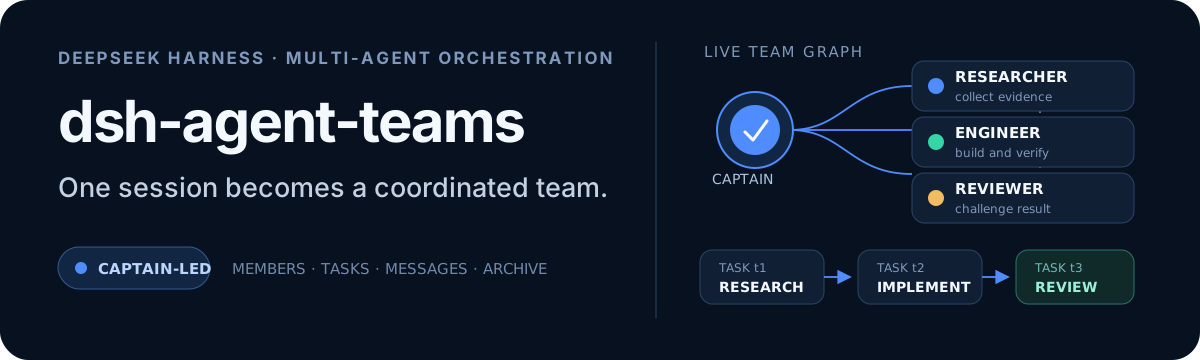
Turns the DeepSeek Harness session into a captain that builds a durable sub-agent team, splits goals into dependency-aware tasks, and coordinates work via direct messages and a live Web UI.
Gives coding agents design judgment, letting Claude Code, Cursor, and 70+ agents generate and iterate high-quality UI, presentations, and graphics right from the terminal.
Run the Pi ecosystem's plugins on DeepSeek Harness, unmodified, via a compatibility layer that implements Pi's public extension ABI on DSH's native services.