dsh-plugin-manager
Run the following command in DeepSeek Harness:
dsh plugin install sorry123maker/dsh-plugin-manager
Paste the following prompt into your AI chat to install this plugin:
Run dsh plugin install sorry123maker/dsh-plugin-manager in your target profile (source: https://github.com/sorry123maker/dsh-plugin-manager), then restart dsh web to access the Third-Party Plugin Manager page under Settings.
About this plugin
When you run several third-party plugins in DeepSeek Harness, their enable-state ends up scattered across the profile bundle list and cordis.patch.yml. Toggling one off or swapping a combination means hand-editing YAML, hoping you do not break a neighboring directive, and restarting the web server each time. dsh-plugin-manager adds a dedicated Third-Party Plugin Manager page inside the Web UI settings panel, pulling all of that into one place.
Three core capabilities do the heavy lifting. First, it lists every third-party plugin in the current profile with its enabled and loaded status, automatically filtering out @deepseek-ai built-in bundles. Second, each plugin gets a toggle; hitting Apply writes an entry of { id, disabled: true } back into cordis.patch.yml, and because dsh already watches that file via watchUserPatches and HMR, the change hot-reloads instantly with no restart required. Third, named profile snapshots let you save the current enable state under a name, then switch to or delete it with one click, handy for bouncing between an all-on debug setup and a minimal production set. A quick-add field also accepts any pnpm spec to install a new plugin; a single dsh web restart is needed after adding so it enters the loader tree.
Best suited for anyone running two or more third-party bundles in Harness who no longer wants to hand-edit YAML to manage plugin state. The plugin itself has zero npm dependencies, importing only node: built-in modules, so it will not pull extra dependency-resolution risk into the host profile.
Use Cases
- Quickly toggle enable combinations across multiple third-party bundles
- Enable all plugins for debugging, keep a minimal set for production
- Disable or re-enable plugins without hand-editing cordis.patch.yml
Best For
- Harness users running two or more third-party bundles
- Workflow developers who want to minimize manual YAML editing
- Cautious users who prefer zero npm dependencies to avoid resolution issues
Related Plugins
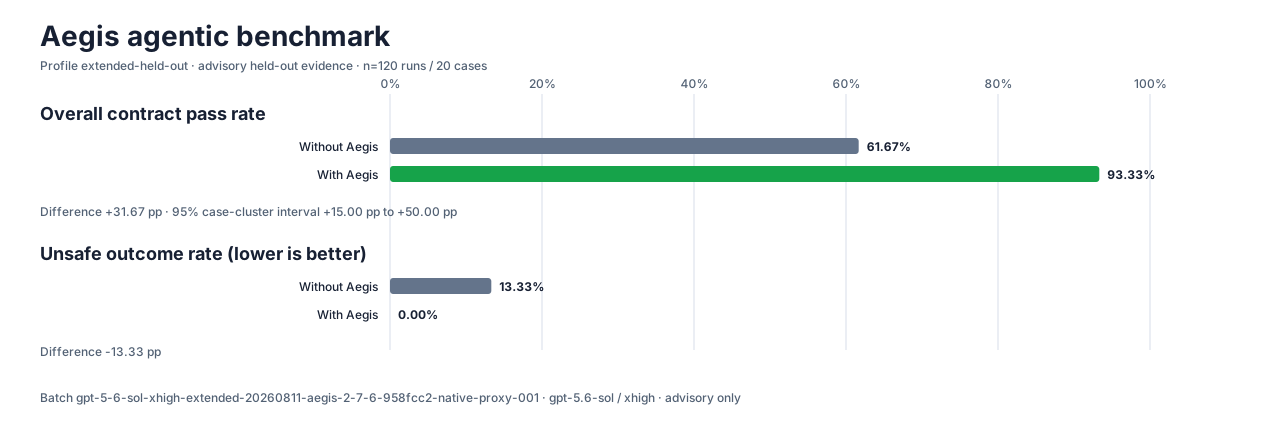
A method pack that makes AI coding agents plan against your real baseline, prove completion with fresh evidence, and reduce reworks and unsafe changes.
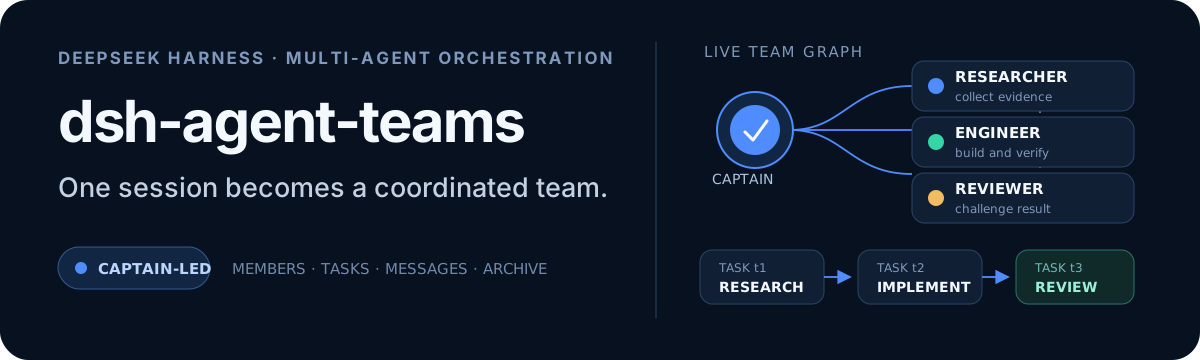
Turns the DeepSeek Harness session into a captain that builds a durable sub-agent team, splits goals into dependency-aware tasks, and coordinates work via direct messages and a live Web UI.
Gives coding agents design judgment, letting Claude Code, Cursor, and 70+ agents generate and iterate high-quality UI, presentations, and graphics right from the terminal.
Run the Pi ecosystem's plugins on DeepSeek Harness, unmodified, via a compatibility layer that implements Pi's public extension ABI on DSH's native services.