dsh-rest-time
Run the following command in DeepSeek Harness:
dsh plugin install uckkk/dsh-rest-time
Paste the following prompt into your AI chat to install this plugin:
Run dsh plugin install uckkk/dsh-rest-time inside DeepSeek Harness to install the plugin; the source code is available at https://github.com/uckkk/dsh-rest-time .
About this plugin
In multi-phase agent workflows, a sensible rest buffer between task groups is often a key lever for scheduling quality, yet hand-estimating that duration is imprecise and brittle whenever parameters shift. dsh-rest-time collapses this into a single structured tool call so the workflow engine can compute inter-group rest time deterministically rather than relying on a hard-coded guess or a vague prompt instruction.
The core capability is tightly scoped: the rest_time tool accepts calculation parameters and returns a detailed result for the inter-group rest duration. The entire implementation is pure Node.js with zero network dependencies, which means it runs safely inside offline sandboxes, local CI pipelines, or intranet agent chains without being blocked by external request latency or network policy.
It is well-suited for developers who orchestrate multiple agent task groups and need precise, repeatable control over the interval between them, particularly teams that want to promote rest-time calculation out of prompt instructions and into a deterministic, reusable tool call. The plugin is tiny, dependency-free, and released under the MIT license, making it trivial to drop into any existing stack.
Use Cases
- Computing inter-group rest duration in multi-phase agent workflows
- Dependency-free duration calculation in offline sandboxes or intranet chains
- Promoting rest-time calculation from prompts into a deterministic tool call
Best For
- Developers orchestrating multiple agent task groups with precise interval control
- Workflow engineers needing offline or intranet execution
- Agent developers pursuing zero-dependency, stack-agnostic integrations
Related Plugins
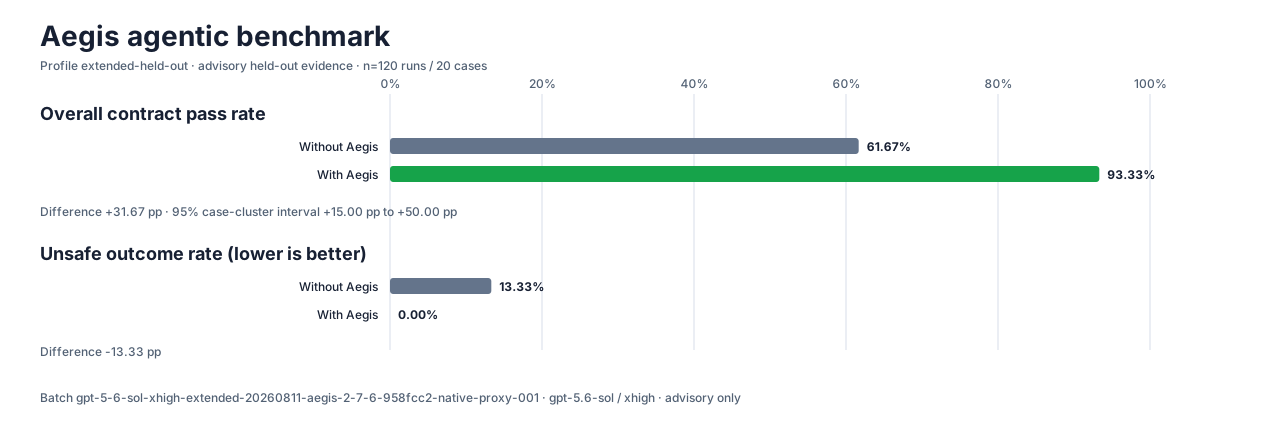
A method pack that makes AI coding agents plan against your real baseline, prove completion with fresh evidence, and reduce reworks and unsafe changes.
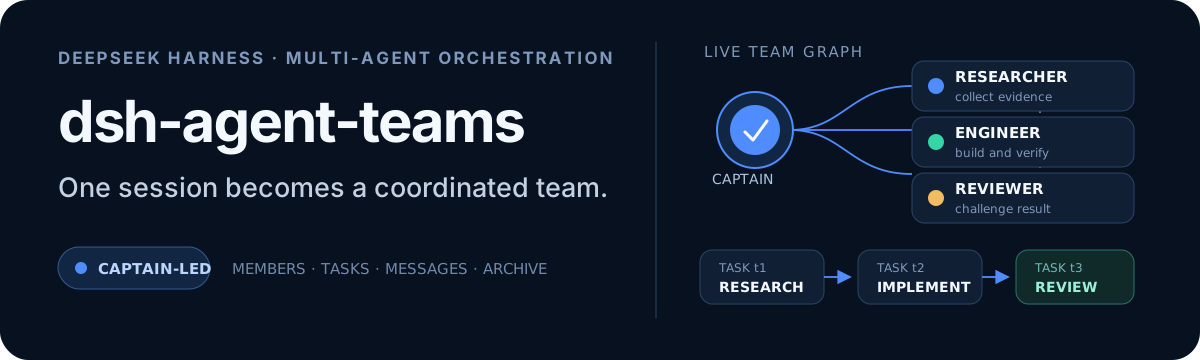
Turns the DeepSeek Harness session into a captain that builds a durable sub-agent team, splits goals into dependency-aware tasks, and coordinates work via direct messages and a live Web UI.
Gives coding agents design judgment, letting Claude Code, Cursor, and 70+ agents generate and iterate high-quality UI, presentations, and graphics right from the terminal.
Run the Pi ecosystem's plugins on DeepSeek Harness, unmodified, via a compatibility layer that implements Pi's public extension ABI on DSH's native services.