dsh-web-pass
Run the following command in DeepSeek Harness:
dsh plugin install linz919/dsh-web-pass
Paste the following prompt into your AI chat to install this plugin:
Run dsh plugin install linz919/dsh-web-pass in DeepSeek Harness to install the plugin; the source repository is https://github.com/linz919/dsh-web-pass
About this plugin
Sharing a DeepSeek Harness web interface over a LAN or the public internet has always been awkward: DSH expects loopback-only browser trust, its built-in token-and-cookie dance is opaque to casual visitors, and settings pages silently blank out the moment the URL stops being localhost. dsh-web-pass solves this by running a zero-dependency reverse proxy inside the DSH process itself. It rewrites Host and Origin headers to satisfy DSH's browser-trust check, stacks a cookie-based password gate on top, and—because it shares the same process—silently acquires and injects DSH's persistent authentication cookie into every forwarded request and WebSocket handshake. Visitors see exactly one password form and nothing else; DSH's internal auth stays fully transparent.
Beyond the password gate, the plugin ships a built-in access-log viewer at /dsh-logs/ that records only authentication-related requests (login success, password error, lockout, page view, logout, first-time setup). Visitor IPs are never stored raw: they are pseudonymized with HMAC-SHA256 and truncated to a network prefix (/24 for IPv4, /64 for IPv6), so logs remain aggregatable for abuse analysis without leaking personal data. Files rotate by size (default 1 MB per file, 7 files kept) giving the log a hard total cap of roughly 8 MB. Repeated password failures trigger a temporary lockout, and a Web Password tab in the DSH settings panel lets you change the access password or log out at any time.
This plugin is best suited for small teams or individuals who expose a DSH instance on a trusted LAN or behind a TLS-terminating tunnel, want a single shared-password gate without standing up nginx Basic Auth or a full identity provider, and value audit-ready logs that respect visitor privacy. There is no account database, no 2FA module—just one scrypt-hashed password, a 3-attempt lockout, and a size-bounded log file, all living under $DSH_HOME/dsh-web-pass/ so the plugin repository stays clean and upgrades are a simple file swap.
Use Cases
- Sharing a DSH instance over a LAN without standing up nginx Basic Auth or a full identity provider
- Exposing DSH via a public domain or TLS tunnel with a single password gate that transparently proxies built-in auth
- Auditing DSH access while keeping visitor IPs pseudonymized via HMAC-SHA256 so raw addresses never persist in logs
Best For
- Ops or developers sharing a DSH instance within a small team who do not want to introduce an account directory
- Individuals exposing DSH via a Cloudflare tunnel, VPS public mapping, or similar reverse-proxy setup
- Privacy-conscious users who want auditable access logs that never store raw visitor IPs in plaintext
Related Plugins
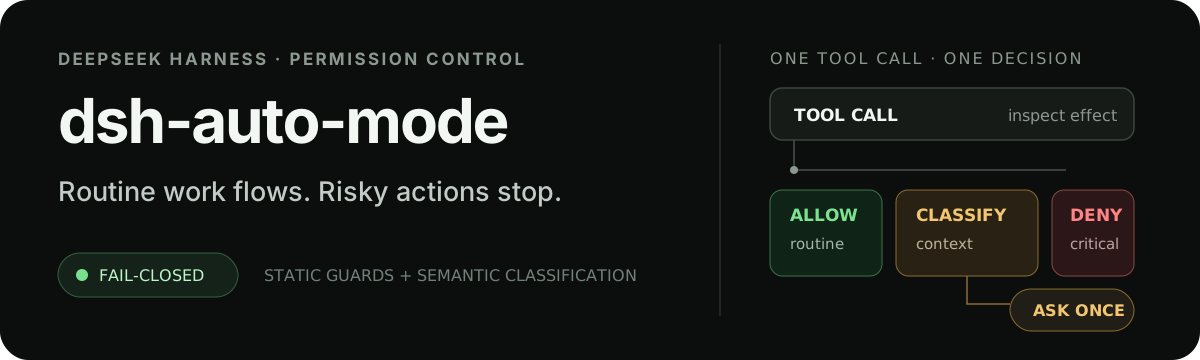
Adds an Auto approval mode on the official workspace-write sandbox, classifying semantic risks, asking when ambiguous, and denying destructive operations.

Undo/rollback system for DSH: config & plugin snapshots, one-click undo/redo/restore, message-level revert, secret masking, safe mode, and offline WebUI/GUI/CLI rescue tools for when DSH won't start.
Packages all 87 SKILL.md files from upstream reverse-skill as a DeepSeek Harness plugin that auto-registers them for authorized reverse engineering, penetration testing, and security research.
Dockyard DSH is a native DeepSeek Harness plugin that unifies official OAuth/client sessions for Codex, Antigravity, Grok, Claude, and Cursor, providing account pool, model catalog, and quota status.