dsh-malware-audit
Run the following command in DeepSeek Harness:
dsh plugin install rand0wn/dsh-malware-audit
Paste the following prompt into your AI chat to install this plugin:
Run dsh plugin install rand0wn/dsh-malware-audit inside your DeepSeek Harness to install the plugin; the project source is available at https://github.com/rand0wn/dsh-malware-audit .
About this plugin
Every dsh plugin runs with real filesystem and process access, and installing one is a single-line command. Existing audit tools report what a plugin can touch, then explicitly stop short of judging intent. dsh-malware-audit fills that narrow gap: it walks the real TypeScript-compiler AST of every installed plugin and looks for the handful of patterns that separate a legitimate multi-capability plugin from one that is concealing what it does, such as dynamic code execution from decoded strings, fetch-and-execute shell pipelines, cross-plugin file writes, and exfiltration-shaped network calls.
Beyond the manual scan command, it offers an optional periodic schedule and an opt-in auto-quarantine that kicks in on critical-severity findings. Quarantine safely moves the node_modules entry out of the profile and cleans the bundle list across every local profile, so no dangling reference can cause a hard boot failure on the next start.
This plugin is aimed at dsh users who install multiple third-party plugins and want a lightweight heuristic layer on top of the existing capability audits. It is not an antivirus and carries no signature database, but a small fixed set of AST-level rules catches the most common malicious techniques and gives a practical risk signal without the noise of a full sandbox.
Use Cases
- Quickly triage potential malicious behavior after installing multiple third-party plugins
- Schedule periodic scans and auto-quarantine plugs with critical findings
- Add a heuristic intent-detection layer on top of existing capability audits
Best For
- Security admins managing multi-plugin dsh environments
- Ops engineers with extra supply-chain security concerns
- Developers wanting low-cost plugin behavior audit signals
Related Plugins
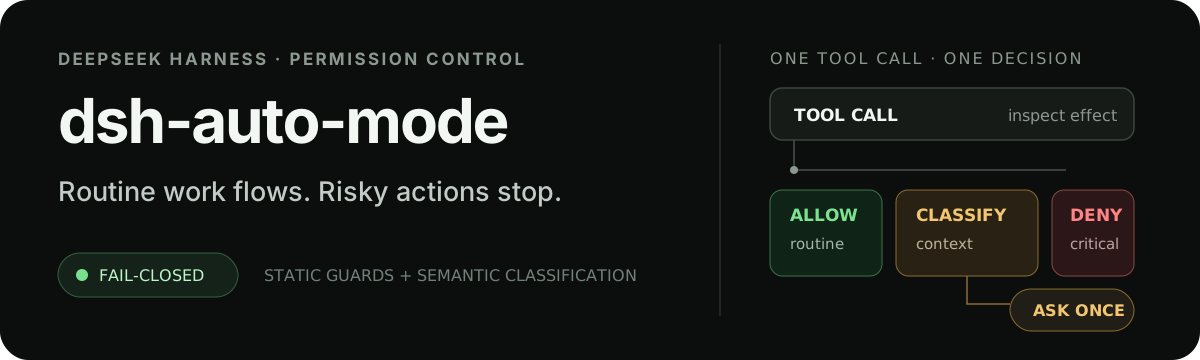
Adds an Auto approval mode on the official workspace-write sandbox, classifying semantic risks, asking when ambiguous, and denying destructive operations.

Undo/rollback system for DSH: config & plugin snapshots, one-click undo/redo/restore, message-level revert, secret masking, safe mode, and offline WebUI/GUI/CLI rescue tools for when DSH won't start.
Packages all 87 SKILL.md files from upstream reverse-skill as a DeepSeek Harness plugin that auto-registers them for authorized reverse engineering, penetration testing, and security research.
Dockyard DSH is a native DeepSeek Harness plugin that unifies official OAuth/client sessions for Codex, Antigravity, Grok, Claude, and Cursor, providing account pool, model catalog, and quota status.