dsh-token-vault
Run the following command in DeepSeek Harness:
dsh plugin install YYfather/dsh-token-vault
Paste the following prompt into your AI chat to install this plugin:
Run dsh plugin install YYfather/dsh-token-vault in the DeepSeek Harness terminal to install the plugin. The source lives at https://github.com/YYfather/dsh-token-vault . After installation, restart DSH Desktop and add your tokens via Settings → Credential Vault.
About this plugin
The moment an AI agent needs to push to GitHub, publish to npm, or call an authenticated API, its credentials risk traversing the model context, landing in a plaintext file, or round-tripping through a browser. dsh-token-vault eliminates that exposure entirely: every GitHub, npm, or custom API token lives exclusively in the DeepSeek Harness host-level credential store. No stray files are created, no secret touches the model context, and no browser round-trip is required. The security boundary is enforced by architecture, not by convention.
The plugin registers seven agent-facing tools that cover the full credential lifecycle. Store with vault_set, migrate in one click with vault_import (from gh auth token or .npmrc), check presence with vault_has, list names with vault_list, delete with vault_remove, and—most critically—vault_run, which injects the token into a child-process environment variable (GH_TOKEN or NPM_TOKEN), executes the command, and discards the secret before stdout, stderr, or logs are ever written. The single disclosure path, vault_show, demands an explicit confirm flag, making accidental exposure by the agent structurally impossible.
If you rely on DeepSeek Harness to let an AI agent perform authenticated GitHub or npm tasks and refuse to hand tokens into a model context or scatter them across config files, this plugin was built for exactly that workflow: set credentials once in the settings panel, and every subsequent operation is brokered by the host with a clean, auditable boundary and zero plaintext residue.
Use Cases
- When an agent pushes to GitHub or calls an authenticated API, the token is injected into a child process on the host and never enters the model context
- One-click migration of tokens from gh auth or .npmrc into a unified vault, eliminating scattered plaintext configs
- When the agent runs npm publish or other authenticated operations, the secret exists only in a child-process env var and leaves zero trace in stdout, stderr, or logs
Best For
- Solo developers who let a DeepSeek Harness agent perform authenticated GitHub or npm operations
- Engineering teams that refuse to expose production secrets in AI conversation contexts and demand minimal attack surface
- Security leads who need central control over the full credential lifecycle—write, use, disclose, and delete—from the host side
Related Plugins
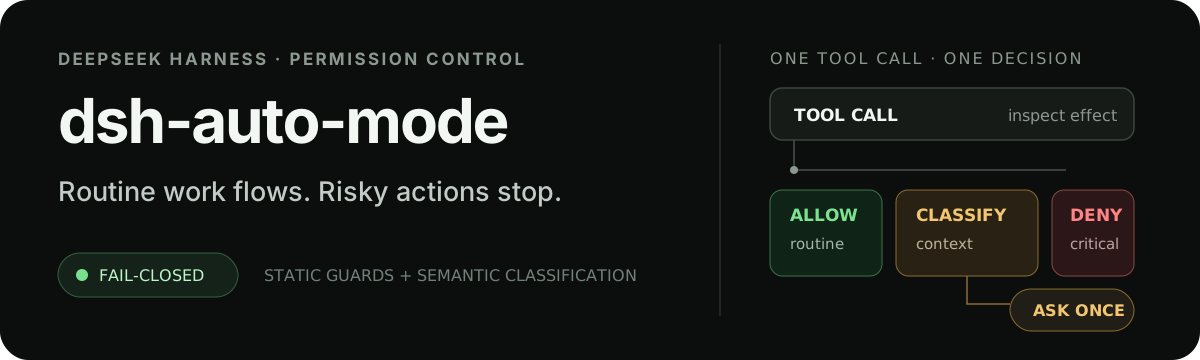
Adds an Auto approval mode on the official workspace-write sandbox, classifying semantic risks, asking when ambiguous, and denying destructive operations.

Undo/rollback system for DSH: config & plugin snapshots, one-click undo/redo/restore, message-level revert, secret masking, safe mode, and offline WebUI/GUI/CLI rescue tools for when DSH won't start.
Packages all 87 SKILL.md files from upstream reverse-skill as a DeepSeek Harness plugin that auto-registers them for authorized reverse engineering, penetration testing, and security research.
Dockyard DSH is a native DeepSeek Harness plugin that unifies official OAuth/client sessions for Codex, Antigravity, Grok, Claude, and Cursor, providing account pool, model catalog, and quota status.