dsh-agentenv-sandbox
Run the following command in DeepSeek Harness:
dsh plugin install ztting01/dsh-agentenv-sandbox
Paste the following prompt into your AI chat to install this plugin:
In DeepSeek Harness (0.1.0-rc.7 or later), confirm that AgentENV is deployed with a pre-built template, then run dsh plugin install ztting01/dsh-agentenv-sandbox to add the plugin to your target profile; the source repository is available at https://github.com/ztting01/dsh-agentenv-sandbox.
About this plugin
By default, DeepSeek Harness executes Bash commands, file operations, persistent terminals, and LSP processes directly on the host filesystem, effectively granting the model full system access. dsh-agentenv-sandbox relocates this entire execution layer into an AgentENV Firecracker microVM. Through the official E2B adapters, Bash, file tools, PTY, and LSP all share a single remote Linux world, while local filesystem and subprocess providers are permanently disabled. Any failure in AgentENV creation or workspace upload hard-rejects the session instead of falling back to host execution.
On first launch the plugin performs a bounded initial upload of the selected workspace into the microVM (default caps: 50,000 files, 512 MiB aggregate). After that, every model-facing file and process operation goes through the remote providers, and there is no automatic write-back channel to the host. The microVM can be configured to pause rather than destroy on Harness exit, allowing the next session to reconnect by recorded ID, which suits iterative debugging across sessions. The MVP requires WSL 2 or Linux, Node.js 22.19 or later, a running AgentENV 0.1.0 or 0.1.3 instance with a pre-built template, and binds each Harness process to one sandbox and one fixed working directory.
This plugin suits developers or teams who run Harness on Linux or WSL 2, have AgentENV deployed, and want a non-bypassable hard isolation boundary around model operations. It does not fit native Windows setups, environments without a pre-existing AgentENV deployment, or workflows expecting a single process to auto-switch between multiple workspaces.
Use Cases
- Isolate model-executed Bash and file operations entirely from the host filesystem
- Preserve microVM state across sessions to avoid rebuilding the sandbox and re-uploading the workspace
- Establish a non-bypassable remote execution boundary for multi-user Harness deployments in production
Best For
- Developers who have deployed AgentENV on Linux or WSL 2 and want hard isolation around Harness model operations
- Security or platform engineering teams building a unified execution sandbox boundary for production Harness deployments
- Independent developers debugging with Harness who do not want the model to touch the host Node.js ecosystem
Related Plugins
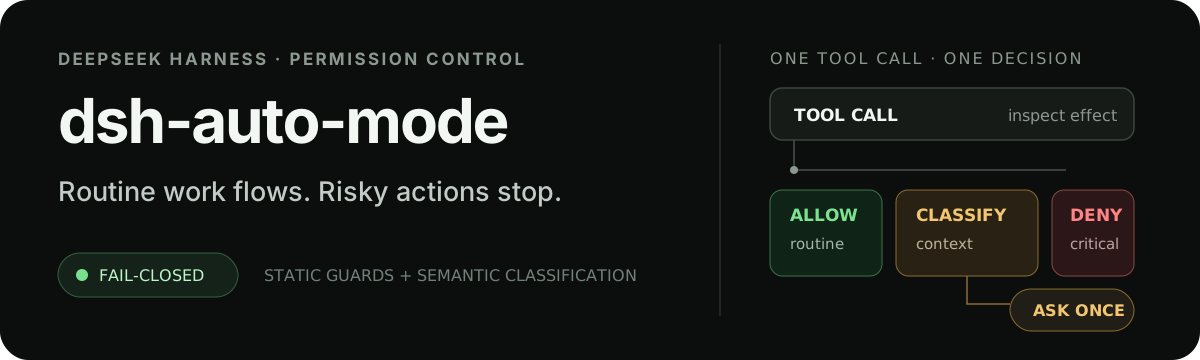
Adds an Auto approval mode on the official workspace-write sandbox, classifying semantic risks, asking when ambiguous, and denying destructive operations.

Undo/rollback system for DSH: config & plugin snapshots, one-click undo/redo/restore, message-level revert, secret masking, safe mode, and offline WebUI/GUI/CLI rescue tools for when DSH won't start.
Packages all 87 SKILL.md files from upstream reverse-skill as a DeepSeek Harness plugin that auto-registers them for authorized reverse engineering, penetration testing, and security research.
Dockyard DSH is a native DeepSeek Harness plugin that unifies official OAuth/client sessions for Codex, Antigravity, Grok, Claude, and Cursor, providing account pool, model catalog, and quota status.