dsh-ui-pricing
Run the following command in DeepSeek Harness:
dsh plugin install ivvan3016/dsh-ui-pricing
Paste the following prompt into your AI chat to install this plugin:
Run dsh plugin install ivvan3016/dsh-ui-pricing in your terminal to install; source at https://github.com/ivvan3016/dsh-ui-pricing
About this plugin
Tracking LLM spend across dsh sessions, pinpointing which hours are pricier and which model burns the most tokens has often meant external scripts or back-of-the-envelope math. dsh-ui-pricing brings the entire pricing engine inside the plugin: fill in per-model list prices (per million tokens) in a settings card, sketch a default timeline (say 1.0 during business hours, 0.5 overnight), and toggle a daily exception when a specific day deviates. Everything else - recalculation, re-projection, live aggregation - is automatic.
Three layers do the heavy lifting. The durable cost projection prices every provider-reported usage sample under the multiplier in force at that point in time; later chunks for the same step replace rather than double-count earlier ones, and changing the pricing section re-registers the projection so the whole log reprices under the new rules. The CostLine in the composer dock sums the total spend across all live sessions, carries an estimate badge since the figure is computed from usage and multipliers rather than an invoice, and lets you type a corrected total in place - the delta is stored as manualSpend and later usage keeps accruing on top. A 24-hour strip on the right, painted by multiplier band (discount, premium, or neutral), tracks the wall clock with a marker at the current minute. The timeline editor inside the settings card supports click-to-split, drag-to-move boundaries, and direct multiplier entry, making multi-segment policies easy to shape visually.
Built for deployment admins who manage mixed-model, multi-timezone fleets and want real-time cost visibility without standing up a separate billing stack. Models absent from the pricing table contribute zero to the projection; timeline boundaries snap to whole hours; day exceptions copy the default schedule at the moment of creation rather than referencing it live. These constraints can be worked around by editing the raw settings document when minute-level precision or late-edit propagation is required.
Use Cases
- Track per-model and per-time-period spend across all live sessions in one view
- Apply time-band multipliers to differentiate peak and off-peak token costs
- Correct the total in place and let subsequent usage accrue on top of the adjustment
Best For
- Ops teams running multi-model LLM deployments that need transparent cost visibility
- Dev admins who want per-session cost projection without an external billing stack
- Platform operators who need differentiated pricing across peak and off-peak hours
Related Plugins
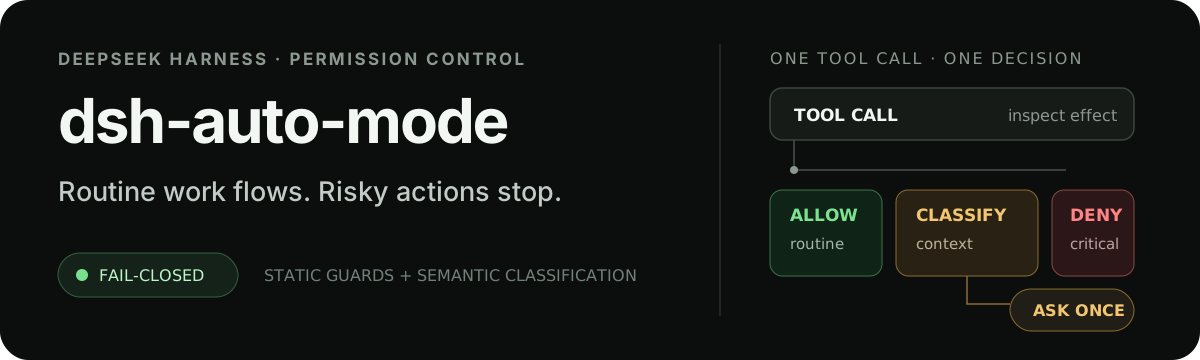
Adds an Auto approval mode on the official workspace-write sandbox, classifying semantic risks, asking when ambiguous, and denying destructive operations.

Undo/rollback system for DSH: config & plugin snapshots, one-click undo/redo/restore, message-level revert, secret masking, safe mode, and offline WebUI/GUI/CLI rescue tools for when DSH won't start.
Packages all 87 SKILL.md files from upstream reverse-skill as a DeepSeek Harness plugin that auto-registers them for authorized reverse engineering, penetration testing, and security research.
Dockyard DSH is a native DeepSeek Harness plugin that unifies official OAuth/client sessions for Codex, Antigravity, Grok, Claude, and Cursor, providing account pool, model catalog, and quota status.