dsh-agent-evolution
Run the following command in DeepSeek Harness:
dsh plugin install FriendsHL/dsh-agent-evolution
Paste the following prompt into your AI chat to install this plugin:
Obtain the plugin source from https://github.com/FriendsHL/dsh-agent-evolution, then run dsh plugin install FriendsHL/dsh-agent-evolution in DeepSeek Harness and restart the DSH process so the Loader picks up the new profile.
About this plugin
In multi-Agent deployments, teams often need to compare how different preset combinations of prompts, tool sets, skills, and compaction strategies perform on the same standalone task. Existing mechanisms either lack auditable execution evidence or jump straight into an automatic scoring-and-selection loop whose permission boundaries are hard to govern. dsh-agent-evolution breaks experimentation down into minimal primitives: it only supports running a task with one preset and running a baseline-versus-candidate pair sequentially, returning two records without scoring, selecting a winner, editing presets, or publishing changes. Deployments decide when and where to introduce subsequent evaluation layers.
Three runtime tools cover discovery, single execution, and sequential comparison. Every run returns the preset id, child session id, stop reason, elapsed time, final assistant content, and a persistence acknowledgment flag; child logs are flushed before the Agent handle is disposed. In comparison mode both presets are validated and authorized before either child starts, the candidate runs regardless of the baseline stop reason, and any creation, persistence, or cleanup exception halts the comparison immediately. Experiment children carry standard lineage metadata (parentSession, delegationDepth, agentPreset) yet do not appear in the SubAgent catalog or control APIs, avoiding semantic conflict with the existing subagent system.
On the configuration side, allowedPresets accepts either the system-trust roster or an explicit allowlist whose ids are all resolved at plugin load time, with unknown or broken entries blocking activation. Parameters such as maxDepth and maxTokens are rejected during configuration or request validation when invalid. This plugin is well suited for platform operators building incremental Agent governance, engineering teams wanting A/B comparisons inside independently scoped permission domains, and architects planning to introduce evaluators, failure attribution, candidate authoring, and promotion or rollback as separate, independently permissioned layers.
Use Cases
- Run the same standalone task with two presets and compare returned execution evidence
- Safely test new prompt or tool-set combinations within a scoped permission domain
- Accumulate auditable session records for future evaluation layers
Best For
- Platform operators building incremental Agent governance
- Engineering teams running A/B comparisons in scoped permission domains
- Architects planning layered introduction of evaluators and promotion rollback
Related Plugins
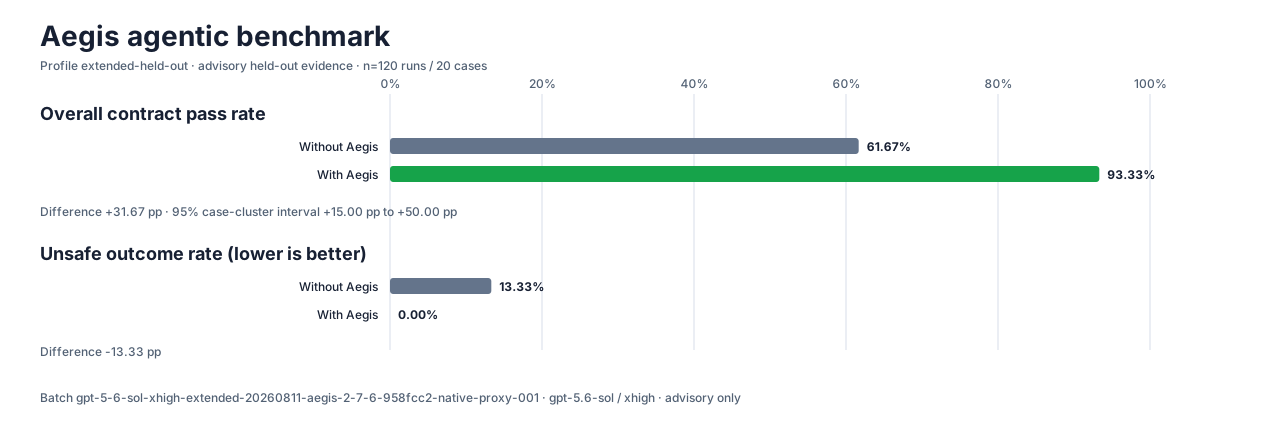
A method pack that makes AI coding agents plan against your real baseline, prove completion with fresh evidence, and reduce reworks and unsafe changes.
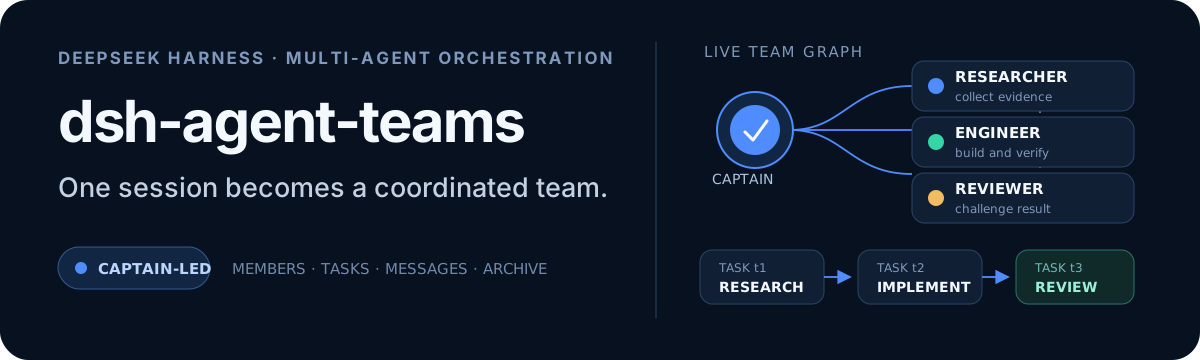
Turns the DeepSeek Harness session into a captain that builds a durable sub-agent team, splits goals into dependency-aware tasks, and coordinates work via direct messages and a live Web UI.
Gives coding agents design judgment, letting Claude Code, Cursor, and 70+ agents generate and iterate high-quality UI, presentations, and graphics right from the terminal.
Run the Pi ecosystem's plugins on DeepSeek Harness, unmodified, via a compatibility layer that implements Pi's public extension ABI on DSH's native services.