dsh-port-guard
Run the following command in DeepSeek Harness:
dsh plugin install PangYiMing/dsh-port-guard
Paste the following prompt into your AI chat to install this plugin:
Install the plugin in DeepSeek Harness by running dsh plugin install PangYiMing/dsh-port-guard; the source repository is at https://github.com/PangYiMing/dsh-port-guard.
About this plugin
EADDRINUSE is the most familiar error before any dev server starts and the easiest one to react to by blindly killing the occupying process. dsh-port-guard pushes back on that instinct: a port in use does not automatically mean it should be killed. A leftover dev server from a previous session should be reused, a process belonging to another project should be bypassed with a different port, and only a confirmed zombie deserves a precise PID kill. Identify first, act second.
The plugin begins with forensics: it prints the full identity of the occupying process, including PPID, tty, file-descriptor targets, elapsed time, and memory footprint. A PPID of 1 signals an orphan adopted by launchd; an empty tty means nobody is running it interactively; fds pointing at a .log file are the fingerprint of a nohup-launched agent or script. Read these clues together and the right course of action becomes clear.
Safety rules are explicit: never run killall node, never touch PIDs below 100, never kill a process belonging to another project, and never act when the command line is unclear. Every action targets a precise PID so unrelated services stay untouched.
Built for front-end and full-stack developers who juggle multiple projects, teams that batch-launch dev servers through agent scripts, and anyone who does not want a single port conflict to take down a service still in use.
Use Cases
- Resolving EADDRINUSE before starting a dev server
- Rapid triage of port conflicts in multi-project workflows
- Cleaning up zombie processes left by agent-launched services
Best For
- Front-end and full-stack developers juggling multiple projects
- Teams managing dev servers via agent scripts at scale
- Developers who prioritize process safety over blind killing
Related Plugins
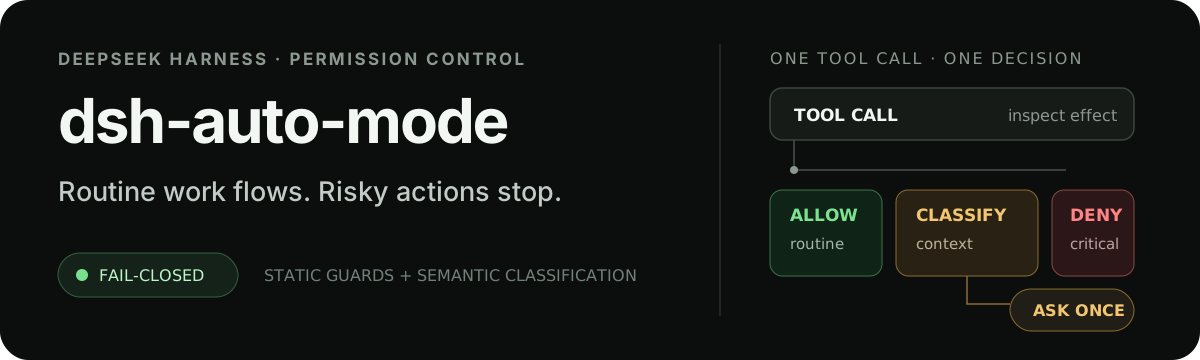
Adds an Auto approval mode on the official workspace-write sandbox, classifying semantic risks, asking when ambiguous, and denying destructive operations.

Undo/rollback system for DSH: config & plugin snapshots, one-click undo/redo/restore, message-level revert, secret masking, safe mode, and offline WebUI/GUI/CLI rescue tools for when DSH won't start.
Packages all 87 SKILL.md files from upstream reverse-skill as a DeepSeek Harness plugin that auto-registers them for authorized reverse engineering, penetration testing, and security research.
Dockyard DSH is a native DeepSeek Harness plugin that unifies official OAuth/client sessions for Codex, Antigravity, Grok, Claude, and Cursor, providing account pool, model catalog, and quota status.