dsh-bisect-debug
Run the following command in DeepSeek Harness:
dsh plugin install PangYiMing/dsh-bisect-debug
Paste the following prompt into your AI chat to install this plugin:
Run dsh plugin install PangYiMing/dsh-bisect-debug inside DeepSeek Harness to install; the source is hosted at https://github.com/PangYiMing/dsh-bisect-debug .
About this plugin
"The bug is in the current code, but where exactly?" — Guessing and shotgun debugging rarely converge. You patch three places, things break in new ways, and you are no closer to the root cause. dsh-bisect-debug turns binary-search bisection into a concrete agent workflow: every round halves the search space, you verify, then halve again—until the culprit is pin-pointed to a specific function, data-flow boundary, or commit.
The plugin ships three complementary bisection modes. Code bisection comments out or disables half the modules to narrow the scope—ideal when you know the bug lives in the current source but cannot see which function is responsible. Boundary bisection walks the data flow hop by hop using curl, logs, or database queries, designed for "is it the frontend or the backend, the gateway or the downstream?" scenarios—a typical run needs three curl calls and zero code changes. Commit bisection encodes the good/bad check as an exit-code script and hands it to git bisect run for fully automated convergence through submission history. The three modes compose naturally: locate the layer first with boundary bisection, then locate the function within that layer using code bisection.
Built-in discipline rules keep the process honest: if two consecutive edits have not resolved the issue, stop and return to bisection; never modify multiple places in one round; confirm symptoms with curl, logs, or pings before reading source; and follow a fallback strategy when the bug is intermittent or one-off. If you frequently hit "changed it a dozen times and still cannot find the root cause"—especially in front-end/back-end split stacks, microservice chains, or long git histories—this workflow turns bug-hunting from a shot in the dark into deterministic convergence.
Use Cases
- Patched several places but the bug persists; halve the search space each round until it is isolated
- Cross-layer or cross-service bug; unsure which tier owns it; walk the data flow hop by hop with curl and logs
- Worked last week, breaks today; auto-converge git history with bisect to find the offending commit
Best For
- Backend or full-stack developers who keep hitting "patched it five times, still broken"
- Engineers debugging across front-end, API gateway, and microservice boundaries
- Teams with long git histories that need fast, deterministic commit-level root-cause tracing
Related Plugins
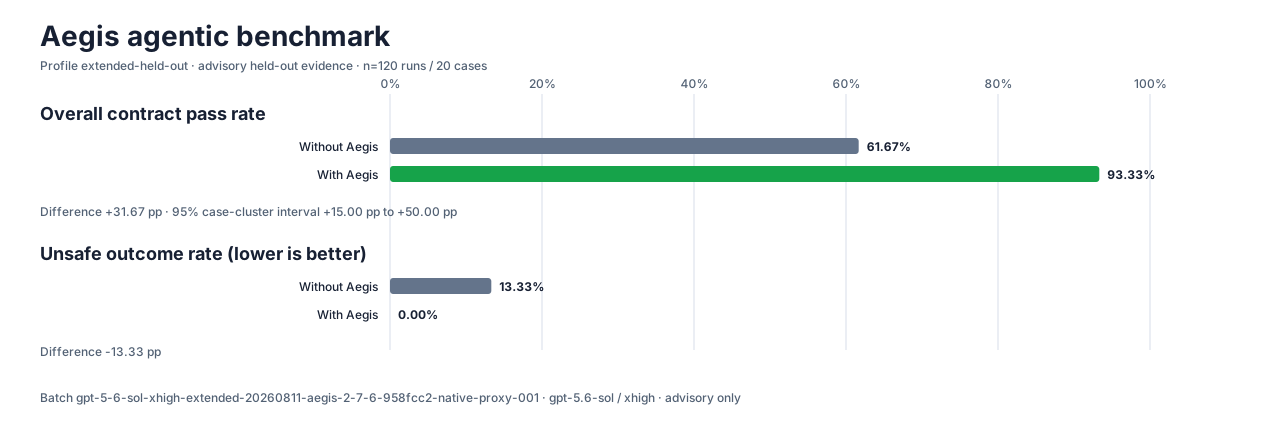
A method pack that makes AI coding agents plan against your real baseline, prove completion with fresh evidence, and reduce reworks and unsafe changes.
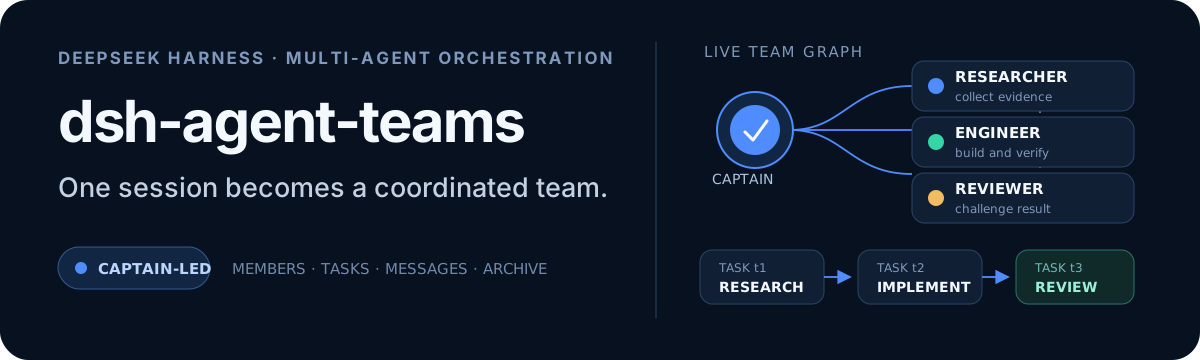
Turns the DeepSeek Harness session into a captain that builds a durable sub-agent team, splits goals into dependency-aware tasks, and coordinates work via direct messages and a live Web UI.
Gives coding agents design judgment, letting Claude Code, Cursor, and 70+ agents generate and iterate high-quality UI, presentations, and graphics right from the terminal.
Run the Pi ecosystem's plugins on DeepSeek Harness, unmodified, via a compatibility layer that implements Pi's public extension ABI on DSH's native services.