dsh-auth-gate
Run the following command in DeepSeek Harness:
dsh plugin install jiang539/dsh-auth-gate
Paste the following prompt into your AI chat to install this plugin:
Install in DeepSeek Harness by running dsh plugin install jiang539/dsh-auth-gate; the full source is at https://github.com/jiang539/dsh-auth-gate.
About this plugin
DeepSeek Harness ships its Web UI bound to 127.0.0.1 by design. The moment you need to expose it on a LAN or the public internet, you are left with no built-in identity check whatsoever. dsh-auth-gate fills exactly that gap: it inserts a login gate in front of the UI and exposes a set of /auth endpoints that feed directly into Nginx auth_request, giving you full authentication and brute-force protection without altering a single line of DSH core code.
The authentication pipeline spans an SVG captcha, dual-axis brute-force locking (per-IP and per-account), and server-side session management with sliding expiry, single-session enforcement, and optional IP binding. Passwords are stored as bcrypt (12-round) hashes; every login or password-change failure is captured in an audit log. On the host side the plugin registers /auth/* routes; on the client side it injects a login page through DSH's native Slot system. The two layers are independent by design: Nginx rejects unauthenticated requests with 401 before they ever reach DSH, while the plugin layer shields the UI itself—so even a direct /api call is guarded by the auth_request sub-request.
This plugin is for anyone deploying DSH on a trusted internal network or behind a public HTTPS endpoint who does not want to fork or patch the core. Out of the box you see a working login page in seconds; the forced first-login rename-and-password-change tightens the attack surface immediately. Pair it with the Nginx examples in the repo (public HTTPS or LAN HTTP) and you can move from local development to production with minimal friction.
Use Cases
- Exposing DSH Web UI on a trusted LAN for team access
- Public HTTPS deployment requiring identity verification and brute-force protection
- Adding a login gate to DSH without modifying core code
Best For
- Self-hosters exposing DSH Web UI beyond localhost
- Developers deploying DSH behind an Nginx reverse proxy
- Teams adding baseline security to LAN or public DSH instances
Related Plugins
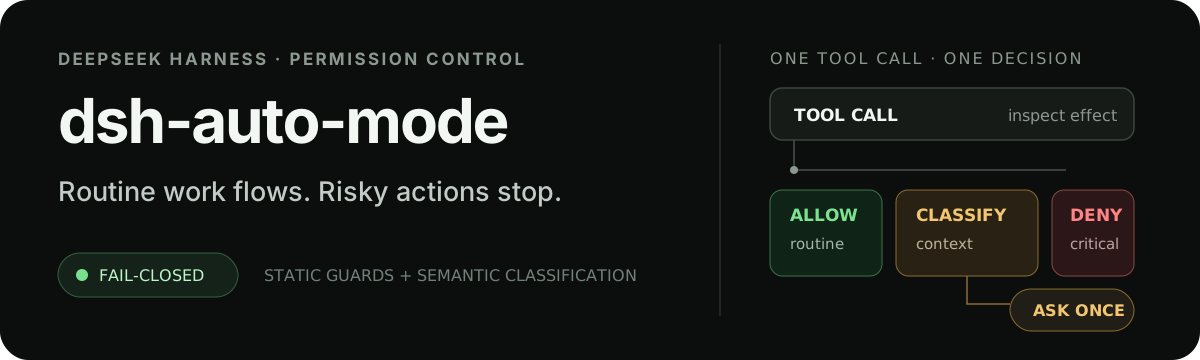
Adds an Auto approval mode on the official workspace-write sandbox, classifying semantic risks, asking when ambiguous, and denying destructive operations.

Undo/rollback system for DSH: config & plugin snapshots, one-click undo/redo/restore, message-level revert, secret masking, safe mode, and offline WebUI/GUI/CLI rescue tools for when DSH won't start.
Packages all 87 SKILL.md files from upstream reverse-skill as a DeepSeek Harness plugin that auto-registers them for authorized reverse engineering, penetration testing, and security research.
Dockyard DSH is a native DeepSeek Harness plugin that unifies official OAuth/client sessions for Codex, Antigravity, Grok, Claude, and Cursor, providing account pool, model catalog, and quota status.