dsh-workloads
Run the following command in DeepSeek Harness:
dsh plugin install yewenyell-lang/dsh-workloads
Paste the following prompt into your AI chat to install this plugin:
Run dsh plugin install yewenyell-lang/dsh-workloads in DeepSeek Harness to install the plugin; the source repository is at https://github.com/yewenyell-lang/dsh-workloads.
About this plugin
In DeepSeek Harness, operations like a dev server or file watcher lack the clean start-finish boundary of a build or a test. Treating them as ordinary Session Jobs creates a lifecycle mismatch—Jobs are session-owned and die with the session, yet a long-running service needs a stable, workspace-scoped identity that survives across sessions. dsh-workloads fills that gap with durable, workspace-owned process management for long-running services, plus a Runtime Center that keeps session jobs and workspace workloads visible without conflating their lifecycles.
Each Workload carries a stable workloadId; every start or restart mints a new runId and increments a generation counter. Records, rotating logs, and readiness evidence (log-text match, TCP probe, localhost HTTP check) are persisted outside the business repository, with bounded run history. The browser-side Runtime Center shows both Session Jobs and Workspace Workloads under a session boundary, supporting stop, restart, and stop-all—each action validated against the workspace cwd and screened for credential patterns. On the Agent side, an opt-in preset exposes seven workload_* tools so the model can start and stop long-running services conversationally, while the shared Host service remains un-isolated from any single Agent.
This plugin is a good fit if you regularly keep dev servers, watchers, local proxies, or debuggers alive inside DSH and want them in a separate, durable layer from one-shot builds and tests. The Provider is currently Windows local-process only, and the Service/API contract is still pre-1.0, so it suits DSH users comfortable with early-stage iteration.
Use Cases
- Running a dev server and build tasks in a DSH session with separate workspace and session lifecycles
- Persisting a watcher, local proxy, or debugger across sessions without losing it on session close
- Letting the Agent start and stop local long-running services and inspect readiness evidence and log tails
Best For
- Developers who maintain dev servers, watchers, or local proxies in DSH daily
- Workflow users who need to separate session-scoped jobs from workspace-level service lifecycles
- Advanced DSH users who want Agent-driven management and visibility of local long-running processes
Related Plugins
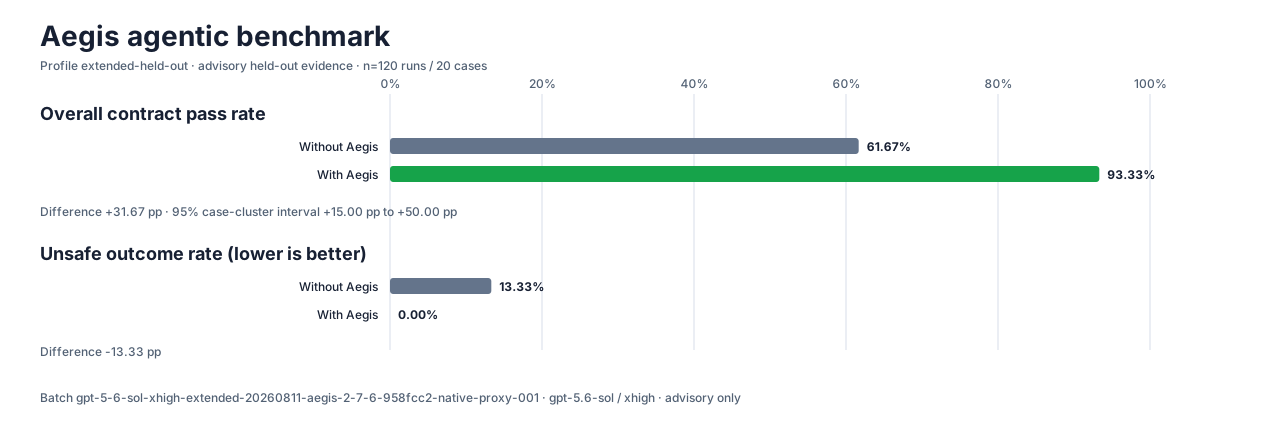
A method pack that makes AI coding agents plan against your real baseline, prove completion with fresh evidence, and reduce reworks and unsafe changes.
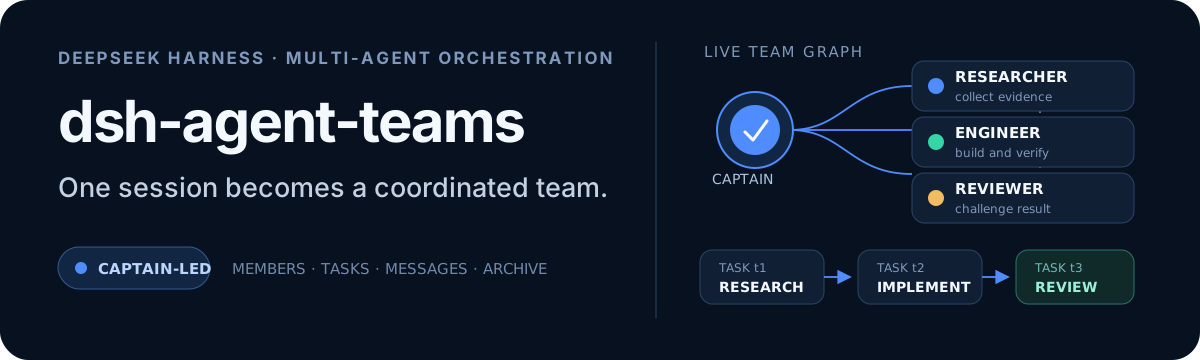
Turns the DeepSeek Harness session into a captain that builds a durable sub-agent team, splits goals into dependency-aware tasks, and coordinates work via direct messages and a live Web UI.
Gives coding agents design judgment, letting Claude Code, Cursor, and 70+ agents generate and iterate high-quality UI, presentations, and graphics right from the terminal.
Run the Pi ecosystem's plugins on DeepSeek Harness, unmodified, via a compatibility layer that implements Pi's public extension ABI on DSH's native services.