dsh-mattpocock-skills
Run the following command in DeepSeek Harness:
dsh plugin install GongYuanCaiJi/dsh-mattpocock-skills
Paste the following prompt into your AI chat to install this plugin:
Run dsh plugin install GongYuanCaiJi/dsh-mattpocock-skills in DeepSeek Harness to install; the source is available at https://github.com/GongYuanCaiJi/dsh-mattpocock-skills
About this plugin
The most common pitfall of AI-assisted coding is the absence of structured engineering discipline: the model either guesses or waits for you to re-prompt every single turn. This plugin ports 25 battle-tested engineering and productivity skills verbatim into DeepSeek Harness. On the engineering side you get TDD red-green loops, two-axis code review, stress-test questioning, requirement-to-spec and requirement-to-ticket workflows, domain modeling, codebase design, and bug diagnosis. On the productivity side the pack adds grilling, teach, handoff, and writing-for-agents. The model loads a full structured workflow when a task matches, instead of starting from scratch every turn.
All 76 skill files are byte-identical to the upstream release, with hashes pinned and a copy-paste diff command available for verification. There are zero runtime dependencies and no build scripts, and skills load lazily so there is no boot-time cost. You can let the model auto-match a skill during a session, or invoke one explicitly by starting a message with the skill name.
This is for developers who treat dsh as a daily engineering companion and want the AI to behave like a disciplined team member rather than a chat partner. If you just want a ready-to-use set of engineering workflows without worrying about upstream versioning details, this plugin is all you need.
Use Cases
- Drive the model through red-green test cycles with /tdd during feature development
- Run a two-axis review before committing with /code-review
- Break requirements into specs and tickets with /to-spec or /to-tickets
Best For
- Full-stack developers who use AI as a daily engineering companion
- Teams that want structured tooling integrated into their coding workflow
- Indie developers who follow Matt Pocock's engineering methodology
Related Plugins
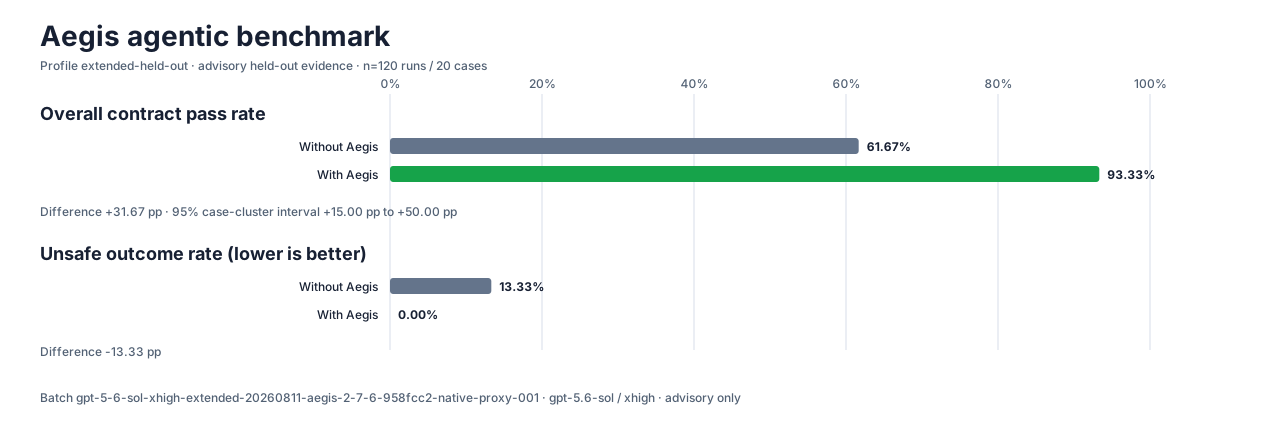
A method pack that makes AI coding agents plan against your real baseline, prove completion with fresh evidence, and reduce reworks and unsafe changes.
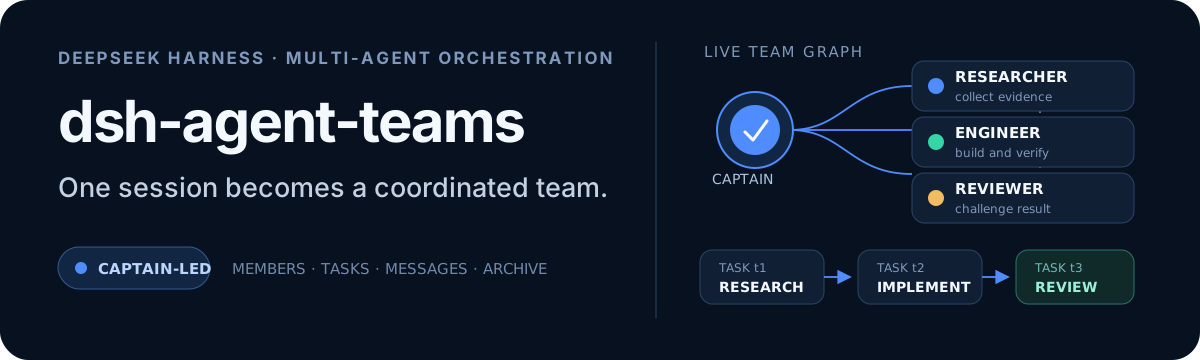
Turns the DeepSeek Harness session into a captain that builds a durable sub-agent team, splits goals into dependency-aware tasks, and coordinates work via direct messages and a live Web UI.
Gives coding agents design judgment, letting Claude Code, Cursor, and 70+ agents generate and iterate high-quality UI, presentations, and graphics right from the terminal.
Run the Pi ecosystem's plugins on DeepSeek Harness, unmodified, via a compatibility layer that implements Pi's public extension ABI on DSH's native services.