dsh-access-mode
Run the following command in DeepSeek Harness:
dsh plugin install ddll8023/dsh-access-mode
Paste the following prompt into your AI chat to install this plugin:
Run dsh plugin install ddll8023/dsh-access-mode inside DeepSeek Harness to install this plugin; the source repository is at https://github.com/ddll8023/dsh-access-mode. After installation, restart dsh web and the access-mode selector will appear on the left side of the composer.
About this plugin
In DeepSeek Harness (DSH), deciding which tools an AI agent may execute autonomously, which actions require human approval, and which file I/O is bounded by which sandbox used to mean three separate, easily misaligned settings. dsh-access-mode collapses them into a single atomic switch with three tiers: Default, No Edit, and Auto. One toggle aligns the tool-access gate, the approval policy, and the sandbox boundary at the same time, and the choice persists per agent session so restoring a conversation never silently reverts to an older state.
The plugin does not patch Harness core code, the agent loop, or tool implementations. It layers on top of the native Approval, Sandbox, Tool Execution, and Session services, injecting three access gates via session events and a tools/pre-execute hook. Default keeps the workspace-write boundary and only auto-clears read-only tools; No Edit raises the sandbox to full-access to avoid path-boundary errors while still routing edits through approval; Auto disables every gate and boundary for fully trusted work. A dropdown in the Web composer or the /access-mode command makes switching instant.
It is aimed at developers who want fine-grained control over what an AI agent may do autonomously while preserving the DSH architecture as-is. If you oscillate within an hour from letting the agent read code to letting it rewrite files behind a checkpoint, dsh-access-mode turns that shift into a single click rather than a config hunt or a service restart.
Use Cases
- Toggle between read-only review and free editing within a single session without restarting the service
- Require human approval for sensitive writes while auto-clearing read-only tools
- Restore a past conversation with the access mode and sandbox boundary intact
Best For
- DSH developers who need fine-grained control over what an AI agent may execute autonomously
- Teams that want to customize approval flows without patching Harness core code
- Independent developers who distinguish trusted from untrusted sessions with different permission levels
Related Plugins
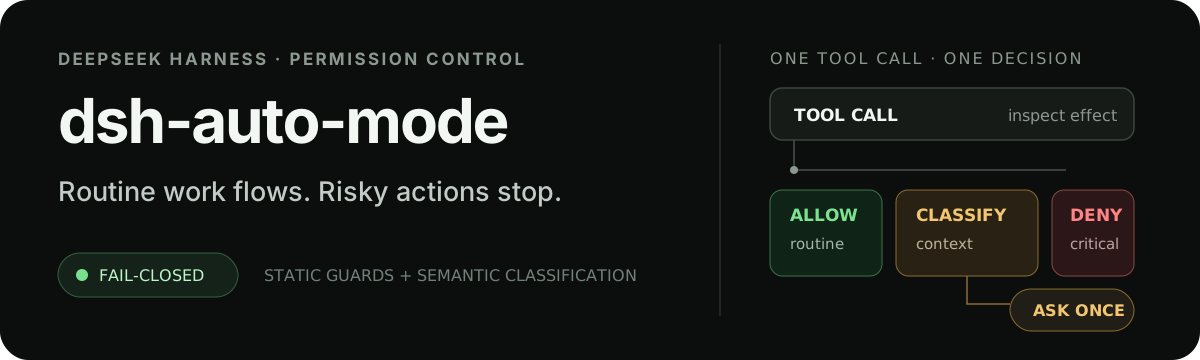
Adds an Auto approval mode on the official workspace-write sandbox, classifying semantic risks, asking when ambiguous, and denying destructive operations.

Undo/rollback system for DSH: config & plugin snapshots, one-click undo/redo/restore, message-level revert, secret masking, safe mode, and offline WebUI/GUI/CLI rescue tools for when DSH won't start.
Packages all 87 SKILL.md files from upstream reverse-skill as a DeepSeek Harness plugin that auto-registers them for authorized reverse engineering, penetration testing, and security research.
Dockyard DSH is a native DeepSeek Harness plugin that unifies official OAuth/client sessions for Codex, Antigravity, Grok, Claude, and Cursor, providing account pool, model catalog, and quota status.