dsh-egress-guard
Run the following command in DeepSeek Harness:
dsh plugin install tancheng33/dsh-egress-guard
Paste the following prompt into your AI chat to install this plugin:
Run dsh plugin install tancheng33/dsh-egress-guard in your DeepSeek Harness terminal to install the plugin; the source code is available at https://github.com/tancheng33/dsh-egress-guard
About this plugin
Most existing security plugins in the DeepSeek Harness ecosystem scan configuration files before an agent starts. The real risk, however, lives in the execution moment itself: a curl to an unfamiliar paste site, a git push to an unexpected remote, an API key in a tool result that the model reads outright. dsh-egress-guard embeds security checks directly into the tool-execution pipeline, denying offending network destinations before they fire and redacting credentials after results return, so every security decision happens in real time with the call.
Three rule pipelines do the heavy lifting: an egress allowlist that intercepts requests to hosts outside your whitelist at the pre-execute stage; secret redaction that rewrites tokens and keys from tool results at the post-execute stage, before the model, the durable session log, or any Code Mode program can read them; and a decision audit log that appends every verdict, including the ones monitor mode would have made, to a JSONL file. The plugin attaches via three listeners on documented extension points and disposes cleanly on unload without forking or patching the main loop.
It ships in monitor mode by default, meaning every rule is evaluated and logged but nothing is blocked or rewritten, guaranteeing installation cannot break a working setup. You can read the audit log for a day, build an allowlist from real traffic, then flip to enforce mode. It is aimed at ops and security teams who need egress control and credential protection for Harness agents, as well as individual developers who want to establish an audit baseline before introducing a full sandbox.
Use Cases
- Block curl or git push calls to unauthorized domains before execution
- Redact API keys and private keys from tool results before the model reads them
- Observe one day of real traffic in monitor mode to build an egress allowlist
Best For
- Ops and security teams managing egress for Harness agents
- Developers building an audit baseline without a full sandbox
- Security engineers preventing credential leakage through tool-call chains
Related Plugins
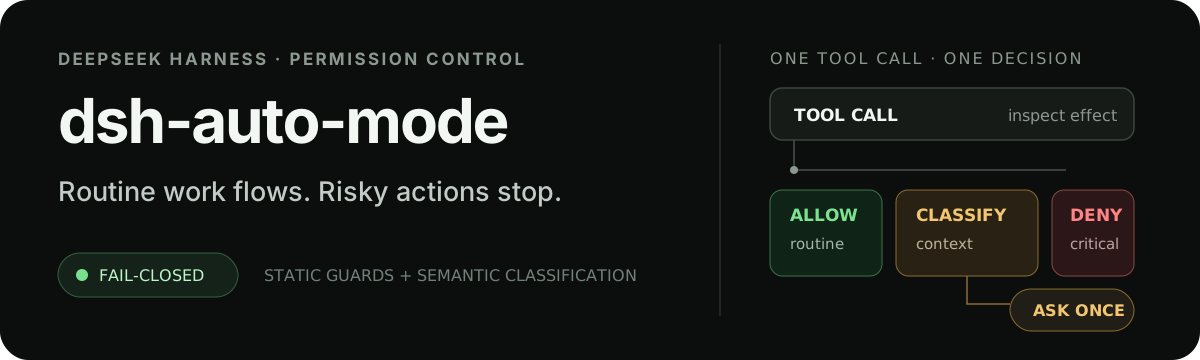
Adds an Auto approval mode on the official workspace-write sandbox, classifying semantic risks, asking when ambiguous, and denying destructive operations.

Undo/rollback system for DSH: config & plugin snapshots, one-click undo/redo/restore, message-level revert, secret masking, safe mode, and offline WebUI/GUI/CLI rescue tools for when DSH won't start.
Packages all 87 SKILL.md files from upstream reverse-skill as a DeepSeek Harness plugin that auto-registers them for authorized reverse engineering, penetration testing, and security research.
Dockyard DSH is a native DeepSeek Harness plugin that unifies official OAuth/client sessions for Codex, Antigravity, Grok, Claude, and Cursor, providing account pool, model catalog, and quota status.