dsh-funnel
Run the following command in DeepSeek Harness:
dsh plugin install YuanyuanMa03/dsh-funnel
Paste the following prompt into your AI chat to install this plugin:
Run dsh plugin install YuanyuanMa03/dsh-funnel inside DeepSeek Harness to install the plugin; the full source is available at https://github.com/YuanyuanMa03/dsh-funnel and it works out of the box with zero configuration.
About this plugin
Every tool result is appended to the conversation and re-sent on every subsequent model request. A 500-line test run, a large file read, a web scrape — all of it rides along for the rest of the session, burning tokens, filling the window, and burying the one assertion error that actually matters. Existing truncation and compaction layers either only cover shell, fire only after the budget is blown, or perform a blind head-tail cut without preserving error lines.
dsh-funnel cures results at the moment they enter context: it keeps the head, the tail, and every error or warning line, then spills the middle to local disk with a path pointer. In a real headless session a 2001-line bash result reached the model as 370 characters — every later turn pays for 370 instead of 8,893. The spill file is not deletion; in testing the agent read the spill file on its own to recover an omitted middle line. Curation is pagination, not loss.
It fits developers running long agent workflows with heavy-output tools (tests, builds, scraping, batch file reads). Zero configuration, byte-identical passthrough under the threshold, error results never touched, and complementary to rather than replacing the official compaction layer.
Use Cases
- Long test or build runs producing hundreds of lines need automatic curation before hitting the model
- Multi-turn agent workflows heavily calling web fetch, bulk file reads, or search tools
- Context window fills quickly as sessions deepen and attention dilutes across irrelevant lines
Best For
- Developers running long agent workflows with frequent large-output tool calls
- Engineers who want lower per-turn token cost and delayed compaction without code changes
- Teams needing session logs that exactly match what the model actually saw for audit and debugging
Related Plugins
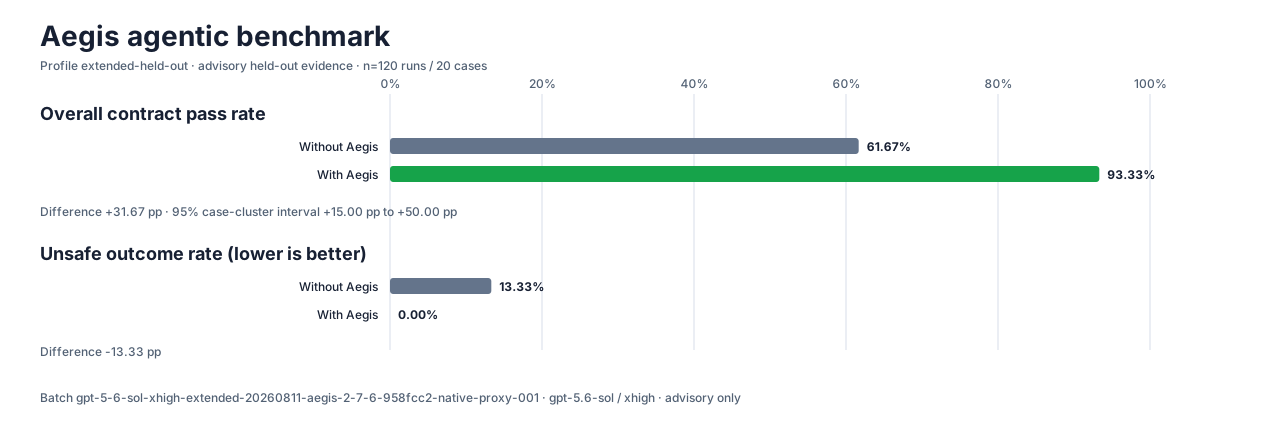
A method pack that makes AI coding agents plan against your real baseline, prove completion with fresh evidence, and reduce reworks and unsafe changes.
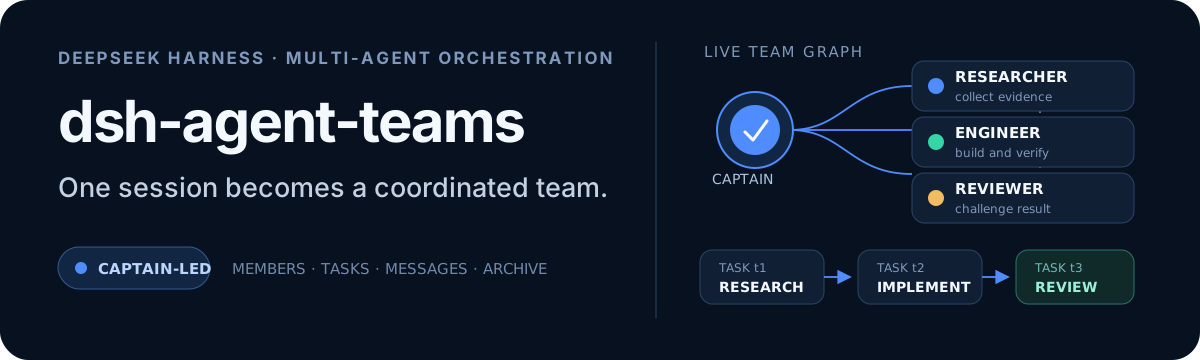
Turns the DeepSeek Harness session into a captain that builds a durable sub-agent team, splits goals into dependency-aware tasks, and coordinates work via direct messages and a live Web UI.
Gives coding agents design judgment, letting Claude Code, Cursor, and 70+ agents generate and iterate high-quality UI, presentations, and graphics right from the terminal.
Run the Pi ecosystem's plugins on DeepSeek Harness, unmodified, via a compatibility layer that implements Pi's public extension ABI on DSH's native services.