deepseek-harness-orchestrate
Run the following command in DeepSeek Harness:
dsh plugin install apheli0os/deepseek-harness-orchestrate
Paste the following prompt into your AI chat to install this plugin:
Run dsh plugin install apheli0os/deepseek-harness-orchestrate in your DeepSeek Harness deployment to add the plugin; the source is available at https://github.com/apheli0os/deepseek-harness-orchestrate and requires ctx.workflowEngine and a subagent provider to already be configured.
About this plugin
When a model faces a complex goal it naturally wants to decompose the work into subtasks with explicit ordering dependencies and then execute them step by step. Until now, DeepSeek Harness lacked a structured entry point that let the model declare an entire task graph in a single call, have it validated, and then executed safely. The orchestrate plugin fills that gap: it exposes an orchestrate_tasks tool so the model can supply a task array, dependency edges, and optional per-task provider, model, and outputSchema descriptions all at once. Before anything starts running the graph is fully validated for acyclicity and bounded size.
Once validation passes the graph is handed off to the existing ctx.workflowEngine and executed in deterministic topological layers. Each completed child returns either plain text or a structured value; a failed child causes its direct downstream tasks to be marked skipped with a deterministic blockedBy list while unaffected branches continue. Final results preserve the original task-array order and carry an aggregate status of completed, partial, or failed. All model-authored identifiers, prompts, dependency IDs, and upstream results travel strictly as JSON data and are never interpolated into JavaScript source, keeping the injection surface closed.
This plugin is well suited for developers building multi-step agent pipelines on DeepSeek Harness who want the model itself to decide the task breakdown and dependency structure rather than hard-coding each step in orchestration code. The host deployment must already provide ctx.workflowEngine and a subagent provider. Credentials are inherited from the existing LLM route and the plugin stores no API keys of its own.
Use Cases
- Model decomposes a complex research goal into dependency-ordered subtasks and submits them in one call
- A single task output needs to feed multiple downstream tasks via explicit DAG edges
- A failed subtask automatically skips its direct dependents while unaffected branches continue
Best For
- Developers building multi-step agent pipelines on DeepSeek Harness
- Teams that prefer model-driven task decomposition over hard-coding every orchestration step
- Deployers who need safe, validated task-graph execution without embedding credentials in source code
Related Plugins
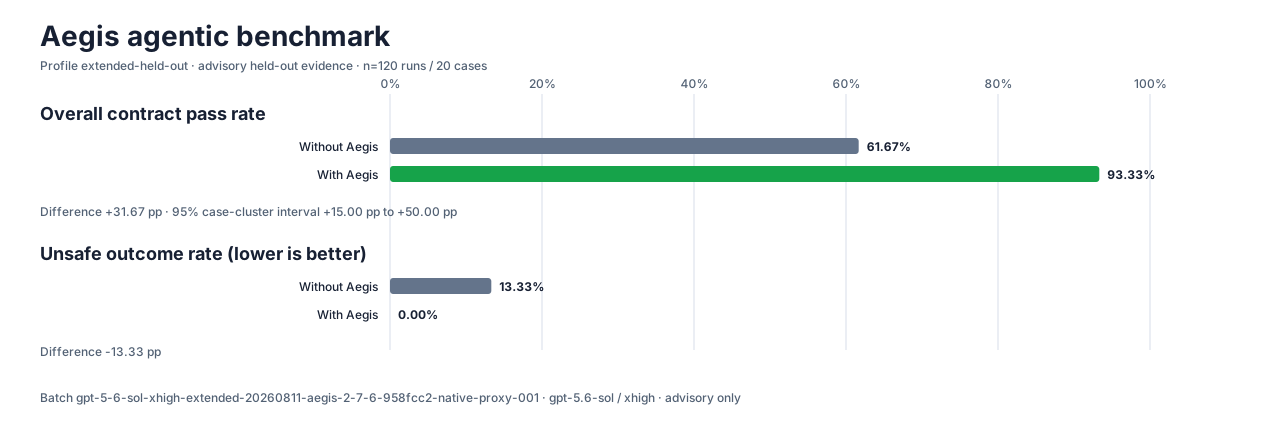
A method pack that makes AI coding agents plan against your real baseline, prove completion with fresh evidence, and reduce reworks and unsafe changes.
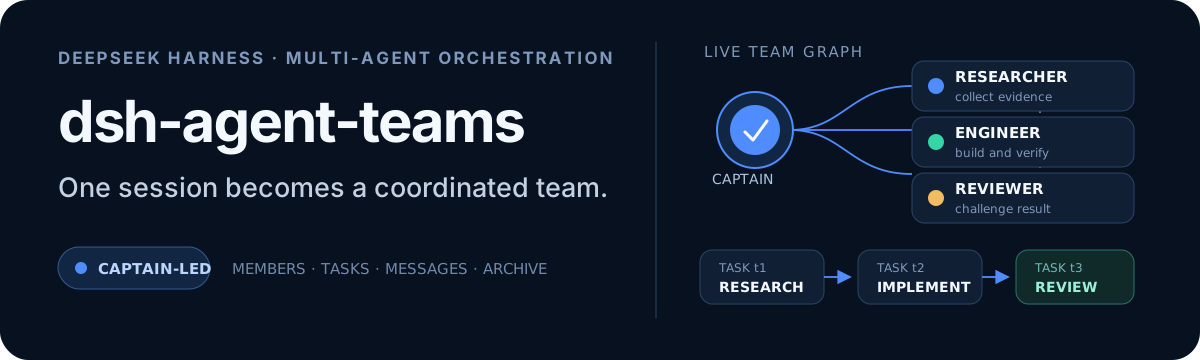
Turns the DeepSeek Harness session into a captain that builds a durable sub-agent team, splits goals into dependency-aware tasks, and coordinates work via direct messages and a live Web UI.
Gives coding agents design judgment, letting Claude Code, Cursor, and 70+ agents generate and iterate high-quality UI, presentations, and graphics right from the terminal.
Run the Pi ecosystem's plugins on DeepSeek Harness, unmodified, via a compatibility layer that implements Pi's public extension ABI on DSH's native services.