dsh-grok-build-auth-bridge
Run the following command in DeepSeek Harness:
dsh plugin install shaomingbo/dsh-grok-build-auth-bridge
Paste the following prompt into your AI chat to install this plugin:
Run dsh plugin install shaomingbo/dsh-grok-build-auth-bridge to install; full source is at https://github.com/shaomingbo/dsh-grok-build-auth-bridge . Make sure the Grok Build CLI is logged in and restart dsh web after installation.
About this plugin
The hardest part of using a Grok Build subscription inside DeepSeek Harness (DSH) is the authentication gap. Grok's refresh token, file locking, and race-safety are all sealed inside the official CLI, while DSH's credential service only understands tokens it manages itself. dsh-grok-build-auth-bridge is a thin Cordis bundle that closes that gap in three moves: read the first-party xAI OAuth session from the local auth.json, delegate the actual token refresh to the official grok binary when the short-lived access token is about to expire, and write only the access token into DSH's credential store. The bridge never reads, writes, or uploads a refresh token, and it never touches ~/.grok/auth.json.
It also auto-registers a grok-build provider route in DSH (grok-4.6, OpenAI Responses protocol, pointing at cli-chat-proxy.grok.com) and attaches the subscription-proxy headers the official client expects: X-XAI-Token-Auth, model override, client mode, and the locally installed Grok version. A background loop checks token validity every ten minutes and again right before each grok-build streaming request, triggering a refresh through the official CLI so Grok's own locked, race-safe rotation is preserved. File-permission checks (chmod 600) and credential isolation mean that even if auth.json were exposed, the leaked access token would expire within minutes.
This plugin is aimed at developers who already route multiple LLM providers through DSH and hold a Grok Build subscription. There is no separate proxy to deploy and no token to copy by hand: once the plugin is installed and the CLI is logged in, Grok models appear alongside your existing providers in DSH's model list, ready for both chat and agentic workloads.
Use Cases
- Route Grok Build subscription models through DSH without copying tokens by hand
- Add Grok 4.6 alongside existing providers in a multi-LLM setup
- Automate token refresh and proxy header injection without deploying a separate proxy
Best For
- Developers with an active Grok Build subscription
- Engineers managing multiple LLM providers in DSH
- AI app developers who want to minimize manual credential maintenance
Related Plugins
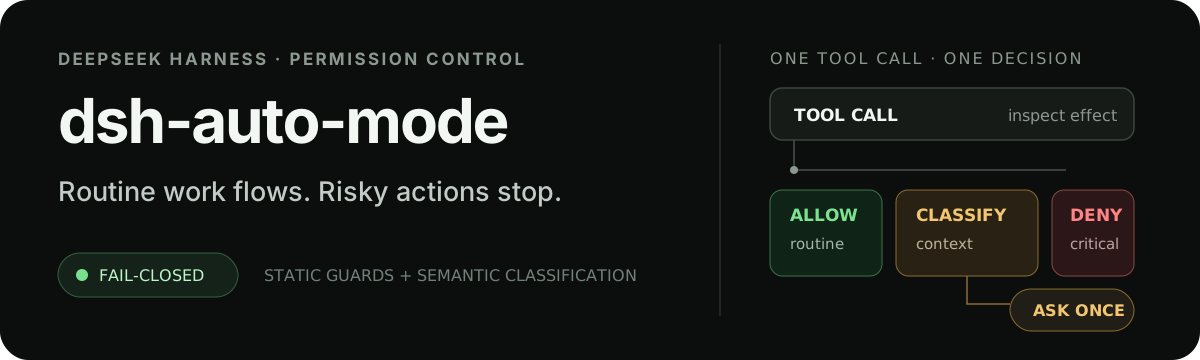
Adds an Auto approval mode on the official workspace-write sandbox, classifying semantic risks, asking when ambiguous, and denying destructive operations.

Undo/rollback system for DSH: config & plugin snapshots, one-click undo/redo/restore, message-level revert, secret masking, safe mode, and offline WebUI/GUI/CLI rescue tools for when DSH won't start.
Packages all 87 SKILL.md files from upstream reverse-skill as a DeepSeek Harness plugin that auto-registers them for authorized reverse engineering, penetration testing, and security research.
Dockyard DSH is a native DeepSeek Harness plugin that unifies official OAuth/client sessions for Codex, Antigravity, Grok, Claude, and Cursor, providing account pool, model catalog, and quota status.