dsh-ocsf-forwarder
Run the following command in DeepSeek Harness:
dsh plugin install CharlotteN7/dsh-ocsf-forwarder
Paste the following prompt into your AI chat to install this plugin:
Install the plugin in DeepSeek Harness by running dsh plugin install CharlotteN7/dsh-ocsf-forwarder; the full source is available at https://github.com/CharlotteN7/dsh-ocsf-forwarder
About this plugin
DeepSeek Harness generates a rich firehose of tool calls, approval decisions, sandbox changes, and team-collaboration events while orchestrating AI agents, yet none of those raw events carry a standardized security format that SOC pipelines expect. dsh-ocsf-forwarder bridges that gap: as a read-side subscriber it normalizes all 51 session event types into OCSF 1.9.0 (ai_operation profile) and maps them to the correct OCSF class—Process Activity for shell and code execution, File System Activity for file tools, HTTP Activity for web tools, Authorize Session for approvals and sandbox changes, and API Activity for everything else.
Key capabilities include correlating tool/call with tool/results to compute approval-decision latency (the approval-fatigue signal), naming the MCP server behind every mcp prefix call, emitting a high-severity record whenever a tool hands work to an external harness and stating the telemetry boundary, and tracking the session log leaving the host. Every spooled record carries an OCSF record_integrity SHA-256 hash chain; editing, reordering, or deleting a record in the middle breaks the chain at that point and the next. The companion dsh-ocsf-verify tool lets you anchor against records already shipped to the SIEM. Durable output goes to a local append-only spool with optional delivery to Splunk HEC or an OTLP/HTTP collector; delivery is cursor-based, so a collector outage costs only disk, and the spool refuses to delete an un-drained generation.
This plugin suits teams that need structured, tamper-evident audit trails of AI agent behavior: SOC analysts can write OCSF-based detection queries; compliance teams get a verifiable, replayable event chain; AI-ops engineers can distinguish a quiet host from a broken one via periodic heartbeats and delivery cursors. The forwarder is strictly read-only—it never writes to the session log, registers no waterfall listener, ships no detection content or secret scanners—keeping its footprint minimal and its blast radius limited to its own spool directory.
Use Cases
- Unify scattered agent tool calls, approval decisions, and sandbox changes into OCSF 1.9.0 records shipped directly to Splunk HEC or an OTLP collector to baseline security detections
- Anchor-verify an existing OCSF event chain to quickly locate gaps or tampered entries in agent session records
- Quantify approval-decision latency to surface fast-approve patterns driven by approval fatigue
Best For
- SOC analysts and detection engineers responsible for AI agent security visibility
- Compliance and audit teams that require a verifiable, replayable event chain
- AI-ops engineers who manage agent fleets and need telemetry integrity signals
Related Plugins
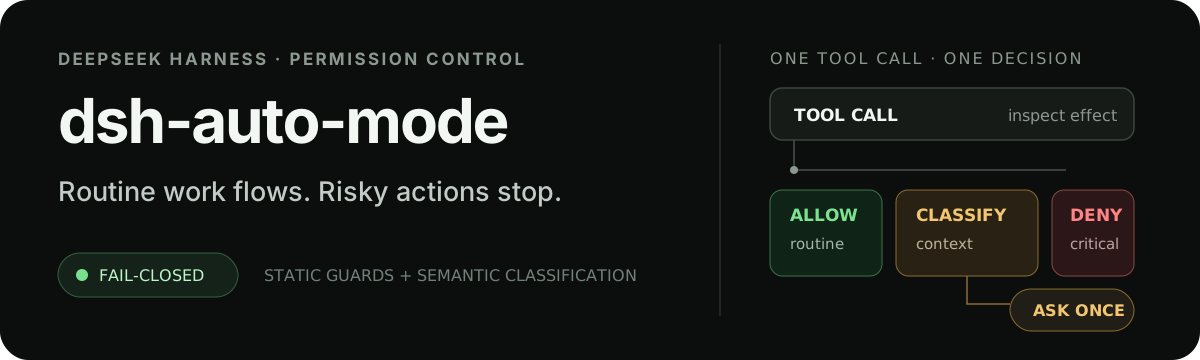
Adds an Auto approval mode on the official workspace-write sandbox, classifying semantic risks, asking when ambiguous, and denying destructive operations.

Undo/rollback system for DSH: config & plugin snapshots, one-click undo/redo/restore, message-level revert, secret masking, safe mode, and offline WebUI/GUI/CLI rescue tools for when DSH won't start.
Packages all 87 SKILL.md files from upstream reverse-skill as a DeepSeek Harness plugin that auto-registers them for authorized reverse engineering, penetration testing, and security research.
Dockyard DSH is a native DeepSeek Harness plugin that unifies official OAuth/client sessions for Codex, Antigravity, Grok, Claude, and Cursor, providing account pool, model catalog, and quota status.