dsh-plugin-auth-guard
Run the following command in DeepSeek Harness:
dsh plugin install lijx122/dsh-plugin-auth-guard
Paste the following prompt into your AI chat to install this plugin:
Run dsh plugin install lijx122/dsh-plugin-auth-guard in the DeepSeek Harness CLI to install the plugin, whose source is hosted at https://github.com/lijx122/dsh-plugin-auth-guard , or search for auth-guard under Settings > Plugins > Marketplace in the DSH Web GUI.
About this plugin
DeepSeek Harness is natively designed for local desktop workflows. The moment a developer tries to expose it across a LAN for mobile access or host it on a cloud server, hard loopback fences trigger 403 blocks, mobile browsers lack the Secure Context that RPCs depend on, and the complete absence of authentication opens the door to remote code execution. dsh-plugin-auth-guard closes every one of those gaps with zero intrusion: it automatically binds the Web GUI to 0.0.0.0, enumerates active LAN interfaces, securely proxies privileged RPCs such as settings.describe and llm.providers for authenticated clients, and dynamically injects crypto.randomUUID and other mobile polyfills into the HTML response so that iOS Safari and Android Chrome work seamlessly over plain HTTP.
On the security front, the plugin intercepts HTTP requests and WebSocket upgrade events at the lowest TCP server level, enforcing a default-deny whitelist across /api/, /api2/, and /sidebar/* routes. Passwords are stored as 32-byte Scrypt hashes with random salts; tokens embed HMAC-SHA256 password fingerprints so that changing the password instantly revokes every token globally and purges all active remote WebSockets within milliseconds. IP sliding-window rate limiting, global burst throttling, a 64 KB request body cutoff, CSRF/CSWSH protection, and physical socket address validation round out a deep-defense posture against spoofing and DoS attacks.
It is built for developers who need to turn DSH from a single-machine desktop tool into a shared or remotely accessible service, and who want a production-grade security gateway, mobile compatibility, and full credential lifecycle management with a single CLI command and no source modifications.
Use Cases
- Exposing DSH over LAN for iOS/Android remote coding sessions
- Hosting DSH on a cloud server for team access without opening arbitrary command execution
- Adding a production-grade shield against spoofing, CSRF, and distributed brute-force attacks
Best For
- Developers upgrading DSH from a single-machine tool to a multi-device or remotely accessible service
- Operators deploying DSH on VPS or container environments and worried about the security boundary
- Users who want a full security gateway with minimal changes and zero DSH source modifications
Related Plugins
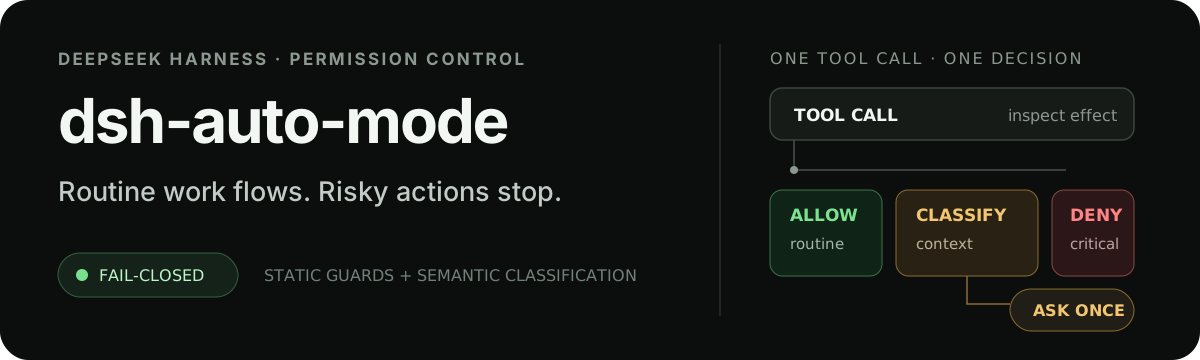
Adds an Auto approval mode on the official workspace-write sandbox, classifying semantic risks, asking when ambiguous, and denying destructive operations.

Undo/rollback system for DSH: config & plugin snapshots, one-click undo/redo/restore, message-level revert, secret masking, safe mode, and offline WebUI/GUI/CLI rescue tools for when DSH won't start.
Packages all 87 SKILL.md files from upstream reverse-skill as a DeepSeek Harness plugin that auto-registers them for authorized reverse engineering, penetration testing, and security research.
Dockyard DSH is a native DeepSeek Harness plugin that unifies official OAuth/client sessions for Codex, Antigravity, Grok, Claude, and Cursor, providing account pool, model catalog, and quota status.