dsh-security-guard
Run the following command in DeepSeek Harness:
dsh plugin install bigclawd/dsh-security-guard
Paste the following prompt into your AI chat to install this plugin:
Run dsh plugin install bigclawd/dsh-security-guard in the DeepSeek Harness terminal to install; the source repository is at https://github.com/bigclawd/dsh-security-guard .
About this plugin
In the dsh plugin ecosystem, third-party code may carry eval calls, postinstall lifecycle scripts, or prompt-injection phrases that can steal credentials or run destructive commands the moment a package is installed. dsh-security-guard adds a lightweight security guard around that lifecycle: it statically scans plugins before and after installation and intercepts dangerous tool calls and file operations at runtime, stopping risk before execution.
Detection is purely static, using only ts.createSourceFile so scanned source is never imported, evaluated, or executed. Rules are plain, auditable JSON files covering four threat classes: malicious code, context injection, token waste, and sensitive-path access. The runtime watcher listens on pre-step, tools/, fs/, and session events to deny destructive shell pipelines, block writes outside workspace roots, and flag suspicious token consumption. An install hook automatically scans every freshly added plugin and records a report, while the web panel, /scan command, and user-managed allowlist close the detect-decide-remit loop.
It suits ops teams managing the dsh plugin ecosystem, platform engineers who need a supply-chain security policy across their organization, and any DeepSeek Harness user who wants to reduce third-party plugin risk without opaque signatures or un-auditable mechanisms.
Use Cases
- Enforcing pre-install security review across a dsh plugin team
- Intercepting dangerous runtime behaviors of malicious plugins in shared environments
- Building an auditable and traceable security baseline for the plugin supply chain
Best For
- Ops and platform engineers managing the dsh plugin ecosystem
- Tech leads enforcing unified supply-chain security policy across an organization
- dsh users who want to reduce the third-party plugin attack surface
Related Plugins
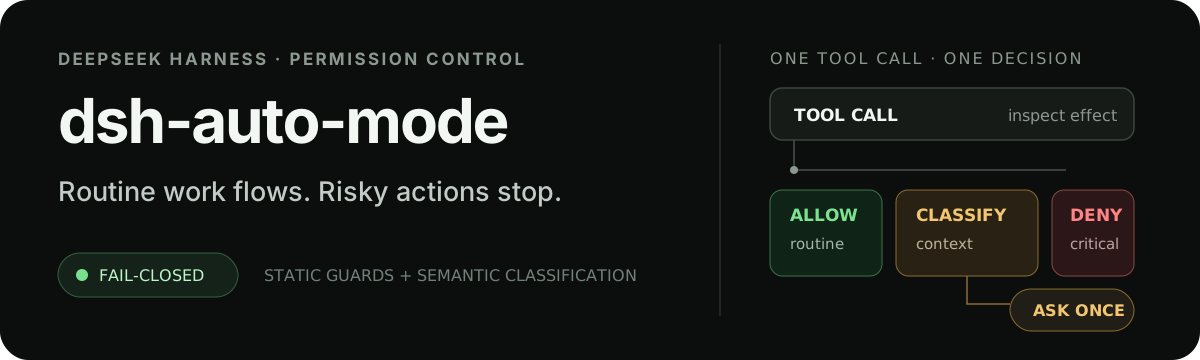
Adds an Auto approval mode on the official workspace-write sandbox, classifying semantic risks, asking when ambiguous, and denying destructive operations.

Undo/rollback system for DSH: config & plugin snapshots, one-click undo/redo/restore, message-level revert, secret masking, safe mode, and offline WebUI/GUI/CLI rescue tools for when DSH won't start.
Packages all 87 SKILL.md files from upstream reverse-skill as a DeepSeek Harness plugin that auto-registers them for authorized reverse engineering, penetration testing, and security research.
Dockyard DSH is a native DeepSeek Harness plugin that unifies official OAuth/client sessions for Codex, Antigravity, Grok, Claude, and Cursor, providing account pool, model catalog, and quota status.