dsh-fetch-third-party
Run the following command in DeepSeek Harness:
dsh plugin install tallahandsome-ux/dsh-fetch-third-party
Paste the following prompt into your AI chat to install this plugin:
Run dsh plugin install tallahandsome-ux/dsh-fetch-third-party in your terminal to install the plugin; source code is at https://github.com/tallahandsome-ux/dsh-fetch-third-party .
About this plugin
When a model's search snippets are not enough to answer a question it needs to fetch the full page. Letting the local machine connect directly to arbitrary URLs, however, exposes an SSRF attack surface that adversarial prompts could exploit to target internal or loopback resources. dsh-fetch-third-party solves this with a courier model: target URLs are proxied exclusively through a user-configured third-party service (Tavily, Jina Reader, Firecrawl, or a custom contract endpoint), so the local runtime never initiates a direct outbound connection to the target, eliminating the SSRF risk by design.
The plugin is autonomous for the model yet fully controllable for the user. When snippets fall short the model invokes web_fetch_url on its own without user prompting. Multiple providers can be chained with ordered failover, exponential-backoff cooldown, and automatic recovery. API keys live only in a 0600 managed vault and are never echoed to the GUI, logs, or responses. Per-session budget caps, in-memory URL caching that skips both quota and budget, deep SSRF defense that rejects internal and reserved addresses before forwarding, structured output including title, headings, links, word count, and reading time, an optional local proxy, and automatic Crawl4AI container management with a live watchdog all round out the feature set.
It suits DeepSeek Harness users who want their model to read full articles rather than snippets, developers who refuse to lock fetching into a single SaaS, and self-hosters who prefer a zero-API-key stack. As long as you can point the plugin at any compatible fetch endpoint it becomes a ready-made deep-reading tool the model can reach for whenever it needs more context.
Use Cases
- Model search snippets are insufficient, so it autonomously calls web_fetch_url to retrieve the full page
- Corporate or campus networks block direct outbound connections, so fetches route through a user-configured third-party proxy
- Self-hosted Crawl4AI container with watchdog self-healing delivers deep fetches with zero API keys
Best For
- DeepSeek Harness users who want their model to read full articles instead of snippets
- Developers who refuse to lock web fetching into a single SaaS provider
- Operators who prefer self-hosted, zero-API-key stacks with session budget and cache controls
Related Plugins
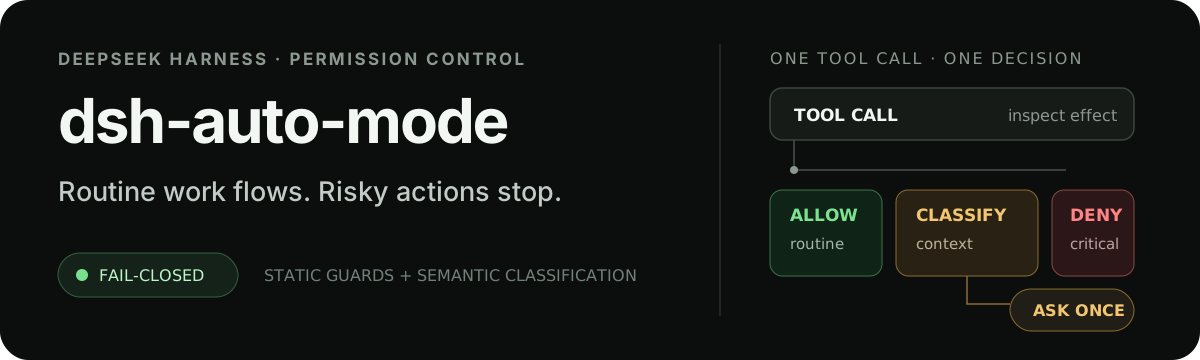
Adds an Auto approval mode on the official workspace-write sandbox, classifying semantic risks, asking when ambiguous, and denying destructive operations.

Undo/rollback system for DSH: config & plugin snapshots, one-click undo/redo/restore, message-level revert, secret masking, safe mode, and offline WebUI/GUI/CLI rescue tools for when DSH won't start.
Packages all 87 SKILL.md files from upstream reverse-skill as a DeepSeek Harness plugin that auto-registers them for authorized reverse engineering, penetration testing, and security research.
Dockyard DSH is a native DeepSeek Harness plugin that unifies official OAuth/client sessions for Codex, Antigravity, Grok, Claude, and Cursor, providing account pool, model catalog, and quota status.