dsh-api-contract
Run the following command in DeepSeek Harness:
dsh plugin install uckkk/dsh-api-contract
Paste the following prompt into your AI chat to install this plugin:
Run dsh plugin install uckkk/dsh-api-contract in the DeepSeek Harness terminal to install this plugin; the open-source repository is available at https://github.com/uckkk/dsh-api-contract .
About this plugin
OpenAPI specs are the one document every team touches and the one most likely to quietly rot: a path gets renamed, a parameter flips from optional to required, a response field vanishes, and downstream clients keep calling the old contract until something 500s at 2 a.m. dsh-api-contract turns that pain into a single local command: it parses your OpenAPI 3.x specification (JSON or YAML) and generates fully typed clients in TypeScript (fetch-based) or Python (requests-based), eliminating the repetitive work of hand-writing interfaces and keeping type hints in sync automatically.
It also ships a diff_spec tool that compares two spec versions side by side and classifies every change into breaking (removed paths or methods, dropped required parameters, parameter type changes, removed 2xx responses, restructured response bodies) versus non-breaking, so you can catch downstream-impacting regressions in a single code-review pass. The entire pipeline runs on Node with no network calls and no external services, keeping your specification files entirely local.
If your team maintains API clients in multiple languages, or you are standardising OpenAPI as the single source of truth driving your development workflow, dsh-api-contract shortens the distance from spec to runnable code and adds a low-cost regression check before every release. It is especially useful for small teams who want typed clients without adding heavyweight code-generation tooling to their build.
Use Cases
- Diff two OpenAPI spec versions before release to catch breaking changes
- Generate a typed TypeScript fetch client directly from an OpenAPI spec
- Produce a Python requests client from an OpenAPI spec without hand-writing types
Best For
- Backend or full-stack teams maintaining API clients in multiple languages
- Platform engineering teams driving development from a single OpenAPI source of truth
- Solo developers who want to catch API contract regressions during code review
Related Plugins
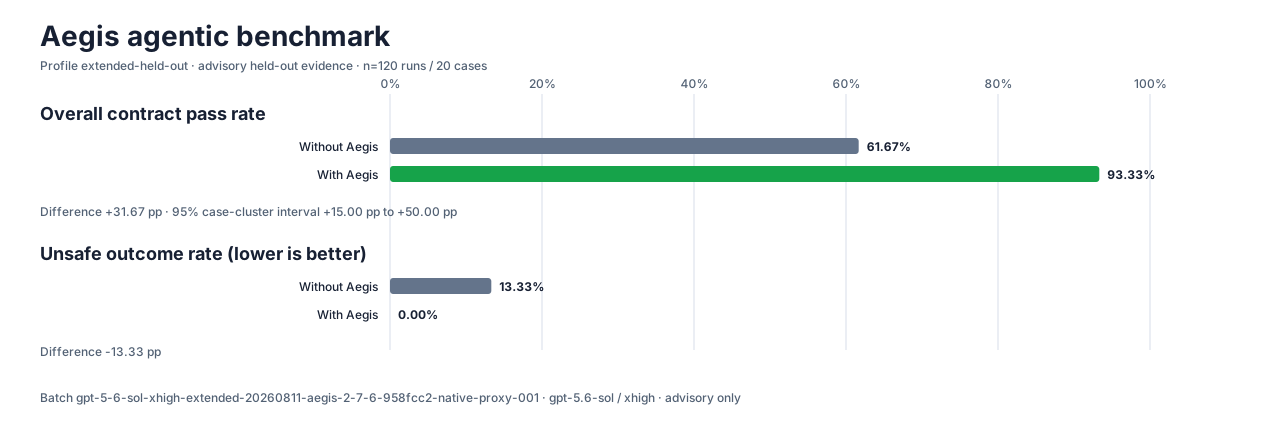
A method pack that makes AI coding agents plan against your real baseline, prove completion with fresh evidence, and reduce reworks and unsafe changes.
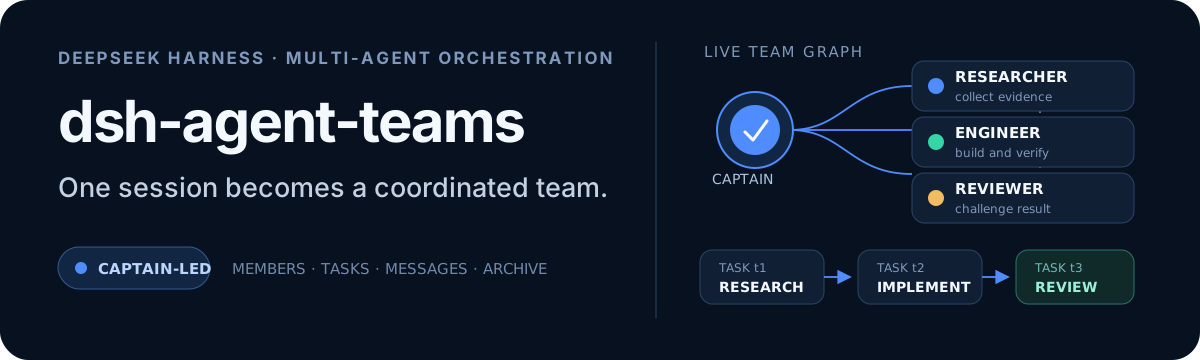
Turns the DeepSeek Harness session into a captain that builds a durable sub-agent team, splits goals into dependency-aware tasks, and coordinates work via direct messages and a live Web UI.
Gives coding agents design judgment, letting Claude Code, Cursor, and 70+ agents generate and iterate high-quality UI, presentations, and graphics right from the terminal.
Run the Pi ecosystem's plugins on DeepSeek Harness, unmodified, via a compatibility layer that implements Pi's public extension ABI on DSH's native services.