gewu-tools
Run the following command in DeepSeek Harness:
dsh plugin install nyantused-cpun/gewu-tools
Paste the following prompt into your AI chat to install this plugin:
Run the install command above in DeepSeek Harness to mount gewu-tools (source: https://github.com/nyantused-cpun/gewu-tools) into your workspace; restart the DSH session after installation to activate it.
About this plugin
DSH's session brain is usually a text-only model. It cannot read a rendered page, so questions like "does this proposal layout hold together, are the diagram connections correct, is the cross-page density consistent" simply go unanswered. Calling a vision subagent directly does not solve the problem either: the subagent lacks session context and mistakes a business badge such as ⭐ for a decorative emoji, while OCR-level misreads combined with screenshot-boundary page drift can corrupt critical numbers. gewu-tools hardens a three-step pipeline, converged on a 24-page pre-sales deck, into two plug-in tools that close the "can see but cannot trust" gap.
The pipeline runs in three stages: screenshot, briefing contract, and ground-truth verification. gewu_prep pages through the HTML with headless Chrome and, in parallel, assembles a context-rich briefing covering client background, a focus checklist, an artifact disclaimer, and output discipline, so the vision subagent knows that ⭐ means "core capability," not a decorative glyph. This systematically eliminates context-blind false positives. gewu_locate then takes every key figure or claim the subagent reports and locates it line by line in the source, returning the enclosing section, page number, and a tag-stripped excerpt. Claims that fail verification are excluded before they reach the user. Together the three steps drive false positives down, keep critical numbers error-free, and make narrative flow, density, and cross-page consistency auditable.
A custom preset lets you inject your own design conventions and acceptance criteria into the briefing, so the subagent reviews against your yardstick; invalid presets degrade gracefully to the community baseline with a clear error message. index.js also runs standalone outside DSH, letting Trae, Codex, Kimi, or any other host obtain the same screenshot, briefing, and verification artefacts via CLI. Whether you plug in a steady-tier or an insight-tier vision model, the verification step guarantees that the output is trustworthy and auditable—this is precisely why gewu-tools locks verification in as the third step.
Ideal for any DSH workflow that demands "look carefully before concluding": pre-sales layout acceptance, multi-page documentation density and consistency review, and any quality gate that pairs visual inspection with source-level proof.
Use Cases
- Multi-page pre-sales deck layout acceptance and diagram wiring checks
- Documentation density, narrative flow, and cross-page consistency review
- Quality gates that pair vision subagent output with line-level source verification
Best For
- DSH users whose session brain is a text-only model needing rendered-page review
- Pre-sales and proposal engineers responsible for multi-page deck quality
- Developers who need to inject custom design conventions and acceptance criteria
Related Plugins
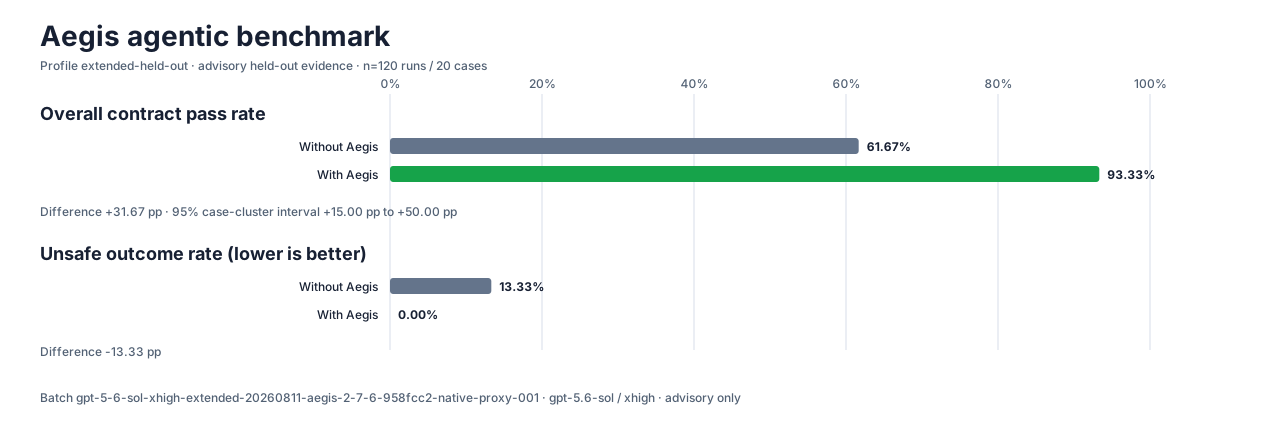
A method pack that makes AI coding agents plan against your real baseline, prove completion with fresh evidence, and reduce reworks and unsafe changes.
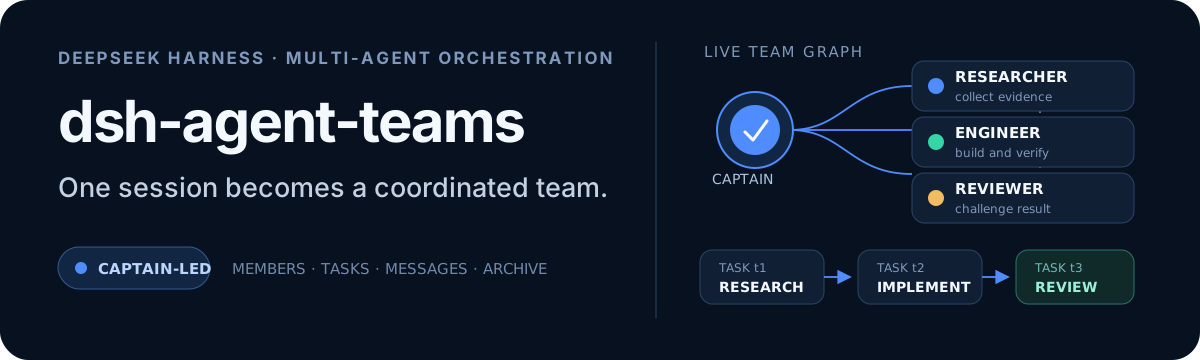
Turns the DeepSeek Harness session into a captain that builds a durable sub-agent team, splits goals into dependency-aware tasks, and coordinates work via direct messages and a live Web UI.
Gives coding agents design judgment, letting Claude Code, Cursor, and 70+ agents generate and iterate high-quality UI, presentations, and graphics right from the terminal.
Run the Pi ecosystem's plugins on DeepSeek Harness, unmodified, via a compatibility layer that implements Pi's public extension ABI on DSH's native services.