dsh-shield
Run the following command in DeepSeek Harness:
dsh plugin install 245678000000/dsh-shield
Paste the following prompt into your AI chat to install this plugin:
Install dsh-shield in DeepSeek Harness from https://github.com/245678000000/dsh-shield by running dsh plugin install 245678000000/dsh-shield.
About this plugin
In DeepSeek Harness, plugins, MCP servers, and built-in tools all execute under the host Node process permissions. A single plugin install can trigger prepare or preinstall scripts that run on your machine before any plugin code is even loaded; at runtime, the model can invoke MCP endpoints to exfiltrate local files, credentials, or client data. dsh-shield sits at exactly these boundaries, covering the critical gaps between install time and execution time with two coordinated layers.
The pre-install scanner downloads, unpacks, parses, and inspects packages without ever executing target code. The runtime guard hooks into the official tools/pre-execute and ctx.tools.guard(), returning allow, ask, or deny for every tool call. Core capabilities span risk discovery, four-tier policy enforcement, MCP trust tiering, credential-exfiltration denial, six-level data classification with automatic redaction, prompt-injection detection with escalating responses, and full audit logging. Risk scores are computed by deterministic formulas; the LLM can never decide ALLOW or DENY, and a broken configuration fails closed rather than silently letting requests through.
Best suited for teams running Harness in production, security and ops engineers who need auditable boundaries around third-party plugins and MCP servers, and developers who want deterministic policy to replace manual line-by-line review. dsh-shield does not claim perfect security or a 100-percent guarantee against prompt injection, but it turns risk discovery, decision traceability, and human approval into a process you can audit rather than a hope you can only wish on.
Use Cases
- Static risk scanning before installing third-party Harness plugins
- Intercepting model-driven MCP calls that exfiltrate credentials or sensitive data
- Establishing auditable tool-call policies and approval workflows in production
Best For
- Engineering teams deploying DeepSeek Harness in production
- Ops and security engineers needing auditable boundaries for MCP and plugins
- Developers who prefer deterministic policy over manual line-by-line review
Related Plugins
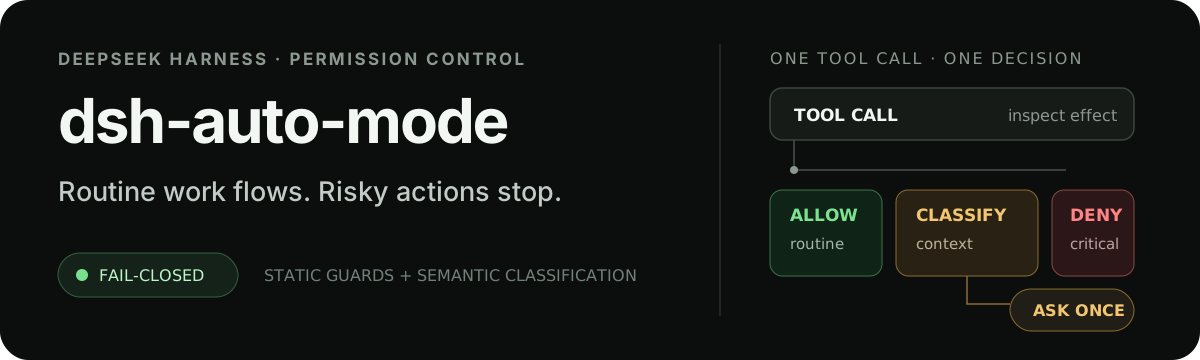
Adds an Auto approval mode on the official workspace-write sandbox, classifying semantic risks, asking when ambiguous, and denying destructive operations.

Undo/rollback system for DSH: config & plugin snapshots, one-click undo/redo/restore, message-level revert, secret masking, safe mode, and offline WebUI/GUI/CLI rescue tools for when DSH won't start.
Packages all 87 SKILL.md files from upstream reverse-skill as a DeepSeek Harness plugin that auto-registers them for authorized reverse engineering, penetration testing, and security research.
Dockyard DSH is a native DeepSeek Harness plugin that unifies official OAuth/client sessions for Codex, Antigravity, Grok, Claude, and Cursor, providing account pool, model catalog, and quota status.