dsh-rgate
Run the following command in DeepSeek Harness:
dsh plugin install raomaiping-hash/dsh-rgate
Paste the following prompt into your AI chat to install this plugin:
Run dsh plugin install raomaiping-hash/dsh-rgate in your DeepSeek Harness to install this plugin, source code: https://github.com/raomaiping-hash/dsh-rgate
About this plugin
The Harness ships a trustedHosts fence that defends against DNS-rebinding, but it is explicitly not an authentication mechanism. The moment you expose the Web UI on a LAN, a Tailscale network, or a public domain, every request whose Host header clears that fence gets full access to your agent. dsh-rgate fills that gap by putting a single-password gate in front of the entire browser surface.
On every page load the plugin injects a gate script that redirects anonymous non-loopback visitors to a self-contained login page. Behind the scenes it shadows all 52 unary RPC routes as well as the respond and session.export endpoints, so any /api call without a valid session cookie receives a 401 before the request body is even parsed. Passwords are stored as scrypt hashes (N=16384, r=8, p=1) with a random salt and constant-time comparison in a 0600 file; login is throttled with exponential backoff after five failures; audit events for success, failure, lockout, and password changes are appended to the harness log; and a Remote Access section in Settings lets you check status, log out, or change the password. Loopback addresses always pass through, so local development and the admin workflow stay friction-free.
The plugin is designed for self-hosted solo developers and small teams who run the Harness on a VPS, a home server, or behind a Cloudflare Tunnel and want a simple, auditable authentication layer without pulling in OIDC or a full IAM stack. One password, one gate, MIT-licensed, no build step, no install script. Local users never see the wall at all.
Use Cases
- Exposing the Harness Web UI on a LAN or public domain and needing a password wall against anonymous visitors and IP scanners.
- Accessing Harness remotely via Tailscale or Cloudflare Tunnel without standing up a full OIDC or IAM stack.
- Keeping local development friction-free while requiring authentication for every non-loopback /api call.
Best For
- Self-hosted Harness maintainers and solo developers who run the Web UI beyond localhost.
- Small teams of two to five who need remote access and want a single-password gate without enterprise tooling.
- Users who value scrypt-hashed storage, audit logging, and login throttling as a lightweight security baseline.
Related Plugins
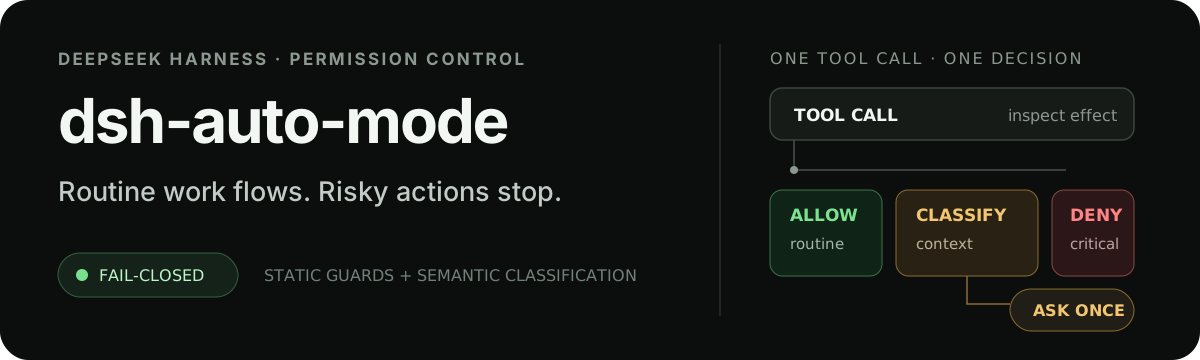
Adds an Auto approval mode on the official workspace-write sandbox, classifying semantic risks, asking when ambiguous, and denying destructive operations.

Undo/rollback system for DSH: config & plugin snapshots, one-click undo/redo/restore, message-level revert, secret masking, safe mode, and offline WebUI/GUI/CLI rescue tools for when DSH won't start.
Packages all 87 SKILL.md files from upstream reverse-skill as a DeepSeek Harness plugin that auto-registers them for authorized reverse engineering, penetration testing, and security research.
Dockyard DSH is a native DeepSeek Harness plugin that unifies official OAuth/client sessions for Codex, Antigravity, Grok, Claude, and Cursor, providing account pool, model catalog, and quota status.