dsh-single-instance-guard
Run the following command in DeepSeek Harness:
dsh plugin install Tang-mm95/dsh-single-instance-guard
Paste the following prompt into your AI chat to install this plugin:
Run dsh plugin install Tang-mm95/dsh-single-instance-guard to add this plugin to your DeepSeek Harness profile; the full source is available at https://github.com/Tang-mm95/dsh-single-instance-guard .
About this plugin
The DSH JSONL session-persistence backend mandates a single live writer per session, yet the framework ships no cross-process guard. When a desktop wrapper spins up its own dsh server while a separate dsh web process is also running, and both resolve to the same DSH_HOME, they end up appending batches with stale sequence cursors. The session logs corrupt silently—no error, no warning—until you scroll through history and notice the timeline is incoherent.
dsh-single-instance-guard converts that silent corruption into an immediate, loud startup failure. At boot the plugin atomically creates .dsh-server.lock via O_EXCL, recording the pid, start timestamp, and hostname. If a lock already exists it probes the pid of the holder: a live holder triggers an abort with a clear bilingual error message; a stale lock (dead pid or unparsable file) is safely removed and acquisition is retried once, so the normal single-instance path is completely unaffected. On clean exit the lock file is deleted only after confirming this process still owns it, preventing accidental removal of the lock belonging to another instance.
The plugin targets setups where multiple dsh instances can share one data root—desktop apps embedding a web view, CI jobs that launch two servers in parallel, or a developer workstation with overlapping instance tags. It ships as a zero-runtime-dependency patch-layer profile bundle, requires no changes to the session backend, and enforces the single-writer guarantee as a hard runtime invariant.
Use Cases
- Desktop wrapper embeds a dsh server while an external web instance writes to the same DSH_HOME
- CI pipelines spin up multiple dsh processes in parallel, risking silent session-log corruption under a shared data root
- A developer runs two dsh service windows locally; the guard catches the conflict at boot instead of after the timeline is already mangled
Best For
- App developers embedding dsh servers in desktop or web wrappers
- Ops engineers orchestrating dsh services in CI/CD pipelines
- Platform engineers accountable for DSH session-log integrity
Related Plugins
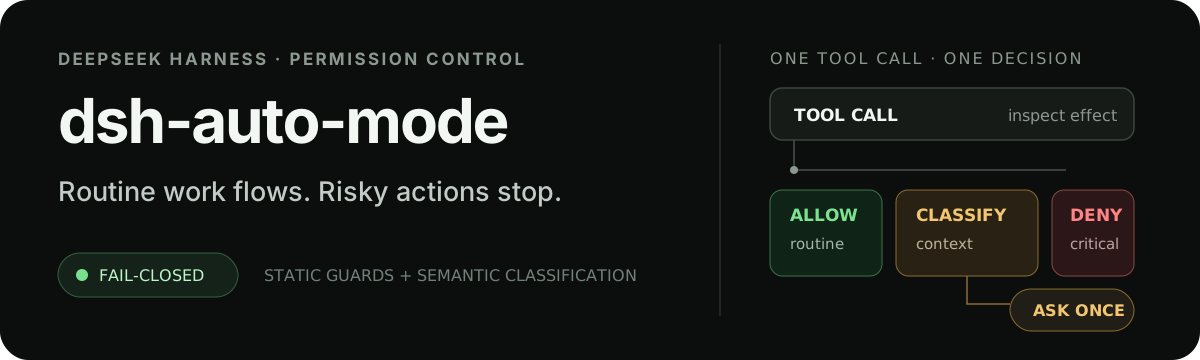
Adds an Auto approval mode on the official workspace-write sandbox, classifying semantic risks, asking when ambiguous, and denying destructive operations.

Undo/rollback system for DSH: config & plugin snapshots, one-click undo/redo/restore, message-level revert, secret masking, safe mode, and offline WebUI/GUI/CLI rescue tools for when DSH won't start.
Packages all 87 SKILL.md files from upstream reverse-skill as a DeepSeek Harness plugin that auto-registers them for authorized reverse engineering, penetration testing, and security research.
Dockyard DSH is a native DeepSeek Harness plugin that unifies official OAuth/client sessions for Codex, Antigravity, Grok, Claude, and Cursor, providing account pool, model catalog, and quota status.