dsh-login
Run the following command in DeepSeek Harness:
dsh plugin install ravenli059/dsh-login
Paste the following prompt into your AI chat to install this plugin:
Install this plugin in DeepSeek Harness (source: https://github.com/ravenli059/dsh-login) by running dsh plugin install ravenli059/dsh-login to attach it to the web profile.
About this plugin
Exposing a dsh-web port directly on a server or LAN leaves the admin interface wide open to anyone who can reach it. dsh-login wraps the webserver with a full session gate: SPA fallbacks, /api transfers, WebSocket and SSE upgrades all pass through cookie-verified sessions before reaching the original handler, and not a single line of dsh source code is modified. It mounts purely as a Cordis bundle, so deployment is as simple as one dsh plugin install command.
Storage is where it earns its trust. Passwords are scrypt-hashed with a random salt (N=2^14, r=8, p=1) using constant-time comparison, and the entire credential file is encrypted with AES-256-GCM before it touches disk. Failed logins hit a sliding-window rate limit plus a deliberate delay, and a dummy hash is burned when the username does not exist to frustrate user enumeration. Sessions live only in memory and vanish on restart; cookies are flagged HttpOnly with SameSite=Strict to block cross-site request forgery. The primary key can be supplied via the DSH_LOGIN_SECRET environment variable, auto-generated into a 0600 key file, or (with a loud warning) fall back to a plaintext store that still benefits from scrypt hashing.
It leaves room for small teams as well. Multiple users log in independently; the web UI and the standalone CLI share the same encrypted store with mtime-based hot-reload, so an account change made from either side is picked up by the other within seconds. Enabling userWorkspaces gives each logged-in user an isolated workspace and session history visible only in their own sidebar. If you are putting dsh-web behind nginx for remote or shared team access, dsh-login is the lowest-friction lock you can add in front of it.
Use Cases
- Exposing a dsh-web port to a LAN for team remote access
- Deploying dsh-web on a server and blocking unauthorized port access
- Sharing one dsh-web instance among multiple users with isolated workspaces and sessions
Best For
- Developers deploying dsh-web on a remote server
- Small teams that need authentication in front of dsh-web
- Sysadmins exposing dsh-web via an nginx reverse proxy
Related Plugins
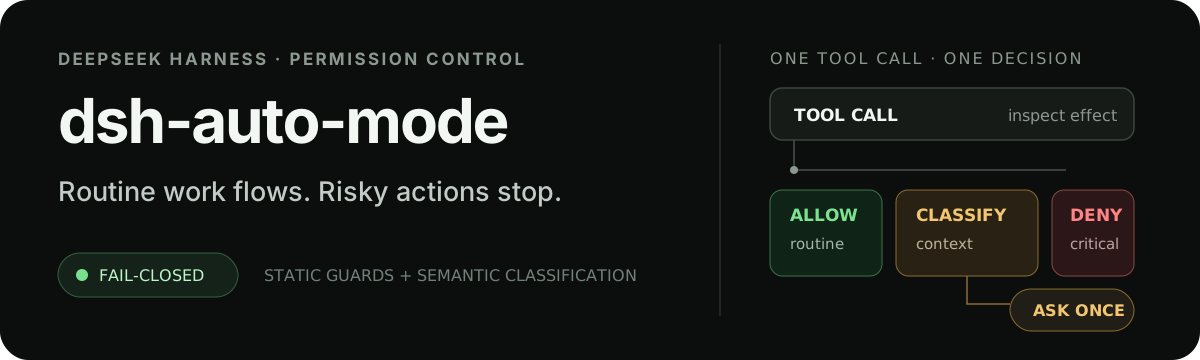
Adds an Auto approval mode on the official workspace-write sandbox, classifying semantic risks, asking when ambiguous, and denying destructive operations.

Undo/rollback system for DSH: config & plugin snapshots, one-click undo/redo/restore, message-level revert, secret masking, safe mode, and offline WebUI/GUI/CLI rescue tools for when DSH won't start.
Packages all 87 SKILL.md files from upstream reverse-skill as a DeepSeek Harness plugin that auto-registers them for authorized reverse engineering, penetration testing, and security research.
Dockyard DSH is a native DeepSeek Harness plugin that unifies official OAuth/client sessions for Codex, Antigravity, Grok, Claude, and Cursor, providing account pool, model catalog, and quota status.