dsh-auth-plugin
Run the following command in DeepSeek Harness:
dsh plugin install v1xingyue/dsh-auth-plugin
Paste the following prompt into your AI chat to install this plugin:
Install this plugin by running dsh plugin install v1xingyue/dsh-auth-plugin. The source repository is at https://github.com/v1xingyue/dsh-auth-plugin
About this plugin
DeepSeek Harness ships with a Web GUI that has no built-in authentication. Once the instance is exposed beyond a single workstation, anyone on the network can invoke the model API. The dsh-auth-plugin plugs this gap: it is a single-file Cordis plugin that wraps the web server as a unified gatekeeper, redirecting unauthenticated visitors to a login page while leaving the existing SPA and API behavior completely untouched once a valid session is established.
Login options span several practical scenarios. Username and password verification uses scrypt hashing with zero external dependencies. Solana developers can sign in through Phantom or Solflare via an ed25519 challenge-response flow guarded by a mandatory public-key allowlist. EVM users can follow the same pattern through MetaMask with EIP-191 personal_sign, provided the optional pure-JS @noble libraries are installed. For teams that prefer third-party identity, the plugin implements a generic OAuth 2.0 authorization-code flow with built-in templates for GitHub, Google, Discord, GitLab, Microsoft, and Bitbucket, or fully explicit endpoint configuration for any standard OAuth provider. All sessions are carried in a self-contained HMAC-SHA256 token over an HttpOnly, SameSite-Strict cookie; logout revokes the token server-side and a one-time nonce or state is consumed and discarded to block replay and CSRF.
At runtime the plugin relies only on Node's built-in crypto module and the global fetch API, so there is no package-manager step and no dependency tree to maintain. Drop the file into the profile directory, add a few lines of configuration, restart, and the login gate is live. It is a good fit for small teams upgrading Harness from a local single-user tool to a shared service, for Solana or EVM developers who prefer on-chain identity as their credential, and for organizations that want to funnel access control through an existing GitHub or Google account.
Use Cases
- Expose DeepSeek Harness on a team network and restrict who can access the Web GUI
- Solana developers signing in to the Web GUI with a Phantom wallet instead of managing passwords
- Organizations funneling member access control through existing GitHub or Google accounts
Best For
- Small teams upgrading a local Harness instance to a shared team service
- Solana or EVM developers who prefer on-chain identity as their login credential
- Tech leads who want centralized OAuth-based access control across the organization
Related Plugins
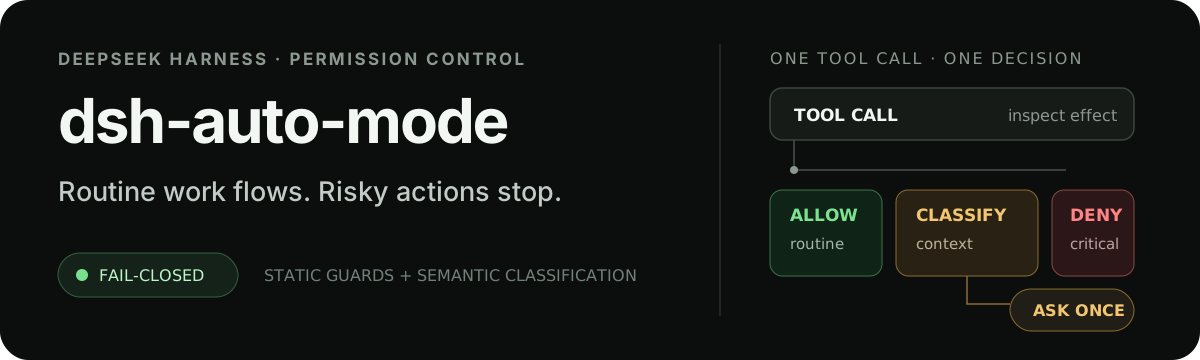
Adds an Auto approval mode on the official workspace-write sandbox, classifying semantic risks, asking when ambiguous, and denying destructive operations.

Undo/rollback system for DSH: config & plugin snapshots, one-click undo/redo/restore, message-level revert, secret masking, safe mode, and offline WebUI/GUI/CLI rescue tools for when DSH won't start.
Packages all 87 SKILL.md files from upstream reverse-skill as a DeepSeek Harness plugin that auto-registers them for authorized reverse engineering, penetration testing, and security research.
Dockyard DSH is a native DeepSeek Harness plugin that unifies official OAuth/client sessions for Codex, Antigravity, Grok, Claude, and Cursor, providing account pool, model catalog, and quota status.