dsh-agent-policy
Run the following command in DeepSeek Harness:
dsh plugin install xingyingyuzhui/dsh-agent-policy
Paste the following prompt into your AI chat to install this plugin:
Run dsh plugin install xingyingyuzhui/dsh-agent-policy in your terminal to install this plugin; the full source is at https://github.com/xingyingyuzhui/dsh-agent-policy
About this plugin
When agent-registry, session-permissions, and agent-gate all live in the same DSH workspace, each plugin tends to interpret policy fields slightly differently. Over time those dialects pile up and debugging a permission question turns into a cross-plugin scavenger hunt. dsh-agent-policy extracts the shared contract for governance Phase 1-2 into a single installable plugin: one policy schema, one set of preset base classes, one MCP initialization default, and one policy version identifier. Every other plugin reads from the same definition instead of maintaining its own copy.
Three capabilities stand out. First, the schema contract gives every plugin an identical vocabulary for field names, allowed values, and versioning rules, removing ambiguity at the source. Second, the MCP init policy offers three presets - none, explicit, and init-defaults - so a freshly created Claw Agent starts with a well-defined MCP surface; servers.allow and servers.deny let you pin the exact service names that are visible at boot. Third, the preset templates (research, developer, etc.) provide reusable starting configurations that land in ~/.dsh/agent-policy/defaults.json and apply to every subsequent Agent creation of that role.
What this plugin explicitly does not do is intercept tool calls. All real rejection and hiding logic lives in dsh-agent-gate. Removing dsh-agent-policy will not loosen any permission; the system simply falls back to DSH's original permission-presets. It is designed for DSH administrators building multi-Agent workspaces who need a consistent policy vocabulary across plugins and role-based MCP surfaces out of the box.
Use Cases
- Multiple governance plugins coexist in one DSH workspace and need a shared policy vocabulary
- Pre-define MCP service visibility for new Agent roles instead of configuring manually each time
- Keep policy schema consistent across registry, permissions, and gate plugins
- Quickly pinpoint contract mismatches instead of diffing each plugin one by one
Best For
- DSH administrators building multi-Agent workspaces
- Platform teams that need a consistent policy vocabulary across plugins
- Developers writing new plugins on top of the DSH governance suite
Related Plugins
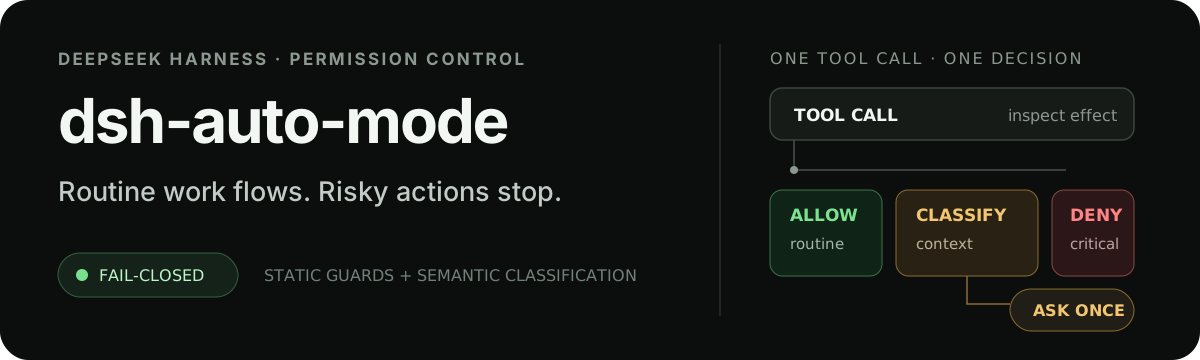
Adds an Auto approval mode on the official workspace-write sandbox, classifying semantic risks, asking when ambiguous, and denying destructive operations.

Undo/rollback system for DSH: config & plugin snapshots, one-click undo/redo/restore, message-level revert, secret masking, safe mode, and offline WebUI/GUI/CLI rescue tools for when DSH won't start.
Packages all 87 SKILL.md files from upstream reverse-skill as a DeepSeek Harness plugin that auto-registers them for authorized reverse engineering, penetration testing, and security research.
Dockyard DSH is a native DeepSeek Harness plugin that unifies official OAuth/client sessions for Codex, Antigravity, Grok, Claude, and Cursor, providing account pool, model catalog, and quota status.