dsh-key-rotation
Run the following command in DeepSeek Harness:
dsh plugin install GooDAnDReaDY/dsh-key-rotation
Paste the following prompt into your AI chat to install this plugin:
Run dsh plugin install GooDAnDReaDY/dsh-key-rotation in the DeepSeek Harness terminal to install the plugin; the full source is hosted at https://github.com/GooDAnDReaDY/dsh-key-rotation . After installation, restart the service and refresh your browser tab to activate it.
About this plugin
High-throughput autonomous agent workflows, parallel subagent swarms, and multi-turn tool loops inevitably collide with upstream rate limits (HTTP 429, RPM/TPM exhaustion), daily quotas, or sudden provider outages. In a standard DeepSeek Harness deployment a single exhausted API key tears the entire execution chain apart, destroys the session replay state, and forces manual intervention.
dsh-key-rotation is built natively on the Cordis microkernel and hooks transparently into credential resolution and the streaming request layer. Without ever altering the provider identity it delivers key-pool rotation, pre-emptive token-bucket throttling (saturated keys are skipped before any network call is issued), least-connections concurrency balancing, and cross-provider failover cascades. When the entire primary provider pool enters cooldown, requests escalate automatically to a fallback provider; before a quarantined key is restored, a lightweight canary probe validates upstream availability so real user traffic is never exposed to an unstable endpoint.
The plugin also ships a rich visual dashboard (parallel sandbox-probe health matrix, live cooldown countdowns, drag-and-drop priority ordering, usage analytics charts), multi-platform interactive webhook alerts with HMAC-signed action buttons on Telegram, Discord, and Slack (admins can reset cooldowns or pause providers directly from their phone), TTFT latency percentile tracking, and strict key security — configuration files store only environment-variable reference names while real secrets live in the DSH Credentials vault, with only a five-character tail exposed to the browser for visual identification.
If you are running production-grade multi-agent pipelines, juggling several API keys to dodge 429 quota walls, or want seamless failover the moment an upstream provider hiccups, dsh-key-rotation is built for you.
Use Cases
- Multi-agent parallel workflows repeatedly hitting 429 rate limits
- Managing multiple provider API keys with automatic cooldown and recovery
- Production environments demanding seamless failover to backup providers on upstream outages
Best For
- Developers running high-throughput AI agent pipelines
- Platform operators managing multiple API key pools
- Engineering teams building multi-turn tool-loop applications
Related Plugins
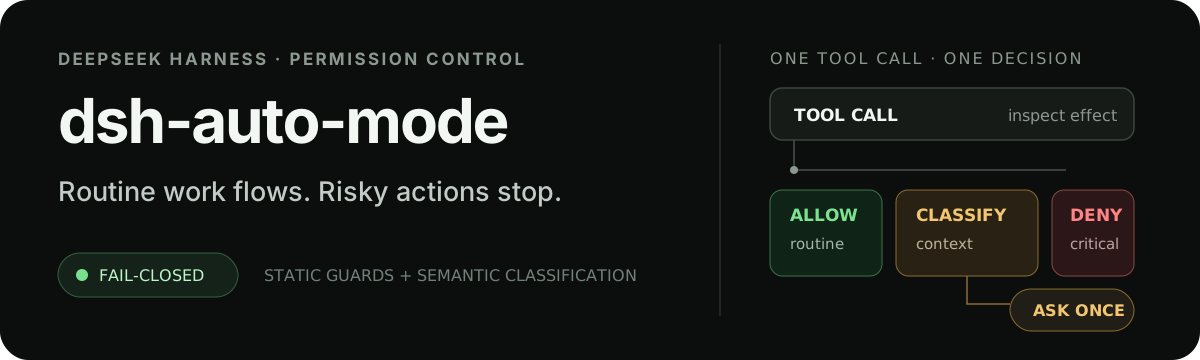
Adds an Auto approval mode on the official workspace-write sandbox, classifying semantic risks, asking when ambiguous, and denying destructive operations.

Undo/rollback system for DSH: config & plugin snapshots, one-click undo/redo/restore, message-level revert, secret masking, safe mode, and offline WebUI/GUI/CLI rescue tools for when DSH won't start.
Packages all 87 SKILL.md files from upstream reverse-skill as a DeepSeek Harness plugin that auto-registers them for authorized reverse engineering, penetration testing, and security research.
Dockyard DSH is a native DeepSeek Harness plugin that unifies official OAuth/client sessions for Codex, Antigravity, Grok, Claude, and Cursor, providing account pool, model catalog, and quota status.