dsh-no-workspace
Run the following command in DeepSeek Harness:
dsh plugin install Syhz-666/dsh-no-workspace
Paste the following prompt into your AI chat to install this plugin:
Run dsh plugin install Syhz-666/dsh-no-workspace inside your DeepSeek Harness project to install; the full source is available at https://github.com/Syhz-666/dsh-no-workspace
About this plugin
Not every DeepSeek Harness session requires full file I/O and a shell. Sometimes you only need to chat, search the web, review past conversations, and track goals. dsh-no-workspace closes that gap by adding a No Workspace (Read-Only Session) entry to the workspace picker, creating a session rooted in an empty isolated directory with no workspace, no write tools, no shell, and no sub-agents.
The lock is structural, not prompt-based. The moment a session is created, zero-length turn/start and turn/end entries are written, making it permanently non-blank so the official preset-switch guard rejects any tool-surface upgrade forever. File reads follow a fail-closed model: relative paths are approved only within the isolated root, while absolute or out-of-directory reads require per-call user approval. Sandboxing can be toggled, but no write tool exists to exploit a wider stance, so safety is guaranteed by the tool surface itself.
The plugin has zero coupling with official source code or build artifacts, injecting menu items in-memory at serve time and reverting on uninstall. It is well suited for users who want a safe, read-only conversation path, for audit scenarios where accidental modifications must be avoided, and for teams that need a default do-not-touch-files option.
Use Cases
- When you only need to chat or search the web without any file access
- During audit or review of past sessions where accidental edits must be ruled out
- Giving team members a default safe path that never touches files
Best For
- DeepSeek Harness users who want safe, read-only conversations
- Managers who need a no-write default policy for their team
- Auditors in compliance scenarios requiring zero accidental modifications
Related Plugins
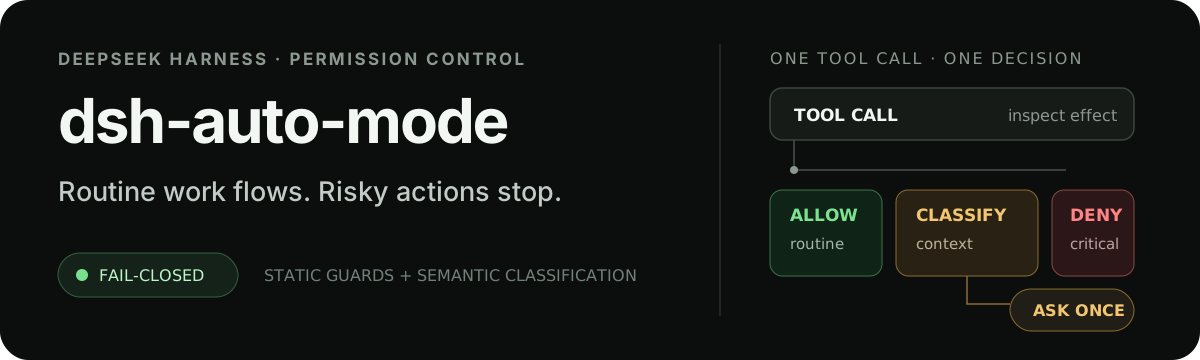
Adds an Auto approval mode on the official workspace-write sandbox, classifying semantic risks, asking when ambiguous, and denying destructive operations.

Undo/rollback system for DSH: config & plugin snapshots, one-click undo/redo/restore, message-level revert, secret masking, safe mode, and offline WebUI/GUI/CLI rescue tools for when DSH won't start.
Packages all 87 SKILL.md files from upstream reverse-skill as a DeepSeek Harness plugin that auto-registers them for authorized reverse engineering, penetration testing, and security research.
Dockyard DSH is a native DeepSeek Harness plugin that unifies official OAuth/client sessions for Codex, Antigravity, Grok, Claude, and Cursor, providing account pool, model catalog, and quota status.