dsh-dep-audit
Run the following command in DeepSeek Harness:
dsh plugin install zoahdev/dsh-dep-audit
Paste the following prompt into your AI chat to install this plugin:
Install in DeepSeek Harness by running dsh plugin install zoahdev/dsh-dep-audit; see the full source at https://github.com/zoahdev/dsh-dep-audit
About this plugin
The most dangerous dependency issues in a dsh plugin supply chain are the ones that never crash a build. A peer range that resolves to nothing on the registry, a latest dist-tag pointing at a stale broken release, an installed version that has silently drifted from what package.json declares, a git or workspace specifier nobody reviewed, a missing license field, a package whose last release was years ago—each one passes local tests and only surfaces in production where the cost of tracing it back is severe. dsh-dep-audit runs a systematic hygiene audit over the entire dependency graph so these issues become visible before they ship.
It performs eight checks—manifest integrity, peer resolvability, dist-tag consistency, source legitimacy, license declaration, freshness, version drift, and version staleness—each graded as fail or warn with a per-item breakdown. The report is pinned to the dsh-dep-audit/v1 schema: stable, machine-readable, and shaped for CI gate logic. Exit codes 0, 1, and 2 cover all-pass, at-least-one-fail, and usage/IO-error respectively, so wiring it into a pipeline takes a single command. Once installed in-harness, an agent can invoke the dep_audit tool directly and fold the audit result back into the conversation.
It serves three audiences: dsh plugin or profile authors who want a pre-release sanity pass on their dependency graph; supply-chain security teams that need a quantifiable, auditable CI threshold; and teams assembling a full security pipeline—dsh-dep-audit covers dependency hygiene, dsh-poison-guard covers malware and obfuscation scanning, and dsh-plugin-doctor covers publish readiness—together spanning the path from clean code to healthy dependencies to shippable output.
Use Cases
- Run a full dependency-graph hygiene audit before publishing a dsh plugin
- Gate CI pipelines on dependency health using exit codes 0/1/2
- Investigate failed peer resolution, version drift, or dist-tag contradictions
Best For
- dsh plugin and profile authors
- Supply-chain security and compliance teams
- Engineering teams building complete plugin security pipelines
Related Plugins
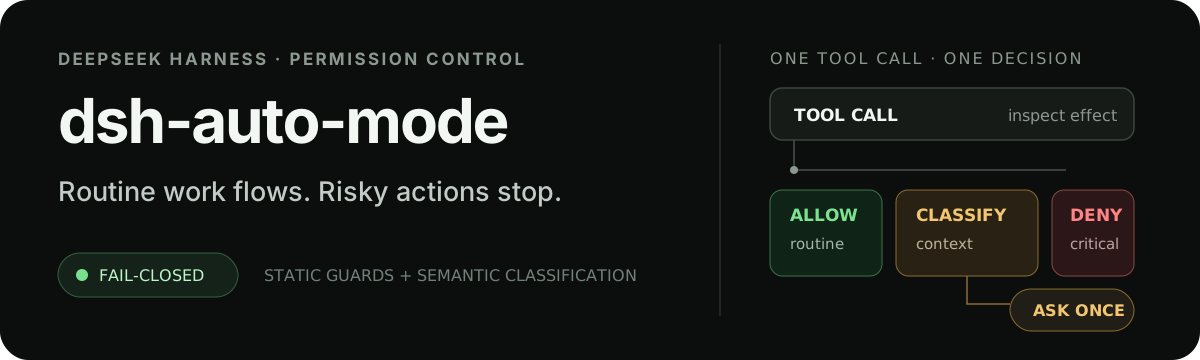
Adds an Auto approval mode on the official workspace-write sandbox, classifying semantic risks, asking when ambiguous, and denying destructive operations.

Undo/rollback system for DSH: config & plugin snapshots, one-click undo/redo/restore, message-level revert, secret masking, safe mode, and offline WebUI/GUI/CLI rescue tools for when DSH won't start.
Packages all 87 SKILL.md files from upstream reverse-skill as a DeepSeek Harness plugin that auto-registers them for authorized reverse engineering, penetration testing, and security research.
Dockyard DSH is a native DeepSeek Harness plugin that unifies official OAuth/client sessions for Codex, Antigravity, Grok, Claude, and Cursor, providing account pool, model catalog, and quota status.