dsh-auth
Run the following command in DeepSeek Harness:
dsh plugin install optttt/dsh-auth
Paste the following prompt into your AI chat to install this plugin:
Run dsh plugin install optttt/dsh-auth in the DeepSeek Harness terminal to install this plugin; the full source repository is at https://github.com/optttt/dsh-auth. Restart dsh web after installation for the changes to take effect.
About this plugin
The DeepSeek Harness web UI is packed with power but ships with no access control at all: whoever finds the port can read settings, manage files, and invoke plugins. dsh-auth fixes that by putting a username-and-password gate in front of every HTTP, API, and WebSocket connection, turning a self-hosted instance into one that is no longer wide open on your LAN.
After the login page, a practical set of session controls is at your fingertips: configurable idle-timeout auto-logout, a maximum session lifetime you can set in minutes, and a single-sign-on mode that instantly invalidates all other sessions on every new login, sending kicked clients back to the login screen with a clear warning. Passwords are stored as scrypt salted hashes and encrypted at rest with AES-256-GCM, requiring zero runtime dependencies. The Settings > Auth panel lets you change the username and password, fine-tune timeouts, and review the last 50 login events with IP, timestamp, and GeoIP location, while one-liner CLI shortcuts make credential resets effortless.
A detail that pays off in real deployments is the built-in LAN reverse proxy: dsh stays bound to 127.0.0.1, while the plugin listens on 0.0.0.0 (default port 3080), correctly forwarding WebSocket upgrade frames and rewriting Host/Origin headers so every /api RPC works out of the box for LAN clients. The UI follows the client language and adapts to light and dark themes automatically. If you run DeepSeek Harness on a local network and want to share the web admin panel with your team without exposing it to the open internet, dsh-auth is the lightest path to a properly gated instance.
Use Cases
- Share the dsh web admin interface safely within a home or office LAN
- Add a username and password login gate to a self-hosted DeepSeek Harness instance
- Prevent session conflicts when several teammates share one server via single sign-on
Best For
- Individual developers who self-host DeepSeek Harness and want LAN-shared web access
- Security-sensitive users who need basic authentication on a local admin panel
- Admins managing a dsh web instance shared by a small team
Related Plugins
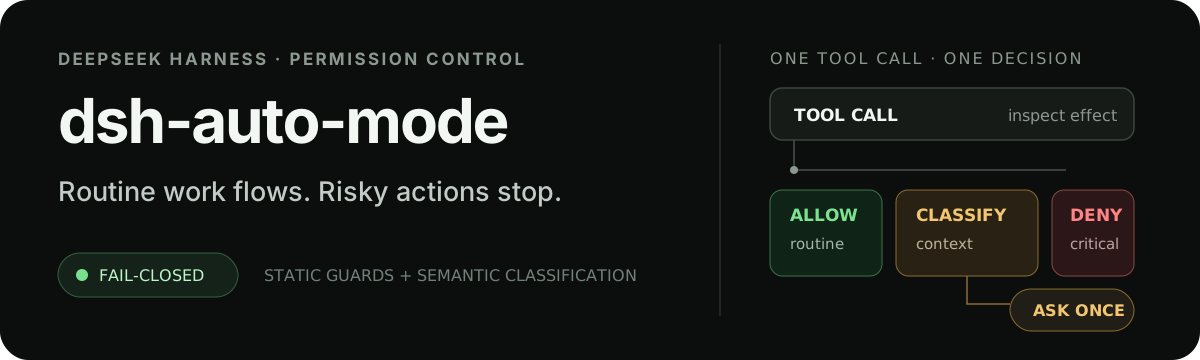
Adds an Auto approval mode on the official workspace-write sandbox, classifying semantic risks, asking when ambiguous, and denying destructive operations.

Undo/rollback system for DSH: config & plugin snapshots, one-click undo/redo/restore, message-level revert, secret masking, safe mode, and offline WebUI/GUI/CLI rescue tools for when DSH won't start.
Packages all 87 SKILL.md files from upstream reverse-skill as a DeepSeek Harness plugin that auto-registers them for authorized reverse engineering, penetration testing, and security research.
Dockyard DSH is a native DeepSeek Harness plugin that unifies official OAuth/client sessions for Codex, Antigravity, Grok, Claude, and Cursor, providing account pool, model catalog, and quota status.