dsh-harness-mcp-server
Run the following command in DeepSeek Harness:
dsh plugin install chushixixin/dsh-harness-mcp-server
Paste the following prompt into your AI chat to install this plugin:
Open your terminal and run dsh plugin install chushixixin/dsh-harness-mcp-server to automatically download and configure the plugin code and dependencies hosted at https://github.com/chushixixin/dsh-harness-mcp-server.
About this plugin
While DeepSeek Harness offers a robust Agent runtime, it traditionally operates as a closed application, making it difficult for external intelligent systems to leverage its power. This plugin breaks down those silos by exposing Harness’s core services—agents, toolchains, and sessions—as a standard MCP Server. By doing so, it enables any compatible client to seamlessly delegate real-world coding tasks to Harness, effectively combining an external brain with Harness’s underlying arms for synergistic results.
Beyond basic connectivity, the extension supports both synchronous execution and asynchronous task queuing with structured feedback. Every task result feeds directly back into the client’s persistent memory, creating a continuous optimization loop. Designed for performance, it reuses agent sessions per working directory, cutting invocation costs by roughly 15–20 times compared to one-shot executions. It also includes sandboxed Bash execution to ensure safe and reliable code manipulation.
This tool is ideal for developers and agentic workflows tackling massive refactors, parallel independent tasks, or scenarios requiring strict context isolation. For routine edits, direct agent interaction remains preferable; however, when you face context window limits or need a stable, reusable programming infrastructure, this plugin delivers exactly that. As a final note, always keep the server bound to localhost to prevent unauthorized access.
Use Cases
- Large-scale code refactoring requiring context isolation to prevent main agent overload.
- Distributing multiple unrelated tasks concurrently and asynchronously collecting structured results.
- External AI clients securely delegating specific coding instructions to the underlying dev environment.
Best For
- Developers and architects building complex multi-agent systems.
- AI assistants relying on persistent memory contexts for long-term project maintenance.
- Workflow engines that need to offload heavy coding tasks from lightweight reasoning models.
Related Plugins
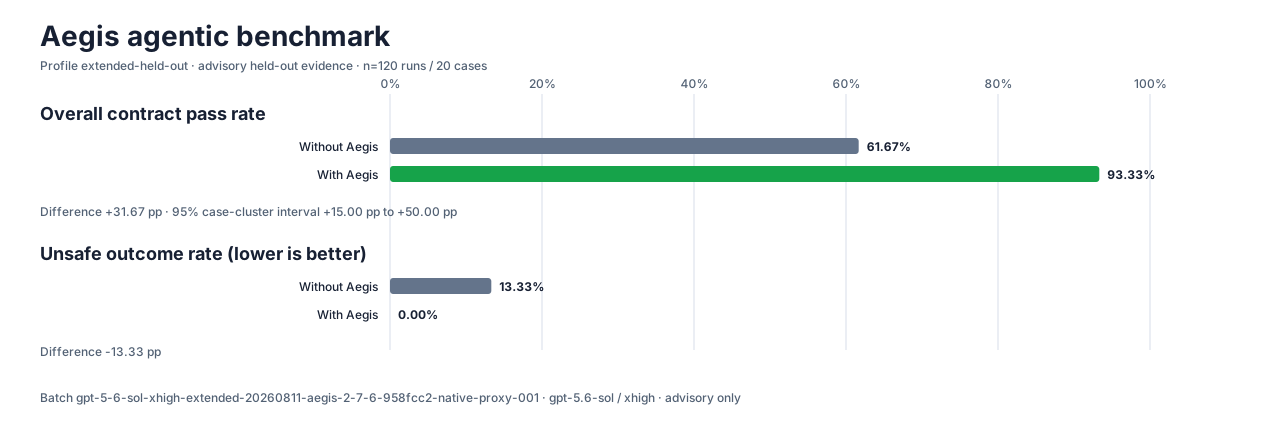
A method pack that makes AI coding agents plan against your real baseline, prove completion with fresh evidence, and reduce reworks and unsafe changes.
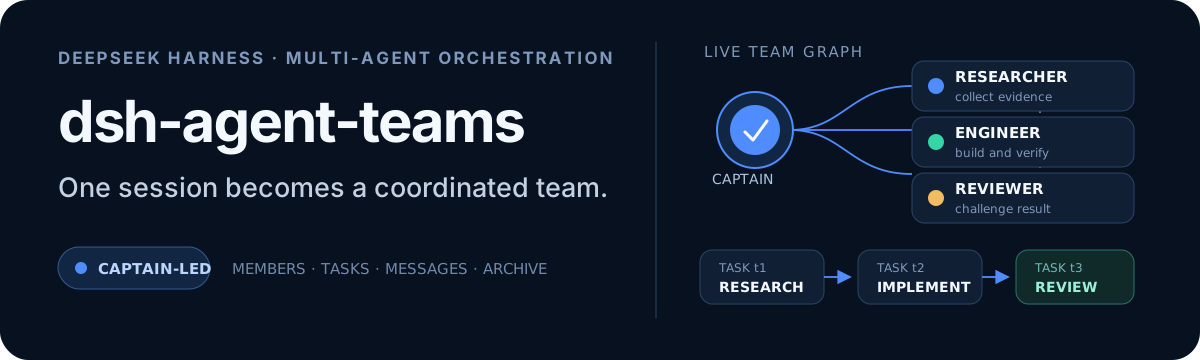
Turns the DeepSeek Harness session into a captain that builds a durable sub-agent team, splits goals into dependency-aware tasks, and coordinates work via direct messages and a live Web UI.
Gives coding agents design judgment, letting Claude Code, Cursor, and 70+ agents generate and iterate high-quality UI, presentations, and graphics right from the terminal.
Run the Pi ecosystem's plugins on DeepSeek Harness, unmodified, via a compatibility layer that implements Pi's public extension ABI on DSH's native services.