dsh-routed-subagent
Run the following command in DeepSeek Harness:
dsh plugin install bpc-oss/dsh-routed-subagent
Paste the following prompt into your AI chat to install this plugin:
Run dsh plugin install bpc-oss/dsh-routed-subagent in your DeepSeek Harness terminal to install; the source repository is at https://github.com/bpc-oss/dsh-routed-subagent . After installation, register the package in your profile's dsh.profile.bundles list as described in the README.
About this plugin
DeepSeek Harness's stock subagent and subagent_fork tools lock every child to the parent's preset—persona, prompt sections, skill catalog, and tools all inherited. When you need a child to run under an entirely different role, tool surface, or model, the native path offers no switching lever. dsh-routed-subagent fills that gap with a custom async mount channel that swaps the child's full composition—identity, mission section, skills, and tools—onto the target preset in one step, rather than copying a persona string.
Beyond preset routing, the plugin handles several practical concerns: per-call model and provider overrides with a fail-fast availability pre-check so you never stare at an opaque child error; background-by-default dispatch that returns a job id immediately, keeping the conversation free to work or fork more children in parallel without the abort cancelling the child; fork mode that seeds the child with the parent's completed turns before mounting the target preset; and continuable mode that mints a durable subagent id you can resume later via send_message. The engine parameter additionally lets you dispatch the subagent to an external CLI—codex's app-server stdio loop, the Claude Code SDK, or CodeBuddy's stream-json CLI—running a full agent pipeline outside the harness kernel.
This plugin is aimed at teams and solo users orchestrating multiple presets inside DeepSeek Harness, automation maintainers who want a single delegation entry point that fans out to different CLI engines, and anyone who needs same-session, different-role, different-model, different-engine flexibility without scattering bespoke config across profiles. If your workflow stays within one preset and never touches model overrides or external engines, the stock subagent tool is sufficient; the moment your work requires compositional freedom across presets, models, and engines, dsh-routed-subagent removes a great deal of boilerplate.
Use Cases
- Dispatch parallel subagents with distinct presets, models, and tool surfaces within a single session
- Route subagent tasks to external CLI engines (codex, claude, codebuddy) for out-of-harness execution
- Mint durable subagent sessions that retain the target preset and tool surface across resumable turns
Best For
- Developers orchestrating multiple agent personas inside DeepSeek Harness
- Automation maintainers routing tasks to diverse CLI agent engines through a single entry point
- Workflow teams that require per-call model override, tool filtering, and parallel background dispatch
Related Plugins
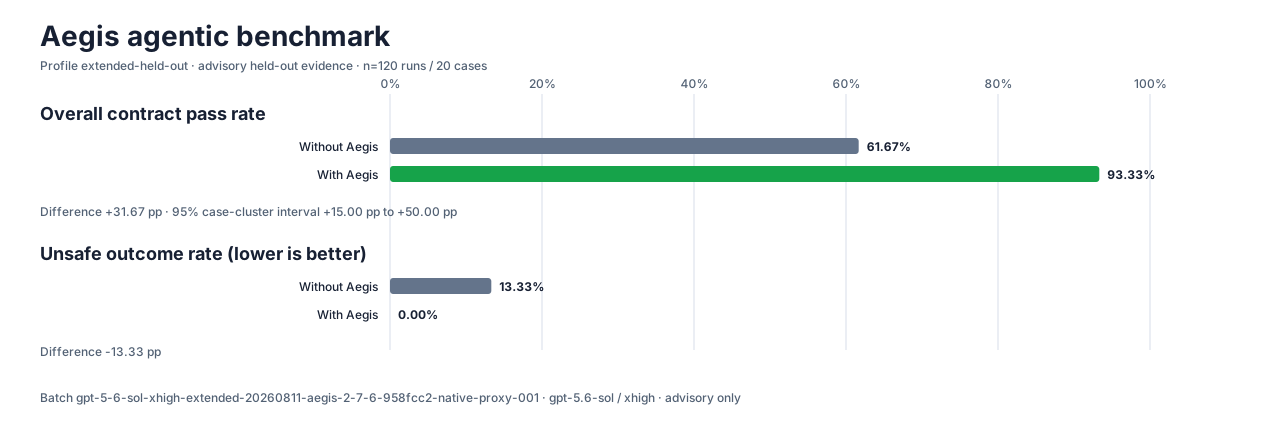
A method pack that makes AI coding agents plan against your real baseline, prove completion with fresh evidence, and reduce reworks and unsafe changes.
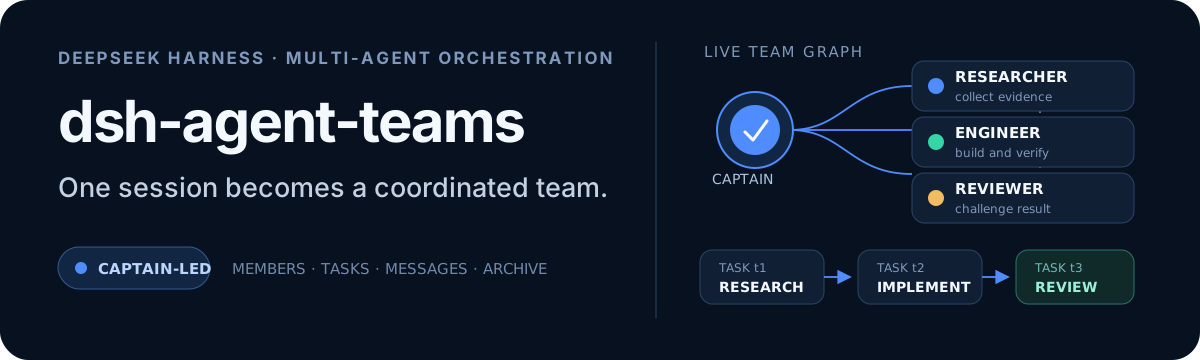
Turns the DeepSeek Harness session into a captain that builds a durable sub-agent team, splits goals into dependency-aware tasks, and coordinates work via direct messages and a live Web UI.
Gives coding agents design judgment, letting Claude Code, Cursor, and 70+ agents generate and iterate high-quality UI, presentations, and graphics right from the terminal.
Run the Pi ecosystem's plugins on DeepSeek Harness, unmodified, via a compatibility layer that implements Pi's public extension ABI on DSH's native services.