dsh-agent-team-gui
Run the following command in DeepSeek Harness:
dsh plugin install toolclub/dsh-agent-team-gui
Paste the following prompt into your AI chat to install this plugin:
Install it in DeepSeek Harness by running dsh plugin install toolclub/dsh-agent-team-gui; the full source repository is https://github.com/toolclub/dsh-agent-team-gui.
About this plugin
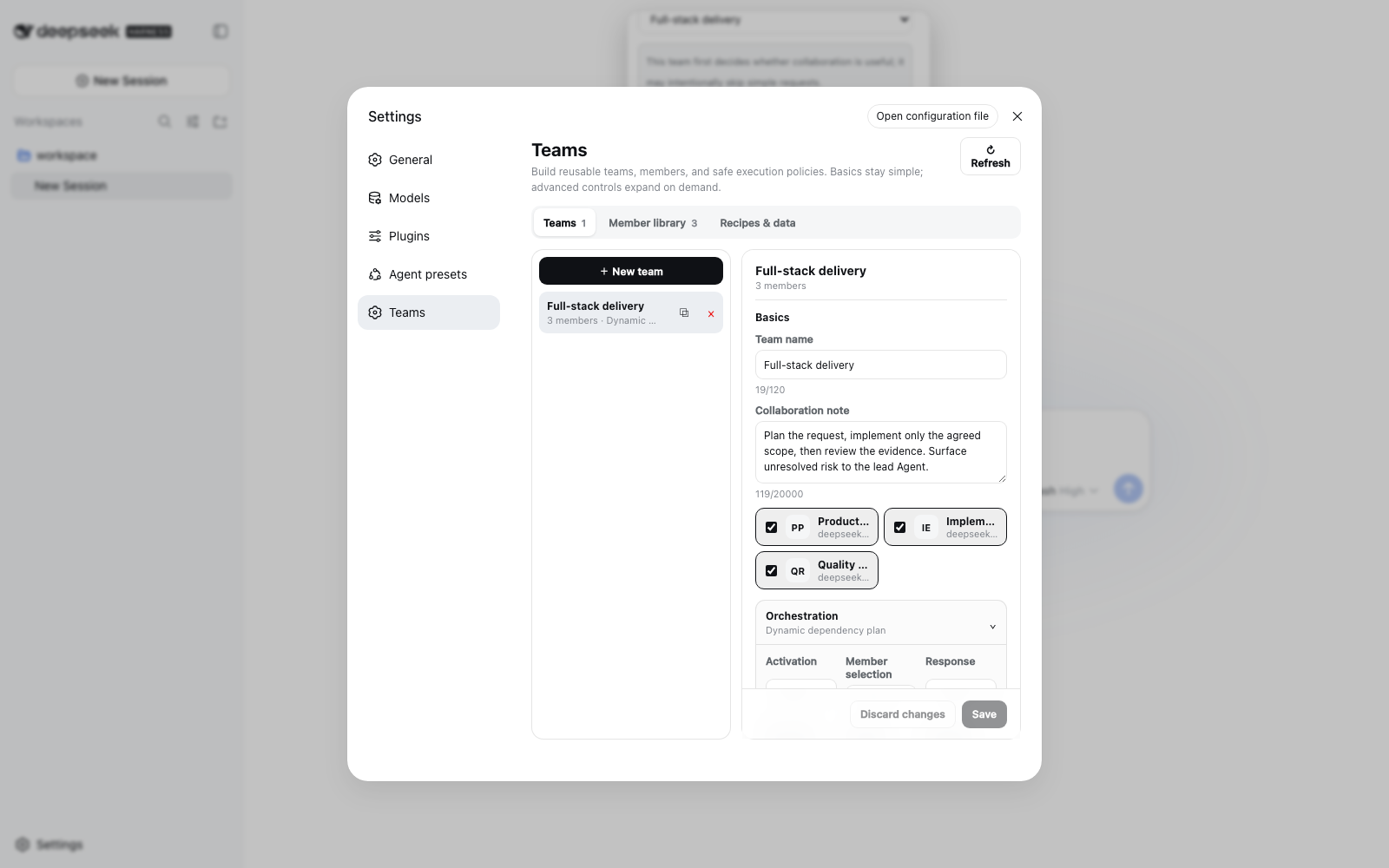
When you work with DeepSeek Harness on a daily basis, a single model often struggles to act as planner, coder, reviewer, and specialist all at once — forcing one model to do everything either muddles your prompts or widens tool permissions too far. dsh-agent-team-gui turns "multi-model division of labor" into a persistent, reusable product object: you create a team once in Settings → Teams, then reuse it across projects and conversations instead of assembling a one-off dispatch scheme every time. A team is not a temporary dispatch form; it is a first-class choice sitting right beside the conversation composer.
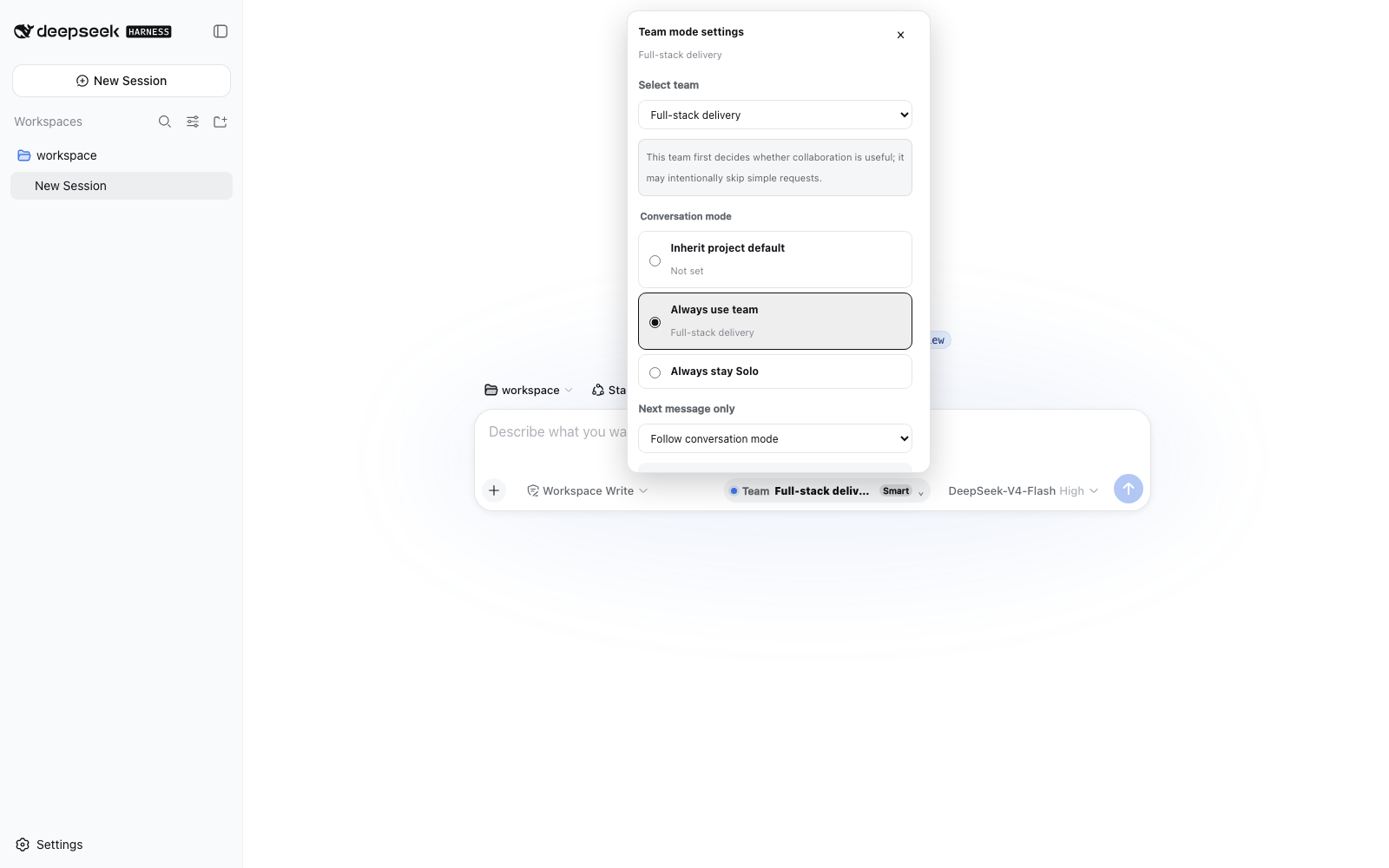
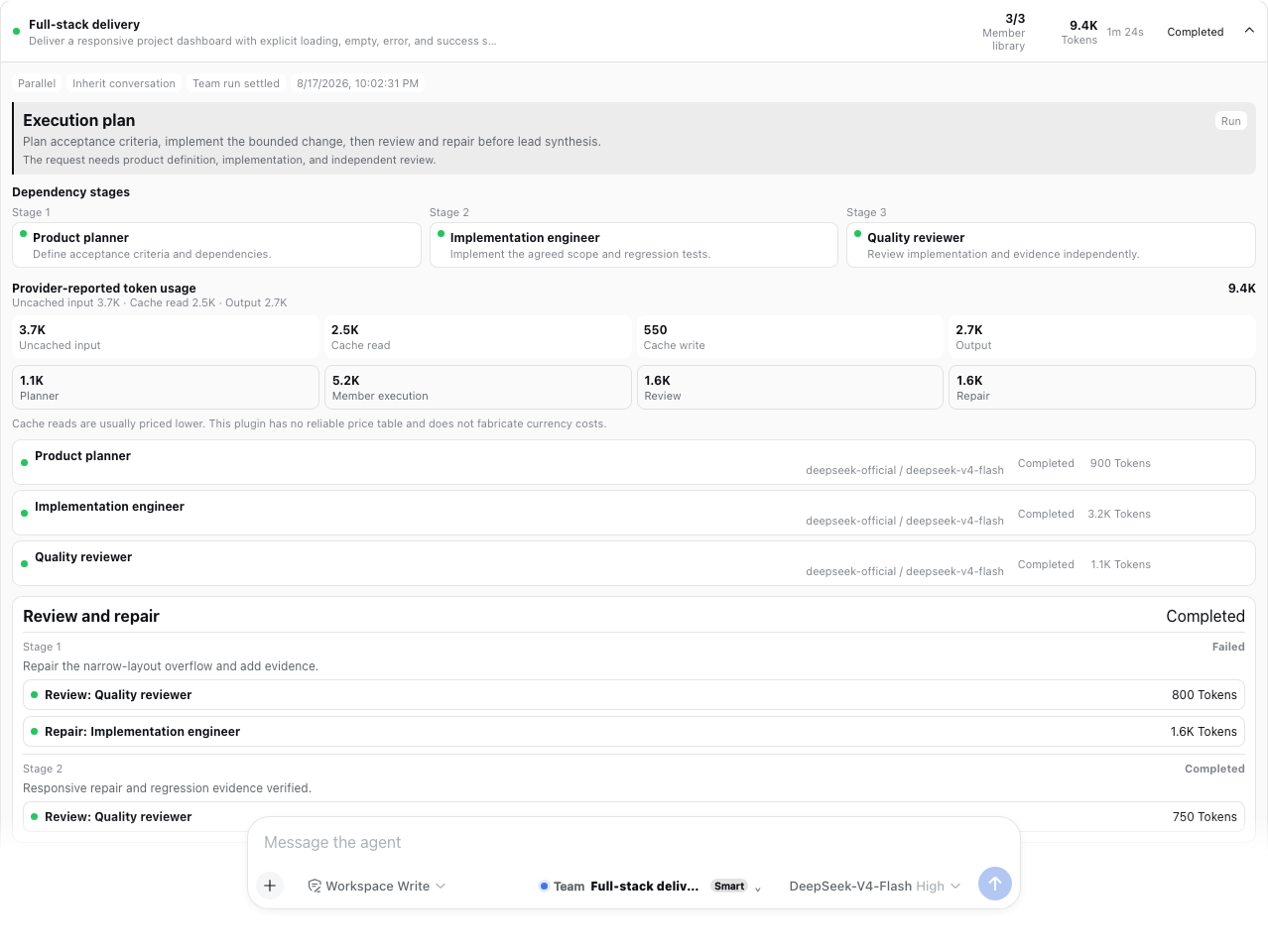
Each team member gets its own primary model, role prompt, fallback route, token limit, and tool allow/deny list. By default, the active conversation's model acts as a bounded planner: it breaks the request into structured assignments and produces an acyclic dependency graph (DAG). Members run with finite concurrency once their dependencies are ready, passing only bounded handoff summaries between stages, while complete raw output stays in durable run history. You can also enable fixed order to turn the team into a repeatable serial pipeline. The Team / Solo / Inherited conversation modes work alongside a crash-safe "next message" one-shot choice, and all of these states survive page refresh, cold Host startup, and live reconnect.
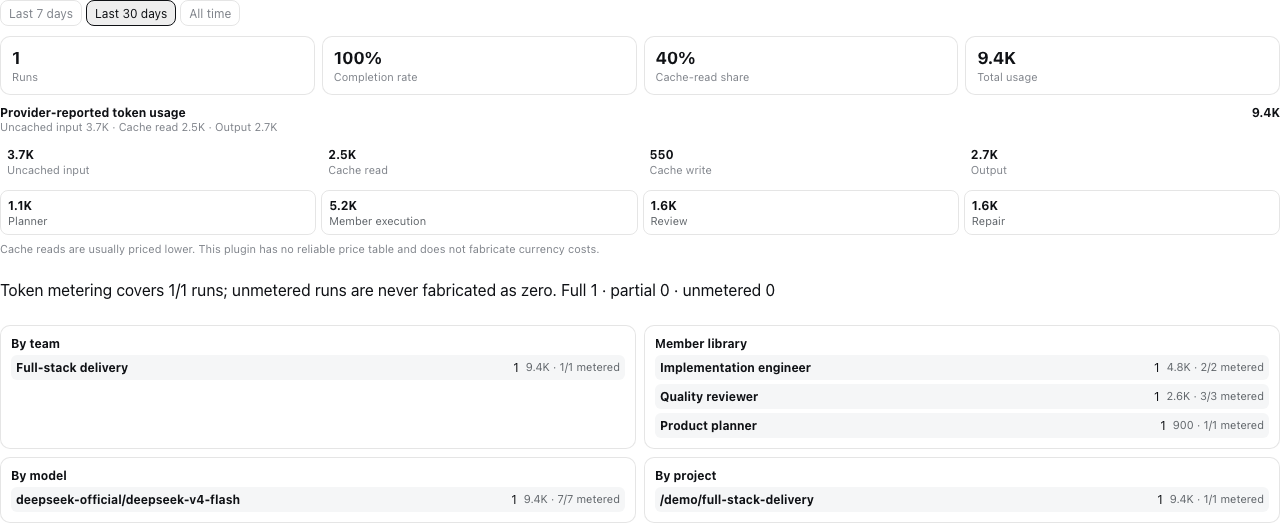
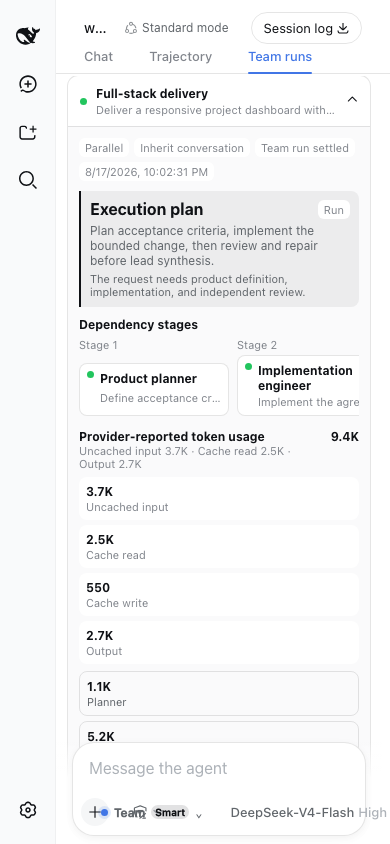
Safety and observability are core to this plugin. Planner, member, reviewer, and repair prompts all follow an exclusive-role, no-delegation contract; team children cannot spawn another team, and detected DSH subagent tools — including renamed registrations — are denied inside team sessions. One durable claim binds both automatic and model-tool dispatch to the latest human message, so repeated tool calls cannot create dozens of duplicate teams. An optional quality gate names one reviewer, one repair owner, explicit criteria, and at most two repair rounds; a rejection reruns only that repair owner. The Run Center exposes foreground/background state, live phase, elapsed time, child IDs, complete outputs, stop, and retries with linked immutable runs. Token usage reuses DSH's official projection with four buckets — uncached input, cache read, cache write, and output — coverage is explicitly labeled full, partial, or unavailable, and no invented prices are ever shown.
Who is this for? If you use DeepSeek Harness for complex tasks that need several specialist roles to collaborate, or you want to codify a repeatable workflow, reproduce it across projects, or share it with collaborators without exposing credentials, this plugin fits well. Team version snapshots, recipe import (Copy/Merge with route remapping), definition backup, and preview-first restore make team definitions as manageable as code. Upgrading never silently deletes existing run history or team versions — retention is deliberately opt-in. As a final note, follow the official README for installation; this plugin targets advanced DSH scenarios, so it helps to be familiar with provider/model route configuration and the Web profile structure before building your first team.
Screenshots
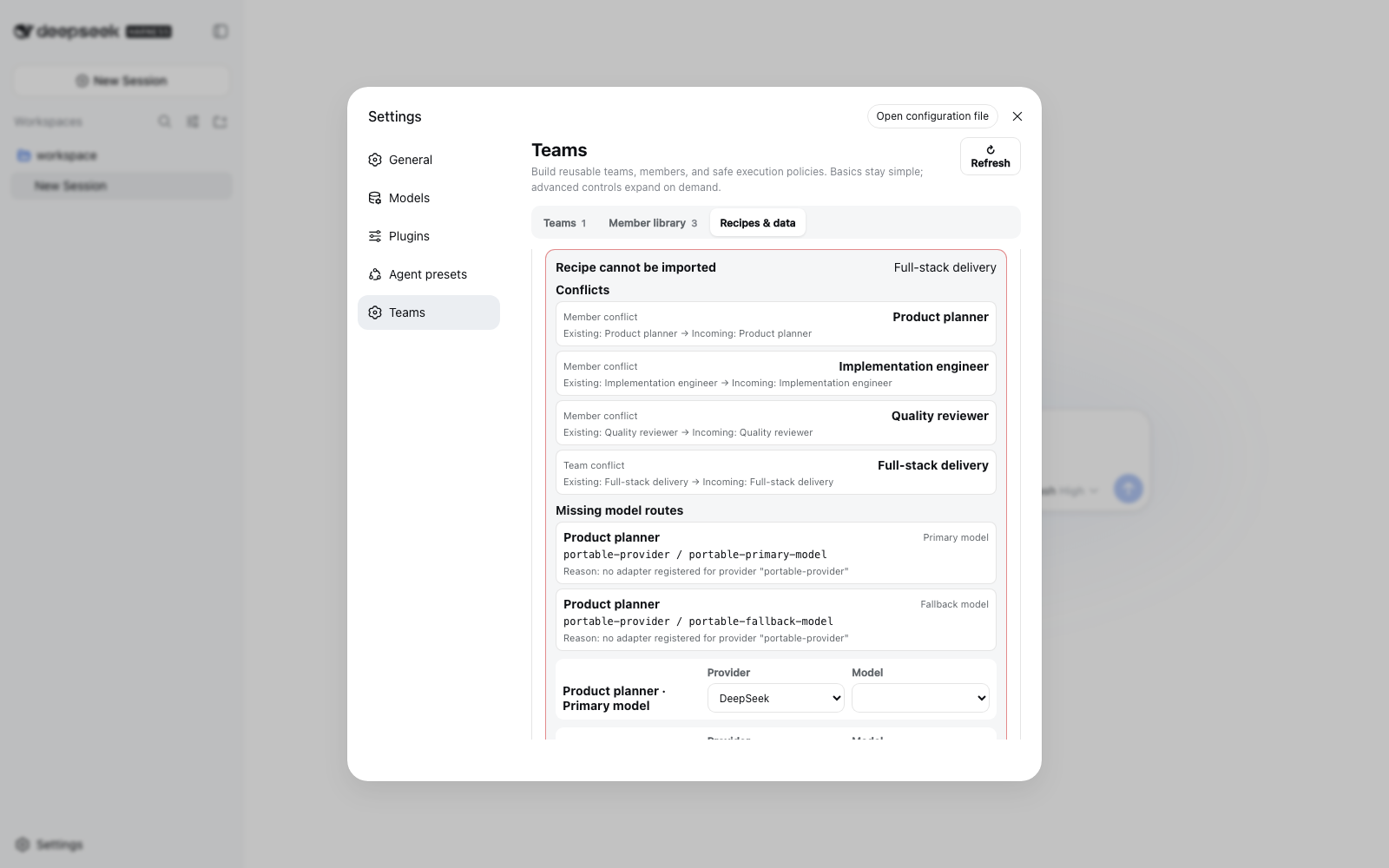
Use Cases
- Create reusable multi-model teams beside the composer, assigning distinct models, tool policies, and fallback routes per role.
- Plan complex tasks with a bounded DAG, run members with finite concurrency, and inspect stages and Token usage in the Run Center.
- Save team versions, import recipes, and reuse them across projects without sharing any credentials.
Best For
- Advanced users who need multiple specialized models to collaborate within DeepSeek Harness.
- Teams and developers who want to codify workflows and reproduce them across projects.
- Operators who value safety bounds, Token observability, and recoverable run history.
Related Plugins
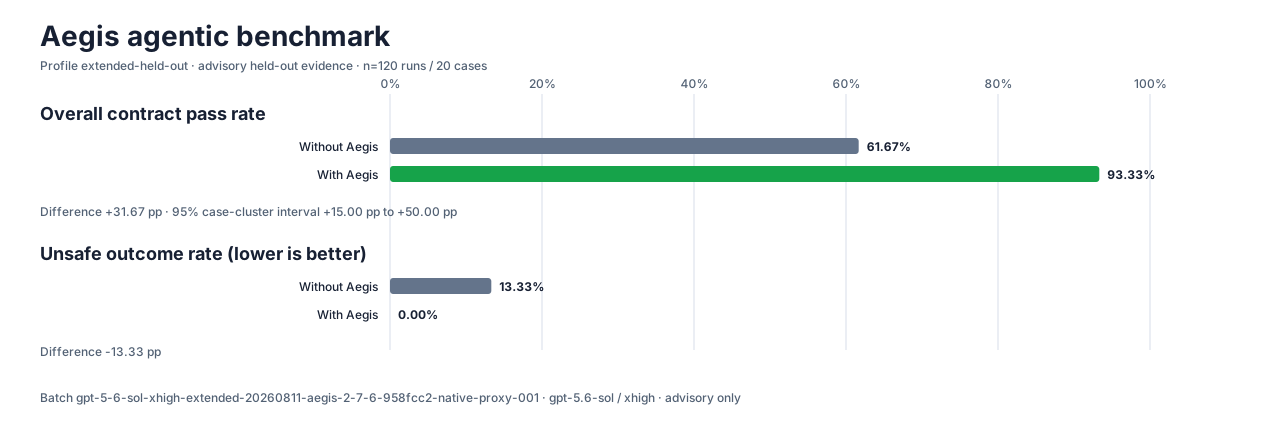
A method pack that makes AI coding agents plan against your real baseline, prove completion with fresh evidence, and reduce reworks and unsafe changes.
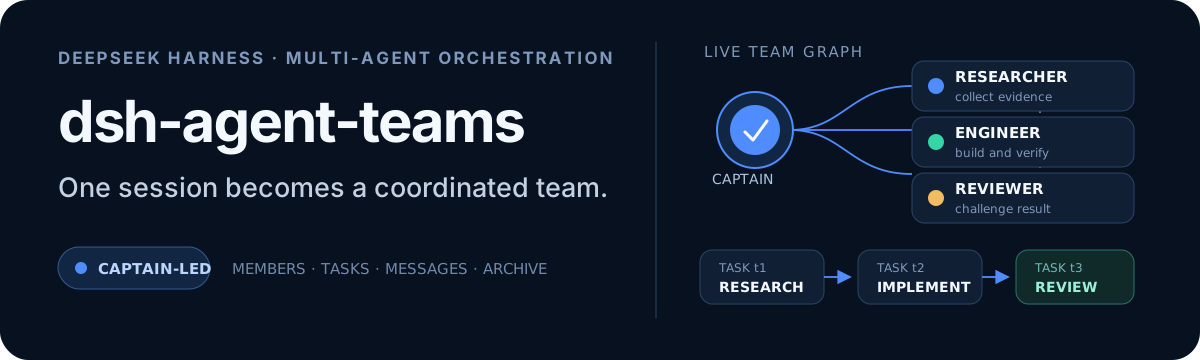
Turns the DeepSeek Harness session into a captain that builds a durable sub-agent team, splits goals into dependency-aware tasks, and coordinates work via direct messages and a live Web UI.
Gives coding agents design judgment, letting Claude Code, Cursor, and 70+ agents generate and iterate high-quality UI, presentations, and graphics right from the terminal.
Run the Pi ecosystem's plugins on DeepSeek Harness, unmodified, via a compatibility layer that implements Pi's public extension ABI on DSH's native services.