dsh-audit-log
Run the following command in DeepSeek Harness:
dsh plugin install ssdyg4444-sys/dsh-audit-log
Paste the following prompt into your AI chat to install this plugin:
Install it in DeepSeek Harness by running dsh plugin install ssdyg4444-sys/dsh-audit-log; the full source repository is available at https://github.com/ssdyg4444-sys/dsh-audit-log .
About this plugin
In DeepSeek Harness, every listener in a waterfall dispatch shares the same args array, and any plugin can silently rewrite a field as it flows through the system. When a critical value vanishes or gets replaced mid-pipe, pinpointing the culprit is nearly impossible without external tooling, and the problem only gets worse as the plugin count grows into the hundreds.
dsh-audit-log mounts as a purely read-only observer at two internal hooks: it snapshots argument shapes (types, keys, lengths) before and after each dispatch to record structural diffs, and wraps every external listener at registration so each call window is compared in isolation. Mutations are attributed to the exact plugin and fiber with a "window" confidence tag rather than a heuristic guess. Because only structural fingerprints are logged and payload values are never captured, secrets stay out of the trail. A ring buffer, package allowlist/blocklist, and event filters keep the audit scope flexible and the overhead negligible.
If your instance loads dozens of plugins, routes data through multiple waterfall, serial, and parallel stages, and you need to answer "who touched my field" before an incident forces you to, dsh-audit-log fills the runtime data-layer observability gap. It complements prompt-level audit tools, so running both gives you a complete input-to-dataflow accountability picture.
Use Cases
- Trace exactly which plugin rewrote or dropped a field during waterfall dispatch
- Audit the structural mutation trail as data flows through every registered listener
- Close the runtime data-layer observability gap that prompt-level tools cannot cover
Best For
- Operations engineers running Harness instances with dozens of plugins
- Data-platform engineers who need to answer who mutated my field before an incident escalates
- Platform architects building plugin-ecosystem security and governance pipelines
Related Plugins
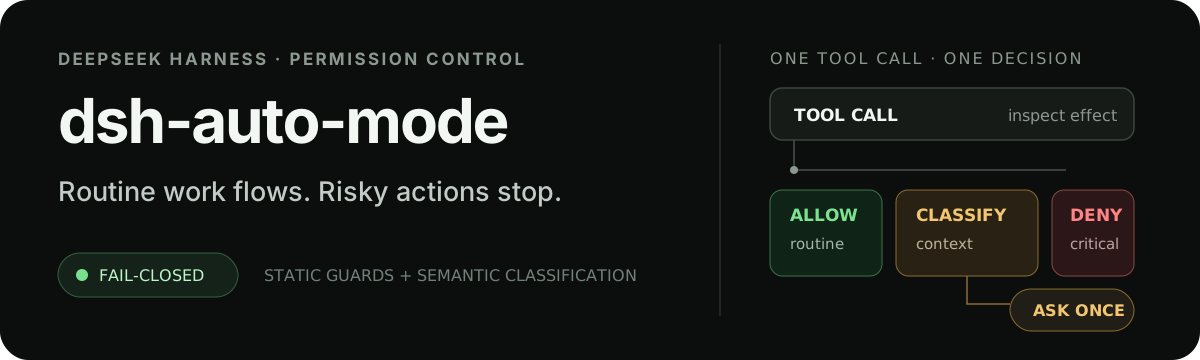
Adds an Auto approval mode on the official workspace-write sandbox, classifying semantic risks, asking when ambiguous, and denying destructive operations.

Undo/rollback system for DSH: config & plugin snapshots, one-click undo/redo/restore, message-level revert, secret masking, safe mode, and offline WebUI/GUI/CLI rescue tools for when DSH won't start.
Packages all 87 SKILL.md files from upstream reverse-skill as a DeepSeek Harness plugin that auto-registers them for authorized reverse engineering, penetration testing, and security research.
Dockyard DSH is a native DeepSeek Harness plugin that unifies official OAuth/client sessions for Codex, Antigravity, Grok, Claude, and Cursor, providing account pool, model catalog, and quota status.