dsh-trajectory-governor
Run the following command in DeepSeek Harness:
dsh plugin install chunsi-w/dsh-trajectory-governor
Paste the following prompt into your AI chat to install this plugin:
Execute `dsh plugin install chunsi-w/dsh-trajectory-governor` in DeepSeek Harness to install, or visit the full source code at https://github.com/chunsi-w/dsh-trajectory-governor .
About this plugin
When building AI Agents for long-context and complex workflows, models often struggle with context loss, meaningless repetitive calls, and accumulating verification debt. As a closed-loop trajectory control plane for DeepSeek Harness, dsh-trajectory-governor fundamentally resolves the 'black box' and 'out-of-control' pain points in Agent execution. Rather than relying solely on prompt constraints, it dynamically tracks task continuity, information gain, and structured verification debt around real event streams, ensuring every step is traceable and substantively progressive.
The core capability of this plugin lies in its rigorous execution governance and benchmark validation mechanisms. It not only monitors tool calls in both Native and Code Modes in real time but also enforces same-spec, tolerance-aware performance regression judgments on workspace revisions, never allowing substandard results to pass. Combined with repetitive call interception, explicit finish gates, and a locally stored, privacy-safe decision ledger, it weaves a tight logical and quality safety net for the Agent.
This plugin is highly suitable for engineers developing highly reliable Agent workflows, researchers conducting automated benchmark evaluations, and advanced DeepSeek Harness users requiring strict code generation and refactoring validation. If you want your Agent to possess genuine self-correction capabilities, a rigorous validation loop, and an interpretable execution trajectory, dsh-trajectory-governor is an indispensable piece of infrastructure.
Use Cases
- Tracking verification debt during complex code refactoring with long contexts.
- Enforcing same-spec performance regression judgments in automated benchmark evaluations.
- Intercepting repetitive tool calls by the Agent that yield no new information.
Best For
- Engineers developing highly reliable Agent workflows.
- Researchers conducting automated benchmark evaluations and testing.
- Advanced Harness users requiring strict code generation validation.
Related Plugins
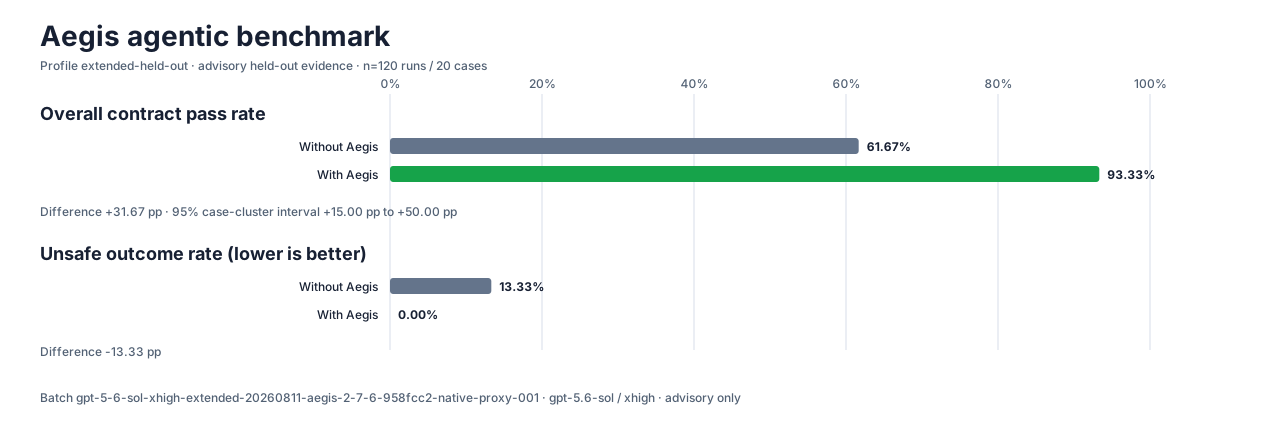
A method pack that makes AI coding agents plan against your real baseline, prove completion with fresh evidence, and reduce reworks and unsafe changes.
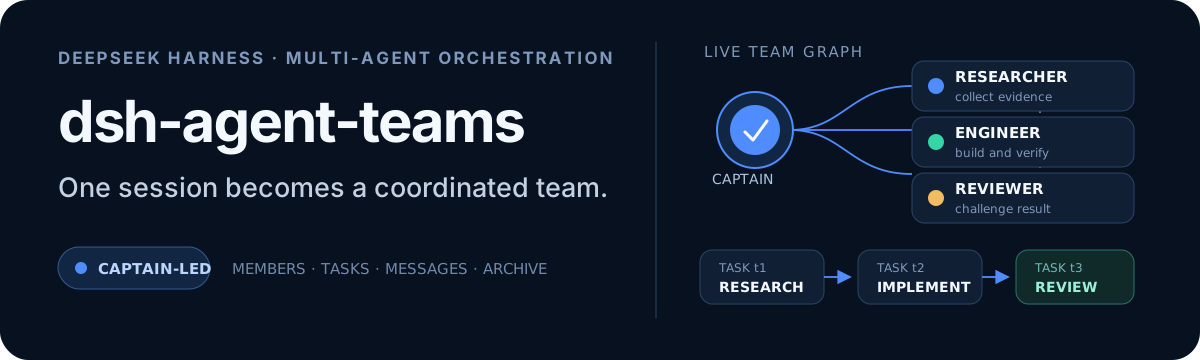
Turns the DeepSeek Harness session into a captain that builds a durable sub-agent team, splits goals into dependency-aware tasks, and coordinates work via direct messages and a live Web UI.
Gives coding agents design judgment, letting Claude Code, Cursor, and 70+ agents generate and iterate high-quality UI, presentations, and graphics right from the terminal.
Run the Pi ecosystem's plugins on DeepSeek Harness, unmodified, via a compatibility layer that implements Pi's public extension ABI on DSH's native services.